The Third World War I: The Guns of June
As covered by media of the day.
JUNE 4, 1989
TROOPS ATTACK AND CRUSH BEIJING PROTEST, THOUSANDS FIGHT BACK, SCORES ARE KILLED
Sakharov Draws Wrath in Stormy Soviet Congress
Poles Begin Voting in First Openly Contested Elections in Soviet Bloc
Khomeini, Imam of Iran and Foe of U.S., is Dead
NICOSIA, Cyprus – Ayatollah Ruhollah Khomeini, Iran's spiritual and political leader, died today, 12 days after he underwent surgery for bleeding in his digestive system, the official Iranian news agency IRNA reported.
His hospitalization heightened already intense speculation about who will succeed him as leader of the theocratic state." Iran's main opposition group, the Mujahedeen Khalq, or People's Holy Warriors, said last week that Khomeini had suffered a heart attack on May 27, but this claim could not be independently confirmed.
Khomeini led the 1979 revolution that topped 2,500 years of monarchy and set up the Islamic Republic of Iran, turning the relatively Western-style country ruled by Shah Mohammed Reza Pahlevi into the most hard-line Islamic nation in the world.
He emerged as an implacable foe of both the United States, which had supported the Shah and saw its embassy overrun by Iranian students under his direction, and the Soviet Union, referring to both the superpowers as "The Great Satans", and he led his country in an eight year war against neighboring Iraq.
More recently, political turmoil has gripped the country since Ayatollah Khomeini launched a radical resurgence in February with his death decree against British author Salman Rushdie for allegedly blaspheming against Islam in his novel, ''The Satanic Verses.'' A purge of so-called moderates who apparently favored rebuilding ties with the West followed, and the 10-year-old Islamic regime withdrew into its traditional isolationist stance.
Khomeini in March ousted his designated successor, Ayatollah Hussein Ali Montazeri, 64, who had openly criticized the regime's shortcomings, and then appointed a 20-member committee to review the succession.
But in the absence of a single personality who could match the patriarch's political and revolutionary authority, there was widespread speculation that Iran may be ruled by a collective leadership in the post-Khomeini era.
JUNE 5, 1989
BEIJING DEATH TOLL AT LEAST 300; ARMY TIGHTENS CONTROL OF CITY BUT ANGRY RESISTANCE GOES ON
Need for Money May Slow Ethics Drive in Congress
Big Solidarity Victor Seen in Poland, Some Communists Are Falling Short of a Majority in Vote
WARSAW, Poland – In their first chance to express at the ballot box their feelings about 44 years of Communist rule, Polish voters today appeared to have overwhelmingly voted for candidates endorsed by the Solidarity opposition and to have endangered many unopposed Communists whose election was thought to have been insured by the intricate election rules.
Official results were not expected until later this week but if the results for the Communists and their allies were as poor as the samplings and exit polls indicated, the opposition may have exceeded its expectations to such an extent as to endanger the regime of President Wojciech Jaruzelski.
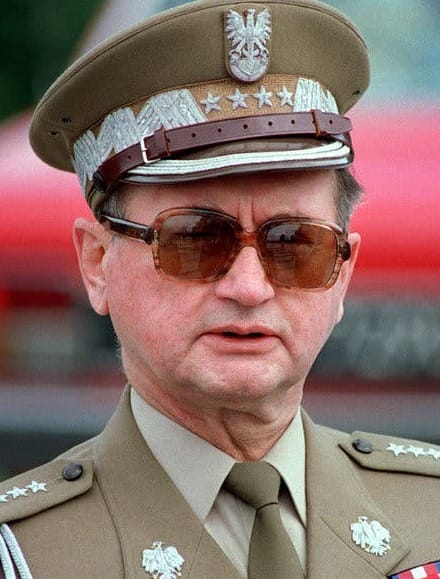
Jaruzelski, while declining to say how he voted, said he hoped Poland "will get peace from this elections." When asked about the possible actions a new opposition-led government would take, Solidarity spokesman Janusz Onyszkiewicz was quoted simply as saying "after all, Krakow wasn't built in a day".
500 on 2 Trains Reported Killed By Soviet Gas Pipeline Explosion
Soviet KGB Chief Kryuchkov in First Interview Says New Legislature Should Ride Herd on His Agency, Cites U.S. Oversight System as the Model
Iranian Leader Tapped as Possible Successor to Khomeini Shot During Massive Funeral Service
TEHRAN, Iran – The Iranian President, Ali Khameini, was shot and killed today while leading a huge and chaotic memorial service for Ayatollah Ruhollah Khomeni, whose death was announced yesterday.
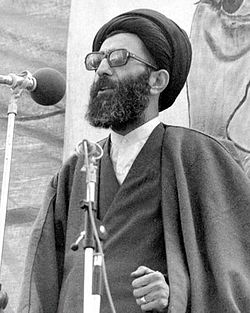
The Presidency in Iran under Khomeini was a ceremonial office, but Khameini was seen as a hard-liner with impeccable religious credentials who had wide support among the various power centers within Iran's ruling leadership and his leading the funeral procession of the fallen leader was seen as a strong signal that he would assume the title of Supreme Leader, a combined civil and religious title previously held by Khomeini.
IRNA, the official Iranian news agency, reported that the assassin, Mohammad Omidvar, was taken into custody immediately as he was attacked by furious onlookers at the service. IRNA further claims that Omidvar is a member of Iran's Tudeh opposition party, which has been believed to have been largely sidelined during the decade of Khomeini's rule.
Before the shooting, the body of Khomeini, in a procession through the streets of Tehran, was surrounded by hundreds of thousands of weeping, chanting mourners. So great was the crush to get close to the Ayatollah's body that at least eight people were trampled to death in a stampede, and more than 500 were injured.
"Sorrow, sorrow is this day", the huge throng chanted. "Khomeini the idol-smasher is with God today."

The streets of the capital were hung with black mourning banners as the death of both Khomeini and Khameini left the nation shaken and its future leadership uncertain. One possible candidate, the commander of the Iranian Revolutionary Guard Corps, General Yahya Rahim Safavi, later appeared on Iranian television calling for calm, advising all citizens to "abstain from just and righteous fury, in the name of the Imam." He continued, addressing the leadership crisis, "We hope temporarily to be able to fill the leadership because the new terms of the Constitution are currently under review."
For the moment, some analysts believe, power here rests in a triumvirate of General Safavi, the Ayatollah's son, Ahmed Khomeini, who had served as his chief aide, and the Speaker of Parliament, Hashemi Rafsanjani.
It was unlikely that anyone would truly be able to replace Ayatollah Khomeini, who became a personification of Iran's revolution, its fierce nationalism, and its resentments. His designated successor, Ali Khameini, was far less well known and will be remembered by history as a transitional figure in the final months of Khomeini's life.
Tudeh is a secular, leftist pro-Soviet party founded in 1941, that has suffered from mass arrests and executions since the founding of the Islamic Republic in 1979. It was believed to have been eliminated as a political force following mass arrests and executions of Iranian political dissidents in 1988, and several leading party figures gave television addresses disavowing their former affiliation and pledging allegiance to "Islam and the great spiritual struggle against Marxism, Zionism, and imperialism".
JUNE 6, 1989
ARMY RIFT REPORTED IN BEIJING; SHOOTING OF CIVILIANS GOES ON; BUSH BARS ARMS SALES TO CHINA
Prime Lending Rate Drops to 11%
New Problem For Afghan Guerrillas: No Russians to Fight
Communists Concede Victory by Solidarity And Call for Coalition
WARSAW – The Communist Party acknowledged tonight that the Solidarity movement had achieved a "decisive majority" of the popular votes in the Polish parliamentary election, and it challenged the victors to join in a coalition government.
Janusz Onyszkiewicz, Solidarity's national spokesman, said at a news conference that initial results showed almost all Solidarity candidates winning. The opposition has captured perhaps as many as 96 seats in the new 100-seat Senate, whose powers will be limited to a veto over legislation.
More significantly, perhaps, the Government was said in unofficial, preliminary results to have fallen short of electing all 35 of its leading members, who had been placed on an unopposed list for the Assembly. Their only requirement for victory was to obtain more than half of the votes cast. Solidarity poll watchers said the Communist list's total vote was averaging 40 to 43 percent. The list includes a majority of the Politburo, among them the Prime Minister, the Interior Minister, and the Defense Minister. Diplomats have expressed doubt that the government could avoid tendering its recognition after such a clear rejection by the voters.
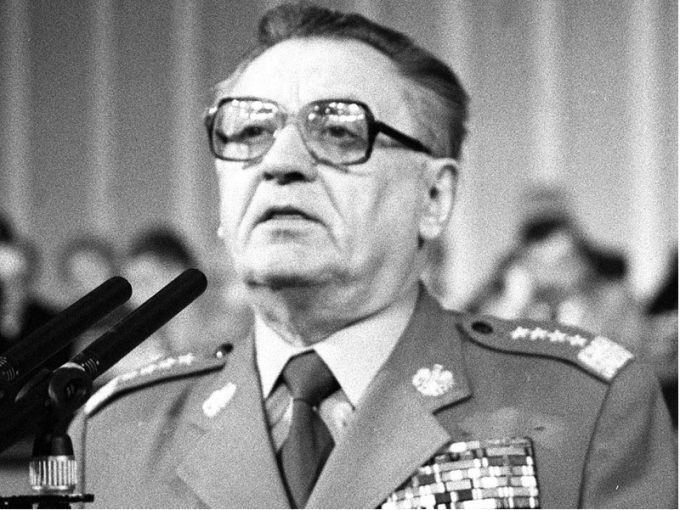
In what was seen by Poles as an ominous reminder of the imposition of martial law in 1981, General Florian Siwicki, the Defense Minister, said in a television statement that the government could not allow a "triumphant mood of adventurism to cause anarchy that would endanger democracy and the social order."
JUNE 7, 1989
ARTILLERY FIRING IN SUBURBS ADDS TO TENSIONS IN BEIJING; MYSTERY ON LEADERS GROWS
Eager Not to Offend, Soviet Congress Criticizes Outside Pressure on China; 'Let Bush Speak for Himself', Gorbachev Says
Solidarity and Warsaw Search For a Way to Govern Poland
Foley Elected House Speaker, But Partisan Warfare Continues
Signing of U. S. and Soviet Pact To Cut Accidental War Risk Postponed at Last Minute, Kremlin Preoccupied With "Internal Drama"
Amid Frenzy And Uncertainty, Iran Buries Ayatollah
TEHRAN, Iran – Ayatollah Ruhollah Khomeini, the revolutionary cleric who dominated Iran for a decade, was buried today after hours of frenzied mourning that at one point saw his body torn from its coffin and carried off by a hysterical crowd.

So huge and so emotional were the crowds, estimated at three million, that there was doubt whether the authorities would be able to push through them to bury the Shiite Muslim patriarch. At one point the state television announced that the burial of the Ayatollah, who died on Saturday, would be postponed until Wednesday.
Vast rivers of humanity clad almost entirely in black, the women wrapped in chadors, clogged the city's streets and the highways throughout the day, walking to Behesht-e-Zahara cemetery on the southern outskirts. There, the Ayatollah was buried near the graves of more than a million ''martyrs,'' as the Shiites say, of the revolution and the eight-year war with Iraq.
As the Ayatollah's body, transferred to an army helicopter when the refrigerated truck carrying it was unable to get through the crowds, first arrived at the burial site at about 11 this morning, a shrieking crowd fell on the coffin.
The crowd, much of it made up of Revolutionary Guards detailed to maintain order, pulled the coffin from the helicopter and began parading it around the makeshift compound surrounding the gravesite.
As the excitement grew, the body of the Ayatollah, wrapped in a white burial shroud, fell out of the flimsy wooden coffin, and in a mad scene people in the crowd reached to touch the shroud. The soldiers pushed and wrestled, finally firing warning shots, to get the body back. Ayatollah Khomeini's son, Ahmed, was knocked from his feet.
But even as the soldiers pushed the body back into the helicopter, the crowd swarmed over the craft, dragging it back down as it tried to take off. Others jumped into the hole dug for the Ayatollah's body. The troops drove the crowd back, finally clearing the compound enough to allow the helicopter to take off, its rotors scattering more mourners.
''People love him too much to let him go,'' said a young man in the crowd that had taken the Ayatollah's body.
It was not until more than five hours later that the Ayatollah was buried.
A succession of camouflage-painted helicopters touched down and lifted off from the now-cleared area. Finally, one of the Shah's old American-supplied Huey helicopters, carrying the Speaker of Parliament, Hashemi Rafsanjani, landed, quickly followed by two more. From the first disembarked the leader of the Revolutionary Guard, Gen. Yahya Safavi, and the commander-in-chief of the Iranian Army, Gen. Ali Shahbazi, in a rare show of unity by the two military leaders. Ahmed Khomeini, in his black clerical turban, emerged from the third helicopter, and then the Ayatollah's body, held in a metal box resembling an airline shipping container, was carried out.
There were fewer people now, soldiers and clerics mostly, but it was still another mad scene of pushing and wrestling as the body was moved toward the grave. The tradition here is for burial wrapped only in a shroud with no coffin, and the top was ripped off the metal box as the Ayatollah's body was put into the grave. Later, the box itself was carried off by the crowd and wrenched to pieces.
''O martyr!'' cried the announcer on state television, breaking into tears.
JUNE 8, 1989
FOREBODING GRASPS BEIJING; ARMY UNITS CRISSCROSS CITY; FOREIGNERS HURRY TO LEAVE; CAPITAL PARALYZED
Pope Sees a 'New and Better Era' on the Way
Soviet Premier Says Cutbacks Could Reach 33% for Military
MOSCOW – The Soviet Prime Minister said today that the Government intended to continue steadily cutting the military budget until at least 1995, slashing annual spending by up to one-third. The cuts go substantially beyond those already announced by President Mikhail Gorbachev.
Addressing the Congress of People's Deputies, Nikolai Ryzhkov, who is in effect Mr. Gorbachev's cabinet chief, also disclosed the financial cost of the war in Afghanistan for the first time. The price of the nine-year conflict, 45 billion rubles, the equivalent of $70 billion, drew a gasp from the congress.
Mr. Ryzhkov also said that by 1991 the Government would end subsidies for industries operating at a loss, brandishing the threat of bankruptcy for an estimated 9,000 unprofitable enterprises.
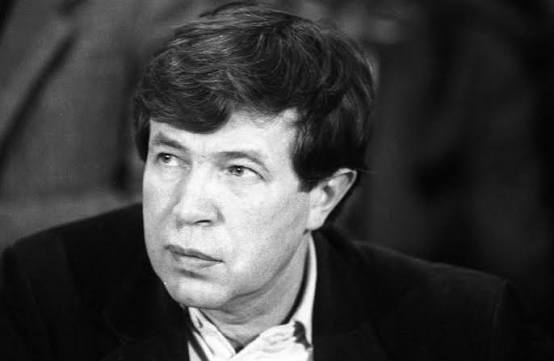
Mr. Ryzhkov's speech was generally received warmly by the reformist factions within the new Soviet Congress. The nationalist group reacted with outrage. "The Red Army is the foundation of this state, and this man proposes to sell it for credits from Washington," shouted Viktor Anpilov, a young hardline Communist and journalist with links to the ultranationalist Pamyat movement. "Let him say so plainly. The Soviet people are listening."
''It was realistic,'' said Nikolai Shmelev, another economist regarded as a radical reformer. ''From my point of view, not radical enough, but realistic.''
JUNE 9, 1989
CHINA'S PREMIER REAPPEARS; ARMY SEEMS TO TIGHTEN GRIP; BUSH BARS NORMAL TIES NOW
Warsaw Accepts Solidarity Sweep And Humiliating Losses by Party
Bush Resists Pressure to Soften Antimissile Policy
Yeltsin, Gorbachev's Wily Goad, Hints of Some Future Ambitions
In Iran, Parliament Chief Arrested as Confusion Over Succession Continues
TEHRAN – The Speaker of Parliament, Hashemi Rafsanjani, was arrested today on multiple charges of corruption in a move widely seen as an attempt to head off a possible leadership bid in the wake of Ayatollah Ruhollah Khomeini's death.
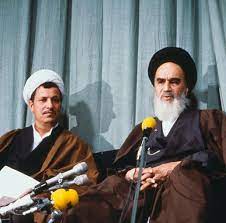
Diplomats said that a deal had been worked out between the Ayatollah and contending clerical factions to make Rafsanjani the president, with increased powers, while assuring a smooth transition by naming a potential rival, Ali Khameini, as Ayatollah Khomeini's successor as supreme religious guide.
But with Khameini now dead and Rafsanjani under arrest, that deal appears to be in tatters. T-72 main battle tanks belonging to the 1st Iranian Armored Division were seen on the streets of Tehran in what was widely believed to be a show of power by the Army's leader, Gen. Ali Shahbazi. A veteran of the Iran-Iraq war, he is seen as more moderate than his rival, the Revolutionary Guards Corps leader Gen. Yahya Safavi.
''Now Shahbazi has the power,'' a Middle Eastern diplomat steeped in the ways of the region said Wednesday, before the announcement of Rafsanjani's arrest. ''Everybody says so. He is to win the election for President in August.'' He quickly added: ''But this is Iran. Nobody really knows. It can all change suddenly.''
JUNE 9, 1989
DENG APPEARS ON CHINESE TV; SURROUNDED BY HARD-LINERS; SHANGHAI PROTESTERS RALLY
Don't Join With Communists, Walesa Is Urging, Advises Newly Elected Solidarity Legislators to Form Independent Government
U.S. Vetoes a U.N. Resolution Condemning Israel, Washington Out-Voted in Security Council
Soviet Congress Ends With One Last Spat
MOSCOW – The National Congress of People's Deputies ended its marathon 13-day debut tonight with Andrei Sakharov raging at the restless assembly that they had failed in their main task, to wrest control from the Communist Party elite.
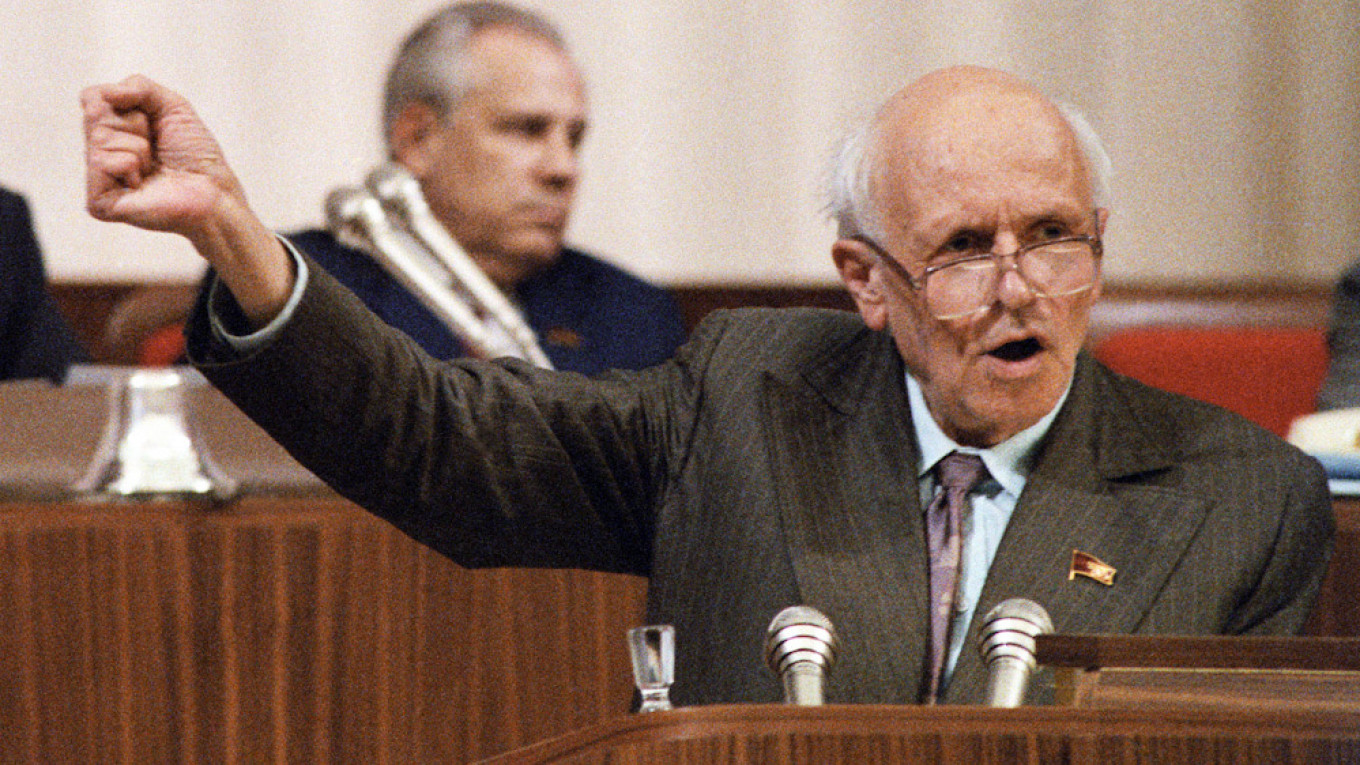
As the crowd tried to shout him down and an irritated President Mikhail Gorbachev fingered the time-limit buzzer, the human-rights advocate labored defiantly on through his indictment of the newborn congress until Mr. Gorbachev switched off the microphone and tried to salvage an upbeat adjournment.
''If you float downstream singing lullabies to yourselves in the hope of changes for the better in the foreseeable future, the growing tension may explode in our society, bringing about the most dramatic consequences,'' Dr. Sakharov warned before he was silenced.
The closing vignette summed up the televised drama of the last two weeks, in which the freedom to speak was unparalleled, but the ultimate power to decide rested with Mr. Gorbachev and his compliant majority.
The Russian writer Valentin Rasputin told the congress earlier this week that a power struggle was under way in the leadership, and asked Mr. Gorbachev to discuss the danger of a coup. Mr. Gorbachev declared in response that despite rumors about the threat of his overthrow, ''there is no danger of coups.''
''According to rumors, I have been killed no less than seven times and my entire family no less than three times,'' the Soviet leader said. ''It is especially unacceptable when deputies have a hand in such empty rumors."
The congress is the first since 1918 in which most of the deputies were chosen in competitive elections.
JUNE 12, 1989
China Seeks Arrest of Top Dissident, Now Living at U.S. Embassy
Moral Majority to Dissolve; "Mission Accomplished", Fallwell Says
West Germany Eager as Gorbachev Visit Begins Today
JUNE 13, 1989
Gorbachev, in Bonn, Sees Postwar Hostility Ending
Arriving for his first state visit to West Germany, a nation that has come to hold him in unusually high esteem, President Mikhail Gorbachev declared today that ''we are drawing the line under the postwar period.''
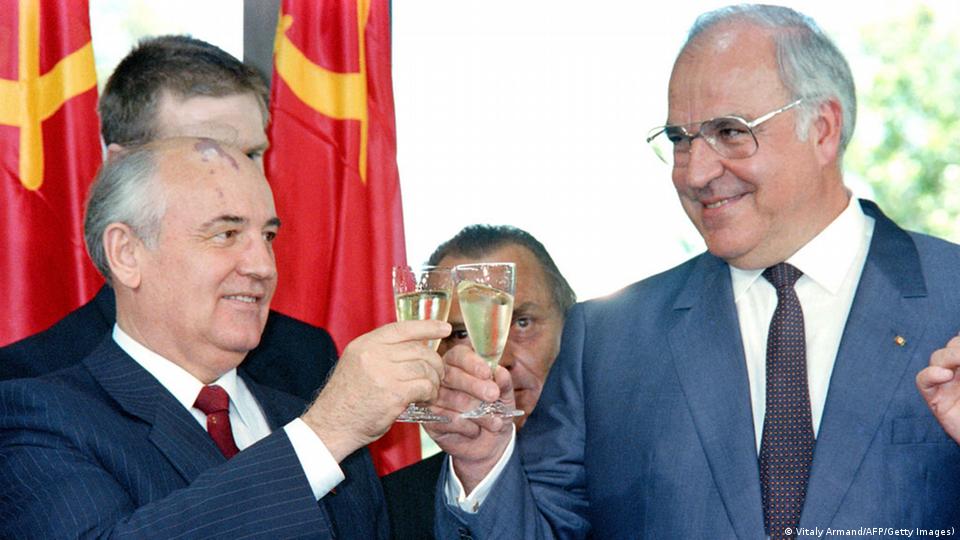
In his dinner remarks, the Soviet leader issued his first response to the recent Polish elections, which appear set to remove the Communist government from power, an event which in the past has provoked Soviet invasions, of Hungary in 1956 and Czechoslovakia in 1968.
"There is a growing understanding that the time has come to reverse the process that has made Europe the most militarized region in the world, oversaturated with arms and armed forces. This is a part of our history that we must all move beyond. We, of course, recognize that, in Poland's case, political structures must be decided by the people who live there. I believe Frank Sinatra had a song, I Did It My Way. So every country must decide on its own which road to take."
Wags in the German press have already termed Gorbachev's statement the "Sinatra Doctrine", referring to its predecessor the Brezhnev Doctrine which proclaimed that any threat to "socialist rule" in any state of the Soviet Bloc was a threat to all of them and therefore justified the intervention of fellow socialist states.
The state visit has added significance because it follows by less than two weeks a brief and successful visit by President Bush. The back-to-back trips here by leaders of the superpowers seem to confirm the pivotal role for West Germany in East-West relations at a time when the nation has become more conscious of its wealth and more assertive of its interests.
Iran Now Free to Pursue a Less Militant Line, Diplomats Say
TEHRAN, Iran – The death of Ayatollah Ruhollah Khomeini could leave a new Iranian leadership free to chart a more moderate, pragmatic course, including a reconciliation with the West, diplomats and many Iranians maintain.
Speculation has centered on the emergence of what appeared to be a leadership bid by the leader of the Iranian Army, General Ali Shahbazi, who is seen as a moderate willing to work with Western nations.
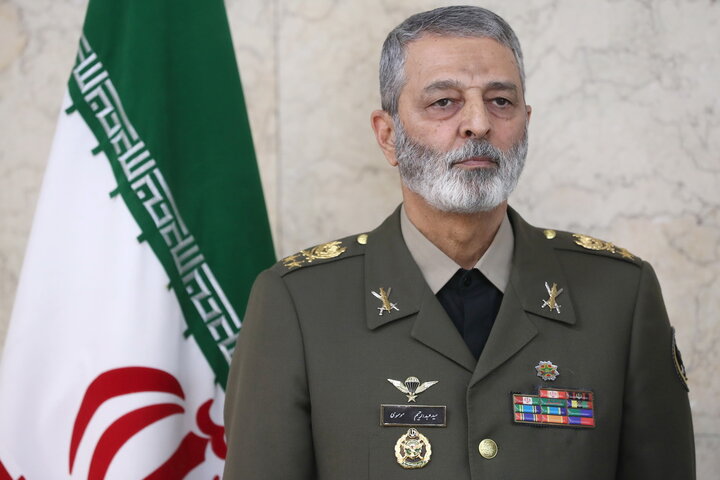
Several diplomats have suggested that Iranian relations with the United States could be restored, and a Western envoy said he expected an American diplomatic presence in Teheran in 18 months.
JUNE 14, 1989
Moderates Appear on Beijing TV, Easing Fears of Wholesale Purge
Gorbachev Urges Greater Trade And Much Closer Ties With Bonn
Najibullah Refuses To Depart as a Step To Afghan Accord
JUNE 15, 1989
HOUSE DEMOCRATS CHOOSE GEPHARDT AND GRAY TO LEAD
China Expels Two U.S. Journalists, Including One From the Voice of America
In Stuttgart, Gorbachev Welcomed with Enthusiasm
JUNE 16, 1989
3 CHINESE WORKERS SENTENCED TO DIE FOR PROTEST ROLE
Court Upholds Use of Rights Law But Limits How It Can Be Applied
A Gorbachev Hint for Berlin Wall
FRANKFURT, West Germany – Wrapping up a triumphant visit to West Germany, President Mikhail S. Gorbachev said today that the Berlin wall was not necessarily permanent, but would be taken down only when conditions that created it fell away.
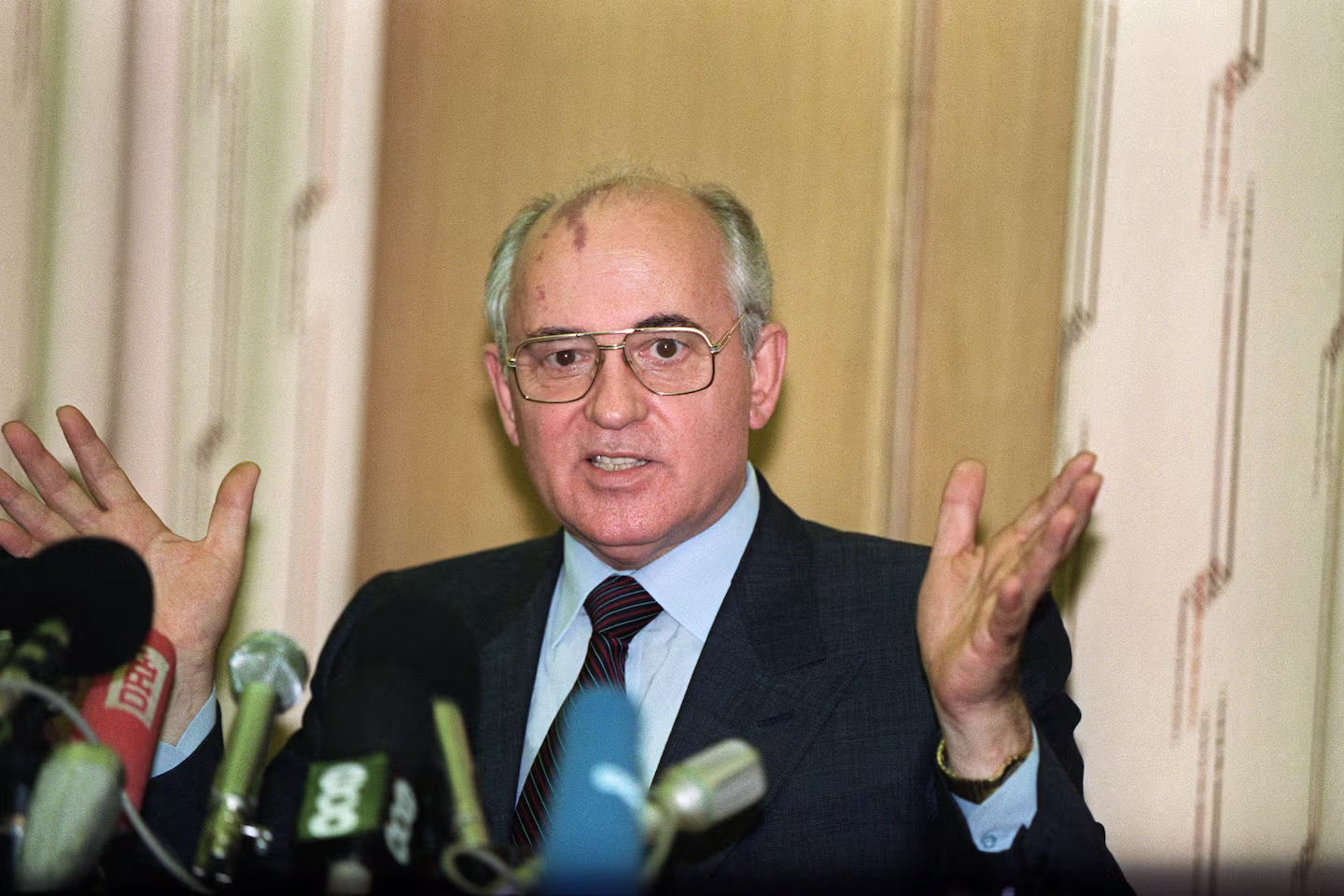
Though Mr. Gorbachev's visit produced no concessions on Berlin's status, his willingness to address the emotionally charged issue in practical terms was taken by West Germans as evidence of the ''new chapter'' that the Soviet leader proclaimed in Soviet-West German relations.
''The wall was raised in a concrete situation and was not dictated only by evil intentions,'' he said at his concluding news conference. East Germany ''decided this as its sovereign right, and the wall can disappear when those conditions that created it fall away,'' he continued. ''I don't see a major problem here.''
He did not elaborate, and the reference to ''conditions'' had an echo of the hard-line stand taken by Erich Honecker, the 76-year-old leader of East Germany. But in the past, any talk of the wall was either stonily ignored by the Russians or assailed as ''revanchism.''
Hans Klein, the West German Government spokesman, called Mr. Gorbachev's comment on the wall ''extremely positive,'' reflecting a consistent effort by the Germans to frame all facets of the visit in the best possible light. Mr. Klein said Berlin had been discussed at some length in the three meetings between Mr. Gorbachev and Chancellor Helmut Kohl, but he declined to give any details.
Mr. Gorbachev also did not rule out a resolution of the division of Germany, though he spoke only in broad terms. ''Time itself must determine this,'' he said. ''The current situation in Europe was created at a specific time by specific realities, and we are bound by this situation. But we hope that time will resolve this.''
JUNE 17, 1989
GORBACHEV IS PLACED UNDER ARREST UPON ARRIVAL IN MOSCOW, OUSTED IN AN APPARENT COUP BY SOVIET ARMED FORCES AND HARD-LINERS: ACCUSED OF STEERING INTO A 'BLIND ALLEY'
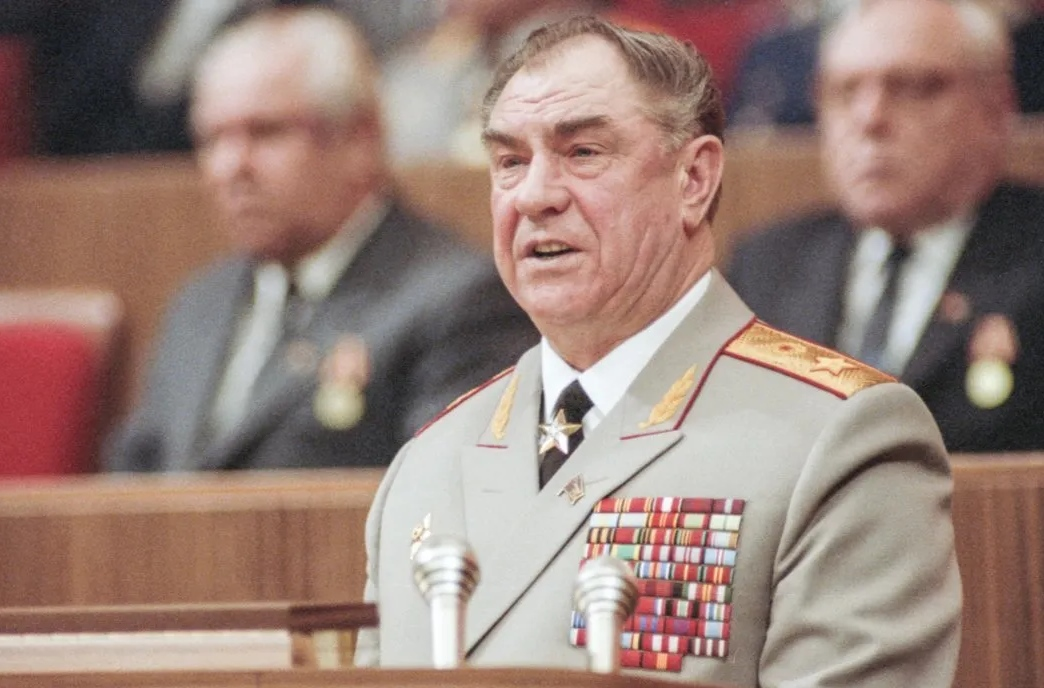
MOSCOW – Mikhail S. Gorbachev was apparently ousted from power today by military and K.G.B. authorities upon his return from his recent trip to West Germany today.
The announcement by "the Soviet leadership" this morning stunned the nation and left it groping for information as Kremlin officials declarted a state of emergency.
Coup Had Been Predicted
The apparent removal of Mr. Gorbachev, four years into his "perestroika" reform program, came just over a week after multiple speakers in the Soviet Congress of People's Deputies, led by physicist Andrei Sakharov, warned of a coming coup d'etat.
The Soviet news agency Tass cited Mr. Gorbachev's "voluntary resignation" upon arrival in Moscow.
Anatoly I. Lukyanov, the First Deputy Chairman of the Supreme Soviet and the committee's only lawyer, was named to assume leadership powers under a new entity called a State Committee for the State of Emergency. Its members include Vladimir A. Kryuchkov, chief of the K.G.B., and Dmitri T. Yazov, the Defense Minister.
'A Mortal Danger'
The shocking announcement said the committee, in assuming powers, had found that "a mortal danger had come to loom large" in the nation and that Mr. Gorbachev's reform program has gone into a "blind alley."
The committee contended the reforms had caused "extremist forces" to threaten the nation and leave it "just a step from mass manifestations of spontaneous discontent."
The scene on the streets of Moscow was calm at the hour of 6 A.M. when the announcement was made. Later in the morning, as the city approached a new work week, Muscovites heading downtown could see 10 armored personnel carriers moving a few miles north of Red Square toward the Kremlin. But there were no crowds or other signs of public reaction.
'Grave, Critical Hour': A Soviet Message
Following is the text of the message to the Soviet people made public here today by Tass, the Soviet press agency:
Compatriots, citizens of the Soviet Union, we are addressing you at the grave, critical hour for the destinies of Motherland and our peoples. A mortal danger has come to loom large over our great Motherland.
The policy of reforms, launched at Mikhail S. Gorbachev's initiative and designed as a means to insure the country's dynamic development and the democratization of social life has entered for several reasons a blind alley.
Lack of faith, apathy and despair have replaced the original enthusiasm and hopes. Authorities at all levels have lost the population's trust. Politicking has replaced in public life concern for the fate of Motherland and the citizen.
Malicious outrage against all state institutes is being imposed. The country has in fact become ungovernable.
Having taken advantage of the granted liberties and encroaching upon the first sprouts of democracy, there have emerged extremist forces that have embarked on the course toward liquidating the Soviet Union, ruining the state and seizing power at any cost.
It is high time people were told the truth: If urgent and decisive measures are not adopted to stabilize the economy, hunger and another spiral of impoverishment are imminent in the near future, from which it is just a step from mass manifestations of spontaneous discontent with devastating consequences.
Only irresponsible people can bank on some aid from abroad. No handouts can solve our problems; our rescue is in our own hands.
The increasing destabilization of the political and economic situation in the Soviet Union is undercutting our positions in the world. Revanchist notes are to be heard in some places and demands are being made for a review of our borders. Voices can even be heard speaking of dismembering the Soviet Union and of the possibility of establishing international guardianship over individual facilities and regions of the country.
Such is the bitter reality. Whereas only yesterday a Soviet person finding himself abroad felt himself a worthy citizen of an influential and respected state, now he is often a second-rate foreigner, the attitude to whom is marked by either contempt or sympathy.
The pride and honor of the Soviet people must be restored in full.
The State Committee for the State of Emergency in the U.S.S.R. is fully aware of the depth of the crisis that has afflicted the country, it takes upon itself the responsibility for the fate of the country and is fully determined to take most serious measures to take the state and society out of the crisis as soon as possible.
We intend to restore law and order straight away, end bloodshed, declare a war without mercy to the criminal world, eradicate shameful phenomena discrediting our society and degrading Soviet citizens. We shall clean the streets of our cities from criminal elements and put an end to arbitrariness of the squanderers of the national wealth.
We are a peace-loving country and shall undeviatingly honor all our commitments. We have no claims to make against anybody. We want to live in peace and friendship with all. But we firmly declare that no one will be ever allowed to encroach upon our sovereignty, independence and territorial integrity. All attempts to talk the language of Diktat to our country, no matter where they may come from, will be resolutely suppressed.
We call on all citizens of the Soviet Union to grow aware of their duty before the country and render all possible assistance to the State Committee for the State of Emergency in the U.S.S.R. and efforts to pull the country out of the crisis.
JUNE 18, 1989
KGB-MILITARY RULERS TIGHTEN GRIP: YELTSIN SHOT DEAD WHILE LEADING PROTEST MARCH IN MOSCOW, AT LEAST 40 OTHERS DEAD, HUNDREDS WOUNDED
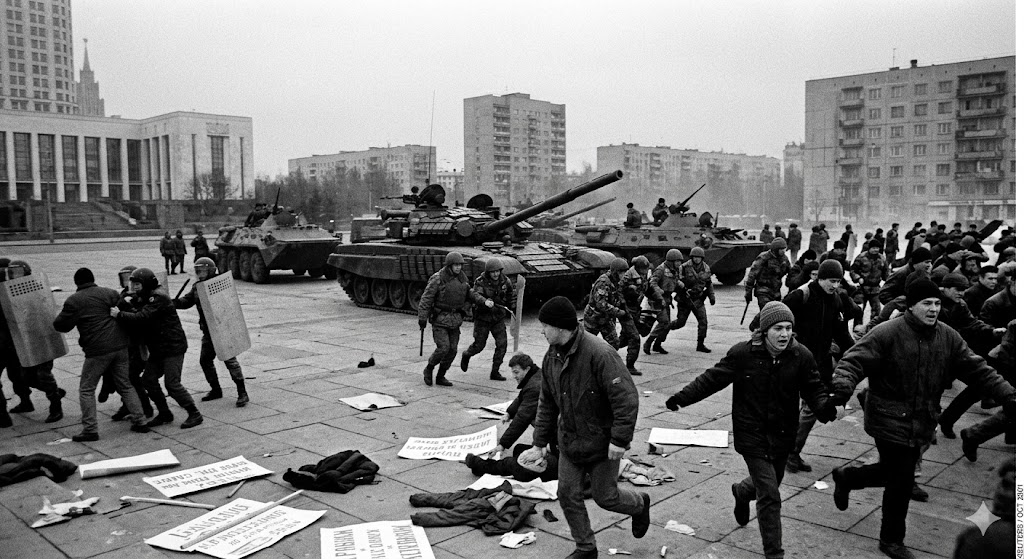
MOSCOW – The engineers of President Mikhail S. Gorbachev's ouster from power moved quickly today to reimpose hard-line control across the nation. The coup leaders, dominated by the military and the K.G.B., banned protest meetings, closed independent newspapers and flooded the capital with troops and tanks.
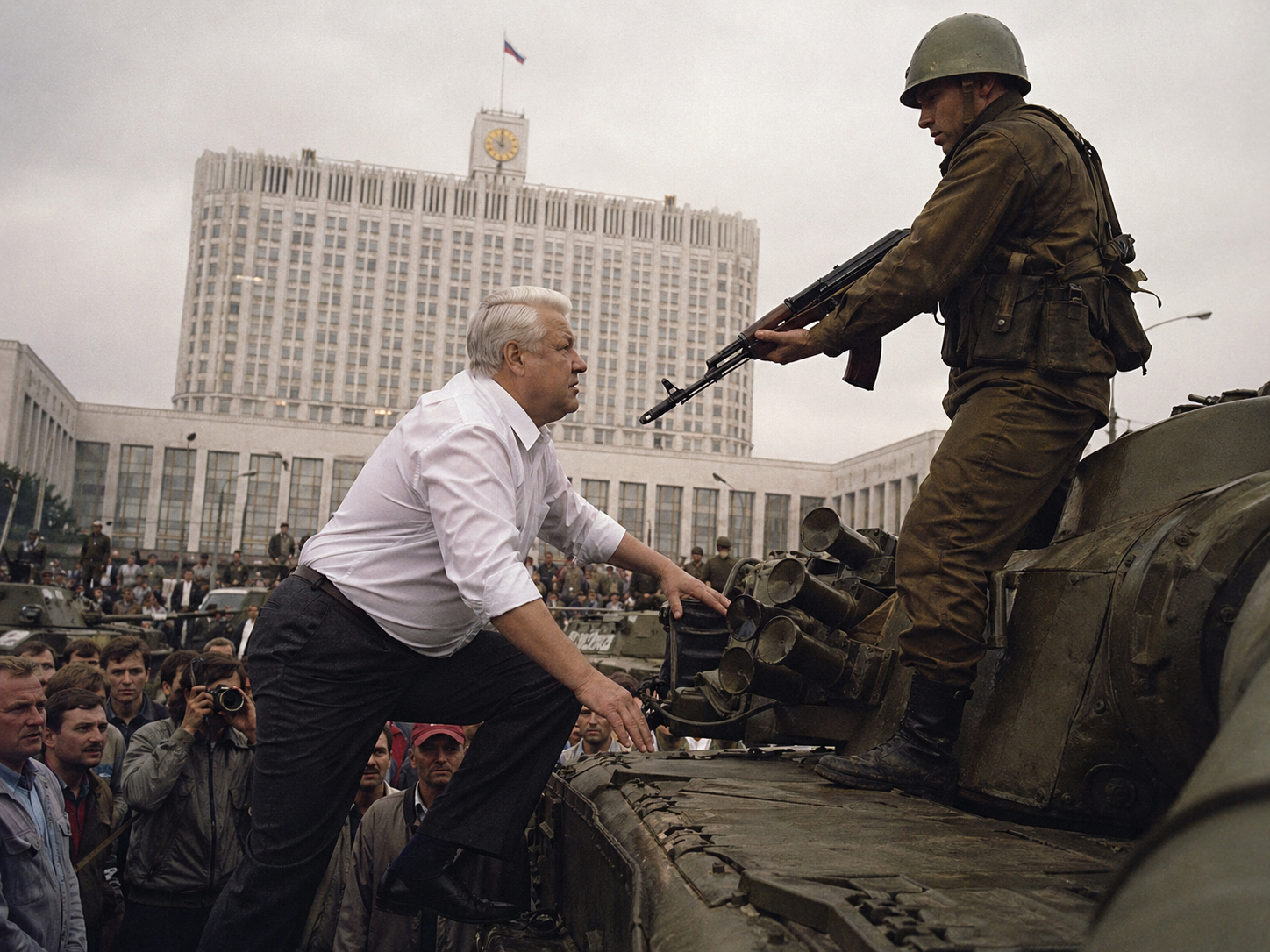
Boris N. Yeltsin, the deposed Moscow party chief whose landslide election to the Congress in March had made him the most popular politician in the Soviet Union and the most isolated man in its leadership, was killed today while leading a protest march demanding Mr. Gorbachev's return in Gorky Park, in the center of Moscow. Confronting a group of tanks believed to be from the elite "Tamanskaya" division, Yeltsin attempted to climb atop one of the lead tanks to address the crowd, only to be shot by one of the soldiers nearby. The troops then opened fire on the protesters wildly, causing a chaotic stampede as people attempted to flee.
By nightfall, KGB and military forces were in command of all state Russian centers of power, and resistance was sporadic, and where it occurred it was unarmed. Most Muscovites reportedly were in a state of shock at the suddenness of events and the apparent return of an authoritarian, brutal rule.
Mr. Gorbachev has been increasingly unpopular at home, in large part because of the country's profound economic troubles, and has been sharply criticized even by many of his former supporters. Still, there was general disbelief here in Moscow at the turn of events and support for the coup organizers appeared minimal.
Mr. Gorbachev's exact whereabouts were unknown. There was one report that he had been placed under arrest in a naval hospital in Murmansk, in the far north of the country. Soviet TV has been mostly silent, save for rebroadcasts of musical programs such as the "Swan Lake" ballet and a rebroadcast of the coup leaders' manifesto at the top of each hour.
The group now in charge is dominated by security and military leaders, and some top political figures, all of whom had strong disagreements with Mr. Gorbachev's democratization and economic-reform programs. Gorbachev's stated willingness during his recent European trip to allow Warsaw Pact allies freedom to elect non-Communist governments was also believed to play a role.
The new ruling group calls itself the State Committee for the State of Emergency, or, in Russian, Gosudarstvenny Komitet po Chrezvychainomu Polozheniyu.
ALL SOVIET TROOPS ORDERED TO BARRACKS FOR REDEPLOYMENT; TROOP MOVEMENTS SPOTTED IN GERMANY, POLAND, CAUCASUS
RESTORE GORBACHEV, BUSH WARNS MOSCOW
IRAN STRIFE: Gen. Shahbazi Reported Killed As IRGC Seizes Control Of Government, Disarms Iran Army Units
JUNE 19, 1989
YAZOV AND KRYUCHKOV GIVE PRESS CONFERENCE; SEVERAL REPORTERS ARRESTED AFTER ASKING "INDISCREET" QUESTIONS; YAZOV DEMANDS NATO MOVE FORCES AWAY FROM EAST GERMAN AND CZECHOSLOVAK BORDERS
Asked the whereabouts of Foreign Minister Eduard A. Shevardnadze, who had accompanied Mr. Gorbachev to Bonn and has not been seen since the aircraft landed, Marshal Yazov replied that Mr. Shevardnadze had "requested release from his duties on grounds of health" and that his functions had passed to his first deputy, Aleksandr A. Bessmertnykh. Asked a follow-up question as to Mr. Shevardnadze's present location, the Marshal did not answer, and the correspondent who had put it was escorted from the hall.
SOVIET TROOPS REPORTED MOVING INSIDE IRAN AS BOTH COUNTRIES CONSUMED BY LEADERSHIP STRUGGLES, TASS REPORTS "PROVISIONAL GOVERNMENT" ESTABLISHED IN TABRIZ UNDER TUDEH COMMUNIST RULE
ISTANBUL - Details are sparse at this time, but it appears that the Soviet army has entered Iran in support of a previously unknown "provisional government" led by pro-Russian forces. This despite the considerable turmoil within the Soviet Union itself, as only three days prior President Gorbachev was overthrown upon his arrival from a diplomatic mission.
No fighting appears to have broken out between Soviet troops and Iranian forces, as the Iranian Revolutionary Guard Corps continues to assert its control over Tehran and the Iranian Army, or "Artesh", appears to be sidelined following the death of its commanding officer.
From Tabriz, Ehsan Tabari, the leader of the Communist "Tudeh" Party and previously believed to have been imprisoned, announced the formation of a "broad based revolutionary government" and formally invited Soviet troops to "establish order and security".
JUNE 20, 1989
PRESIDENT BUSH ADDRESSES NATION, ANNOUNCES THAT "THE DARK DAYS OF THE PAST WILL NOT BE ALLOWED TO RETURN", PLEDGES SUPPORT FOR "THE RUSSIAN PEOPLE, AND THE IRANIAN PEOPLE, WHOMEVER THEY CHOOSE TO LEAD THEM", WARNS SOVIETS TO LEAVE IRAN IMMEDIATELY OR "CONSEQUENCES OF THEIR ACTIONS WILL BE MADE CLEAR"
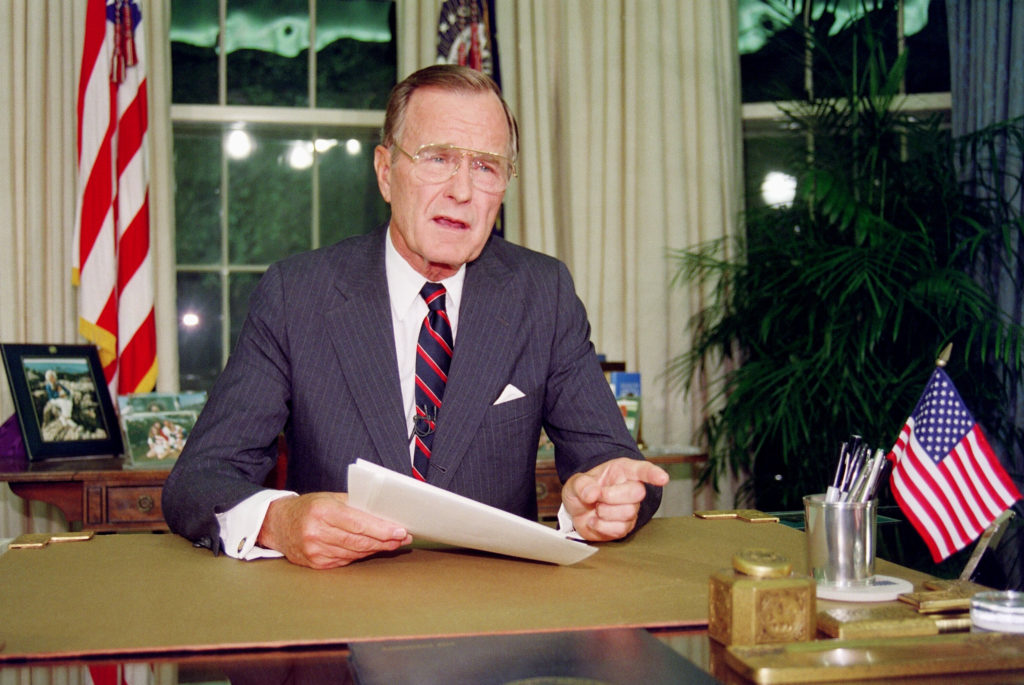
WASHINGTON — President Bush, in a televised address from the Oval Office tonight, declared that the United States would not stand aside as Soviet forces moved against Iran, and warned the leaders of the Moscow coup that "the dark days of the past will not be allowed to return."
"Tonight I speak to you at a moment of grave concern," Bush began, his demeanor unusually grim. "In the space of a few short days, we have seen the overthrow of a duly chosen leader of a great nation, the murder of a courageous man, Boris Yeltsin, who stood unarmed in the path of tanks, and now the unprovoked movement of foreign armies into a sovereign neighbor."
The President said he had spoken in recent hours with Prime Minister Thatcher, Chancellor Kohl, President Mitterrand and Manfred Wörner, the NATO Secretary General, and that "the alliance is united, and it is determined." He added that he had directed Secretary of State James Baker to convene an emergency session of the North Atlantic Council and to seek the urgent attention of the United Nations Security Council.
In what officials described as the most pointed warning to Moscow since the depths of the Cold War, the President declared:
"Let the leaders of the so-called Emergency Committee hear me clearly. The Soviet armies now in Iran must withdraw at once. We pledge our support to the Russian people, and to the Iranian people, whomever they choose to lead them. If our warning is not heeded, the consequences of their actions will be made clear."
The President did not specify what those consequences might be, and pointedly declined to rule any out. He confirmed, however, that elements of the Sixth Fleet had been ordered into the eastern Mediterranean, that the carrier U.S.S. Independence had been redirected toward the Indian Ocean, and that he had placed a number of Army and Air Force units at "an elevated state of readiness." He declined to comment on reports that elements of the 82d Airborne Division, based at Fort Bragg, N.C., had been alerted for possible deployment.
The address, lasting 14 minutes, was simulcast on the three major networks and the Cable News Network. White House officials said the President had drafted the closing passages himself, in consultation with Brent Scowcroft, the National Security Adviser, after an emergency meeting in the Situation Room earlier in the evening.
From the Capitol, Speaker Thomas S. Foley issued a brief statement of support, saying, "In a moment such as this, the President speaks for all Americans."
SOVIET TROOPS RACING TOWARDS TEHRAN, MEET NO RESISTANCE
ISTANBUL — Soviet armored columns were reported tonight to be racing south along the highway from Tabriz toward the Iranian capital, advancing as much as 200 kilometers in a single day, with no organized resistance from any Iranian military unit.
Western intelligence sources monitoring the situation from Turkey said that at least three motorized rifle divisions, believed to belong to the Soviet Transcaucasus Military District, had crossed the border at Astara on the Caspian coast and at Julfa, opposite the Nakhchivan exclave, beginning the night of June 18, and had now passed through Tabriz, Mianeh and Zanjan in a continuous stream of armor and supply vehicles.
The advance is being led, according to the same sources, by elements of the 75th Motor Rifle Division out of Nakhchivan and what appears to be a tank regiment equipped with T-72 main battle tanks. Helicopter formations, including Mi-8 assault transports and Mi-24 gunships, have been seen forward of the column, scouting the route and securing bridges over the Qizil Uzan and Shahrud rivers.
Strikingly, the Iranian Revolutionary Guard Corps, which on Sunday seized control of the government in Tehran following the reported death of the Army Chief of Staff, Gen. Ali Shahbazi, has thus far made no public response to the Soviet advance. The IRGC commander, Gen. Yahya Rahim Safavi, has not been seen in public since Sunday's televised statement, and Tehran Radio has continued to broadcast Koranic recitations and martial music with only brief news bulletins.
"We are watching a country be swallowed without a shot fired," a Western diplomat in Ankara said this evening, asking not to be named. "Whether by design, by paralysis, or by collusion, no one can yet say."
In Tabriz, the so-called provisional government of Ehsan Tabari and the Tudeh Party issued a second proclamation today, declaring martial law in the four northern provinces and calling on "all patriotic Iranians" to assist Soviet forces in "the restoration of order." The Tudeh statement made no reference to the religious authorities in Qom or Mashhad, nor to the Grand Ayatollahs whose silence has been one of the most remarked-upon features of the past three days.
If the Soviet rate of advance is sustained, observers said, the lead elements of the column could reach the outskirts of Qazvin — roughly 150 kilometers from Tehran — by tomorrow evening.
CURFEW ANNOUNCED IN MOSCOW; PROTESTORS FACE TANKS WITH BARE HANDS; PROTEST MARCH IN LITHUANIA DISPERSED WITH "TRULY AWFUL CASUALTIES"
MOSCOW — A round-the-clock curfew was imposed on the Soviet capital tonight by order of Defense Minister Dmitri T. Yazov, one of the principal figures in the Emergency Committee, after a second day of small but defiant protests in the center of Moscow and reports of far more serious unrest in the Baltic republic of Lithuania.
The order, read on Soviet television at 7 p.m. Moscow time by an unidentified announcer, prohibits all assembly of more than three persons, all unauthorized movement of vehicles, and the operation of any printing or duplicating equipment outside state control. Violators, the announcer said, would face "the most severe penalties of revolutionary order."
Despite the order, eyewitnesses in central Moscow reported that small groups of citizens, often no more than a dozen at a time, continued to appear at the approaches to the Manezh and along the Garden Ring, where they confronted tank crews with raised hands, flowers and shouted demands for the return of Mr. Gorbachev. One young man, described by witnesses as a university student, climbed onto the side of a T-80 tank near the Mossovet building before being pulled down and beaten by soldiers. He was reported alive but in critical condition at the Sklifosovsky Institute.
Far worse violence came from Vilnius, the Lithuanian capital, where Interior Ministry troops together with units identified as belonging to the Pskov-based 76th Guards Air Assault Division moved against a march organized by the Lithuanian reform movement Sajudis. The march, which had drawn tens of thousands into the streets in support of the deposed Mr. Gorbachev and in defense of Lithuania's declaration of sovereignty of last May, was dispersed with what one Western correspondent reaching Helsinki by telephone described as "truly awful casualties," at least 60 dead and several hundred wounded by partial accounts. Some of the dead were said to be schoolchildren who had joined their parents in the procession.
Vytautas Landsbergis, the chairman of Sajudis, escaped the initial assault and took refuge with sympathetic clergy at the Cathedral of Vilnius, according to an account reaching Helsinki late tonight. His whereabouts could not be confirmed. Algirdas Brazauskas, the First Secretary of the Lithuanian Communist Party, is under house arrest after refusing a direct order from Moscow to denounce the Sajudis movement and to call out his republic's militia in support of the Emergency Committee.
Telephone and telex links to all three Baltic republics were severed at approximately 10 p.m. local time, and Aeroflot service to Vilnius, Riga and Tallinn has been suspended until further notice.
In Warsaw, an extraordinary session of the Polish Sejm was called for tomorrow morning. In East Berlin, Erich Honecker left the city for an undisclosed location.
JUNE 21, 1989
AMERICAN FORCES LAND IN SOUTHERN IRAN, SECURE MULTIPLE PORTS, MEET LITTLE RESISTANCE
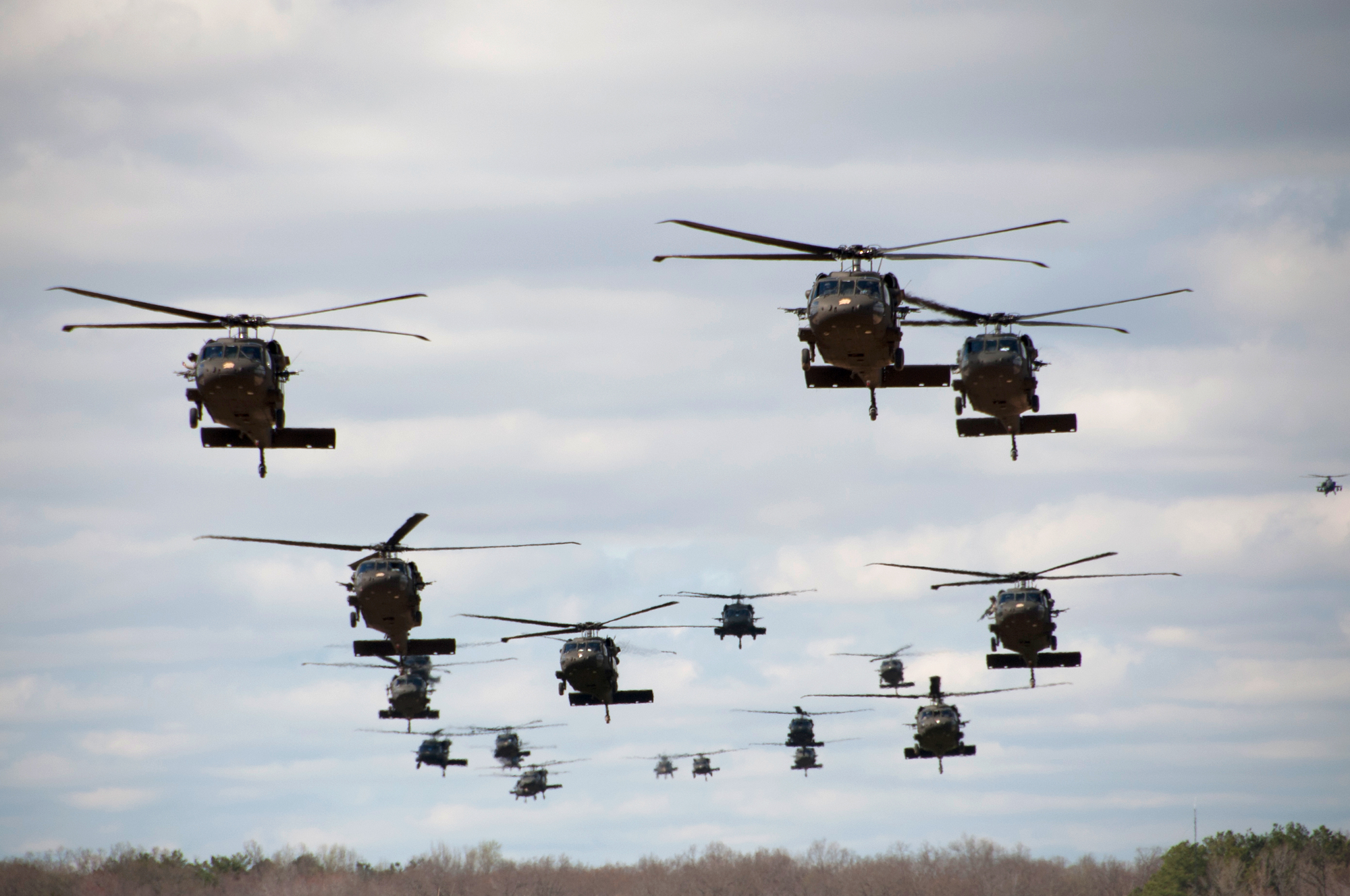
WASHINGTON — In the largest single deployment of American combat forces since the closing months of the Vietnam War, units of the United States Central Command began landing along Iran's southern coast before dawn this morning, seizing the ports of Bandar Abbas and Chah Bahar and securing forward airfields and helicopter operating bases at three additional points across the southeast of the country, in what the Pentagon described as "negligible resistance."
The operation, code-named DESERT EAGLE according to Defense Department officials, has been personally directed by Gen. H. Norman Schwarzkopf, the commander of Central Command, from a forward headquarters established overnight at Riyadh, Saudi Arabia. Officials confirmed that Saudi Arabia, Oman, and Bahrain had granted basing and overflight rights within hours of last evening's address by President Bush, and that Pakistan had agreed to permit the use of airspace and emergency divert fields at Pasni and Karachi.
Marine elements of the 7th Marine Expeditionary Brigade, embarked aboard ships of the U.S.S. Independence battle group, came ashore at Bandar Abbas at approximately 4:30 a.m. local time, securing the harbor and the adjoining airfield. Pentagon officials said the senior Iranian naval officer at the port, identified as a Capt. Madani, had surrendered "without an exchange of gunfire" after a brief negotiation conducted partly in English. A squadron of Iranian Air Force F-4 Phantoms based at the field, officials said, did not lift off and was secured intact, including pilots and ground crews.
Elements of the 82d Airborne Division parachuted onto the airfield at Chah Bahar shortly after first light, securing the runway for follow-on C-141 and C-5 transports. By mid-morning, the lead brigade of the 101st Airborne Division (Air Assault), staging out of Salalah, in southern Oman, and from the U.S.S. Saipan and U.S.S. Nassau in the Gulf of Oman, was inserting by helicopter at points along the highway from Chah Bahar toward Zahedan, with the apparent intention of forming a screening line across the eastern approaches to the country. Pentagon officials said that within twenty-four hours the bulk of the 101st's three brigades, together with their aviation regiments, would be on the ground.
Asked whether the deployment represented effectively the entirety of the rapid-deployment forces of the United States, the Pentagon spokesman, Pete Williams, replied: "It represents whatever the situation requires."
A small number of Western correspondents accompanying the lead elements described a country whose institutions had simply ceased to function. Local police in Bandar Abbas, the correspondents reported, "stood about smoking and watching" as Marine vehicles rolled past the customs house. In one bazaar, a CBS News crew filmed a small crowd applauding a passing column of LAV-25 light armored vehicles. A merchant, asked through an interpreter what he made of the day's events, replied: "Yesterday it was the Russians, today it is the Americans. Tomorrow, God willing, it will be Iranians."
Pentagon planners said the immediate objective of the southern landings was the establishment of a secure logistics base from which to project force northward, and to deny the Soviet army access to the Strait of Hormuz and to the Iranian oilfields of Khuzestan. Whether American forces would be ordered to advance further, and how far, would depend, officials said, "on choices that have not yet been made in Moscow."
BUSH GIVES ULTIMATUM TO SOVIETS; "LEAVE IRAN NOW"
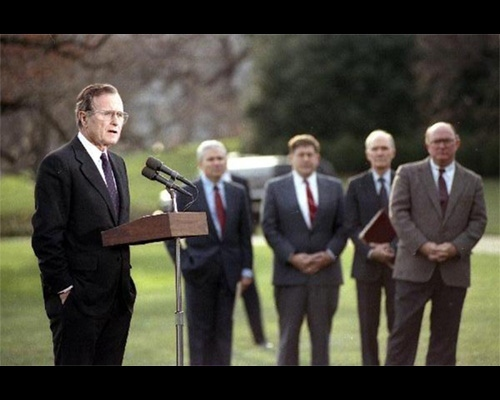
WASHINGTON — President Bush, in a sharply worded statement issued from the South Lawn of the White House this afternoon, demanded the immediate and unconditional withdrawal of all Soviet armed forces from the territory of Iran, and warned that the United States and its allies would, after a period of 48 hours, "take whatever steps are necessary to bring about that withdrawal."
The President declined to take questions following the statement and turned and walked back into the residence as reporters shouted after him. The brevity of the appearance, lasting just under three minutes, and the President's visibly stern manner, were taken by White House correspondents as evidence that diplomatic exchanges with the new Soviet leadership had broken down badly overnight.
"The Soviet government," the President said, "has been advised through every available channel, through our Ambassador in Moscow, through the Soviet Ambassador here, through the United Nations, and through the good offices of Prime Minister Mulroney of Canada, of the gravity with which the United States and its allies regard the present situation. The reply we have received is not satisfactory. It is not even responsive."
"Therefore, on this 21st day of June, 1989," the President continued, "I demand on behalf of the people of the United States, and in concert with our allies, the immediate and unconditional withdrawal of Soviet armed forces from the sovereign territory of Iran. The forces of the so-called Emergency Committee will have a period of 48 hours, beginning at six o'clock this evening Washington time, to commence that withdrawal. If they have not done so, we shall take whatever steps are necessary to bring it about."
State Department officials, briefing reporters on background shortly afterward, said that Secretary Baker had earlier in the day rejected as "frivolous and insulting" a Soviet diplomatic note, signed by Foreign Minister Aleksandr A. Bessmertnykh, asserting that Soviet forces were present in Iran "at the express invitation of the lawful provisional revolutionary government in Tabriz" and warning the United States against "interference in matters internal to the Iranian people."
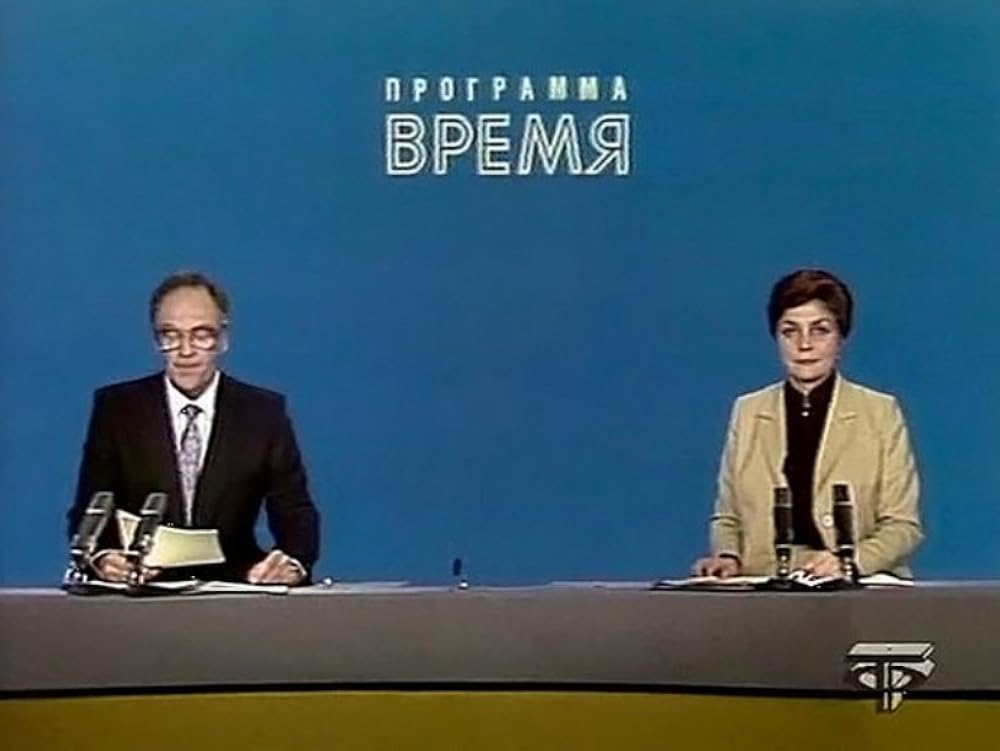
In Moscow, the response came within the hour. A statement read on Soviet television by an announcer of the Vremya evening news program dismissed the American ultimatum as "a piece of imperial theater, addressed not to history but to the next election," and declared that "the Soviet Union does not receive ultimatums from any quarter, on any subject, at any time."
At the United Nations, the Security Council was scheduled to meet in emergency session at 9 p.m. New York time. Diplomats said it remained uncertain whether the Soviet representative, Aleksandr Belonogov, would attend. The Chinese delegation, observers noted, had been silent throughout the day.
In Bonn, Brussels, Paris, and London, NATO governments issued near-identical statements supporting the President's demand. Only the government of Greece expressed reservations, calling for "a further period of dialogue."
In Jerusalem, Prime Minister Yitzhak Shamir convened an emergency session of the cabinet. In Riyadh, King Fahd was in continuous communication with the White House. In New Delhi, Prime Minister Rajiv Gandhi appealed for "the utmost restraint on all sides."
SOVIET TROOPS ENTER TEHRAN, GREETED BY CURIOUS CROWDS, NO RESISTANCE TO BE SEEN
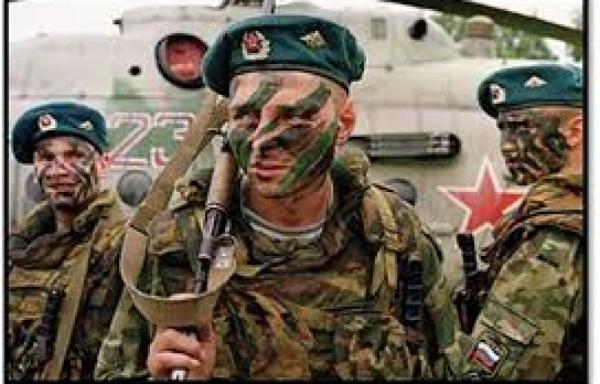
ISTANBUL — Soviet armored and airborne forces entered the Iranian capital today from two directions and within a matter of hours had occupied Mehrabad International Airport, the central radio and television building, the chamber of the Majlis, the Foreign Ministry, and the compound of the United States Embassy, abandoned for nearly a decade and now in Soviet hands without a shot fired.
The first arrivals, witnesses said, were paratroopers of what Western military analysts identified as the 104th Guards Airborne Division, normally based at Kirovabad in Soviet Azerbaijan and well within Il-76 range of the Iranian capital. Beginning shortly after 8 a.m. local time, a stream of Il-76 jet transports descended onto Mehrabad's two runways, disgorging paratroops, BMD airborne combat vehicles, and what one foreign airline pilot present at the field described as "an entire division's worth of fuel trucks." The airport's small Iranian Air Force garrison, the same witness said, formed up in good order, saluted the senior Soviet officer to disembark, and was marched off to a hangar, "where presumably they remain."
The mechanized column from the north, last reported the previous evening at Qazvin, entered the city by way of the Karaj highway shortly after noon and made directly for the central districts. By the late afternoon Soviet T-72s were parked, motors idling, in front of the Majlis, the Foreign Ministry, and the headquarters of the Islamic Revolutionary Guard Corps on Pasdaran Avenue, the latter found, according to a Reuters dispatch reaching Ankara, "open, abandoned, and partially burned from within."
What was almost wholly absent, in the accounts of every Western correspondent able to reach the city, was resistance. The Revolutionary Guard, which only ten days earlier had taken control of the country in the wake of the Khameini assassination and the killing of Gen. Ali Shahbazi, appeared by the morning of the 21st to have ceased to exist as an organized force. Its commander, Gen. Yahya Rahim Safavi, has not been seen in five days. Several Guard bases on the outskirts of the city were the scene of internal gun battles overnight, between factions whose loyalties and grievances were not clear, and from which the survivors appear simply to have walked away. The Iranian Army, or Artesh, disarmed and confined to barracks by the Guard on the 18th after Gen. Shahbazi's killing, did not appear in the city today either to fight or to surrender.
In place of resistance, the Tehranis came out to look. Crowds gathered at the major intersections, at Azadi Square, at Vali-Asr, at Enqelab, and stood in the heat regarding the Soviet columns with a curiosity that several correspondents described as "almost tourist." A few jeered, a few cheered, most simply watched. There were no flowers, but there were also no stones. An elderly man on Vali-Asr, asked by an Italian RAI crew what he thought of the morning's events, looked at the interpreter for some time and then said, in French, that he had no opinion and would prefer not to give his name.
In the foreign diplomatic district, the embassies of the United Kingdom, France, West Germany, and Japan reported that Soviet officers had arrived at their gates within hours of the column's entry to advise the staffs to remain indoors and not to attempt evacuation, and to assure them that the Soviet forces "were not the enemy of any third country." The embassies of Pakistan, Saudi Arabia, and Iraq reported, by contrast, that Tudeh Party militants, appearing openly in the streets of Tehran for the first time in a decade, had begun to gather in numbers outside their gates, shouting anti-American and anti-Sunni slogans.
Of the senior figures of the Islamic Republic, almost nothing could be confirmed. The former Speaker of Parliament, Hashemi Rafsanjani, previously imprisoned after Khomeini's death, was placed by rumor in Qom, in Mashhad, in the holy city of Najaf in Iraq, and in a grave. Ahmed Khomeini, the late Ayatollah's son, is in "Soviet protective custody" at a residence in north Tehran, according to a Soviet officer who spoke to correspondents at Mehrabad. The Grand Ayatollahs of Qom, Golpaygani, Marashi-Najafi, and Araki, issued no statement, and a single source reaching the Pakistani embassy said they had left the city.
Western intelligence sources, speaking on condition of anonymity in Ankara and in Washington, were today beginning to give voice to a suspicion that has hardened over the past seventy-two hours: that the late Gen. Shahbazi, killed by his own subordinates on the 18th, had been a long-running asset of the Soviet Committee for State Security, and that the operation now unfolding had been in preparation for considerably longer than the four days it has thus far been visible to the world.
"Somebody has been working on this file since before Khomeini took ill," one Western official said this evening. "We would all very much like to know since when."
JUNE 22, 1989
SOVIET AIRCRAFT SEEN OVER BANDAR ABBAS, AS US/SOVIET DIPLOMACY FALTERS
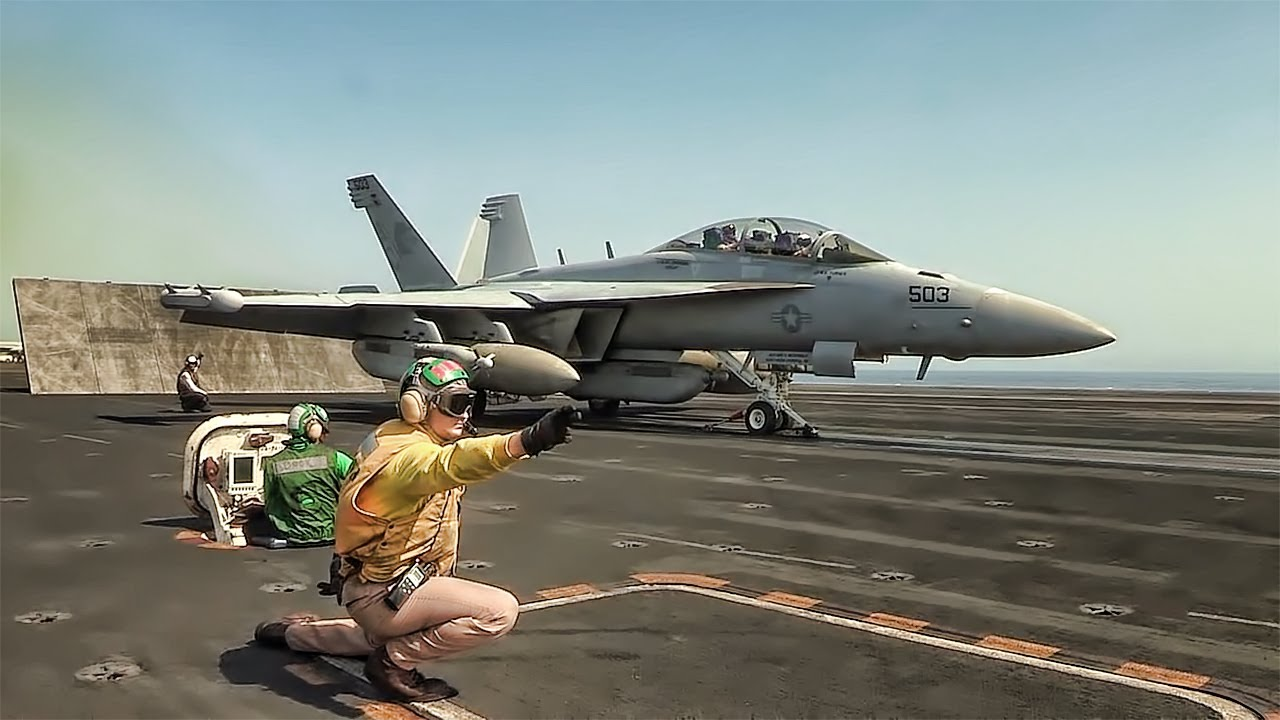
ABOARD U.S.S. INDEPENDENCE, IN THE GULF OF OMAN — A flight of two Soviet MiG-29 fighters, operating from a captured Iranian airbase at Shiraz, overflew positions held by United States Marines at the port of Bandar Abbas this morning at approximately 30,000 feet. Pentagon officials said it was the first direct military contact between American and Soviet armed forces since the Korean War.
The Soviet aircraft, identified by E-2C Hawkeye early-warning aircraft of Carrier Air Wing Six, were intercepted within four minutes by a section of two F-14A Tomcat fighters of Squadron VF-33, which closed to within visual range and shadowed the Soviet flight for the duration of its passage over the Iranian coast. No weapons were fired by either side. The Soviet aircraft did not respond to repeated radio challenges on international guard frequencies, and turned north at the limit of their fuel radius, returning, according to American electronic surveillance, to the same field at Shiraz from which they had departed.
The Pentagon, in a statement issued by its spokesman, Pete Williams, called the overflight "deliberate, and closer to the line than anything we have seen." Mr. Williams declined to say where the line was or what response would follow if it were crossed. He confirmed that the rules of engagement of American forces in theater had been reviewed and adjusted within the past 12 hours, and that "the President has given commanders the authority they require."
In Washington, Secretary Baker met for the third time in 24 hours with the Soviet chargé d'affaires, Sergei Chetverikov, the Soviet Ambassador, Yuri Dubinin, having declined to leave his embassy since Tuesday evening. State Department officials said Baker rejected as "absurd" a Soviet proposal for "a mutual standfast and joint consultations on the future of the Iranian nation." Baker is said to have replied that the United States would consult with no one regarding Iran's future save the Iranians themselves, and that the only matter for discussion between Washington and Moscow was the timetable of Soviet withdrawal.
The American ultimatum issued by President Bush on Wednesday evening expires at 6 p.m. Washington time today. There is no indication from any source that Soviet forces intend to comply. To the contrary, dispatches from the front in central Iran suggest the pace of the Soviet advance is, if anything, accelerating.
In a separate development, the U.S.S. Theodore Roosevelt battle group, sortied from Norfolk on Tuesday, is making 30 knots toward the Mediterranean. The U.S.S. Eisenhower, already in the Mediterranean, has transited the Suez Canal, Egyptian authorities having waived the customary 24-hour notice, and is expected to enter the Red Sea by tomorrow. Six B-52 bombers of the 2d Bombardment Wing, departing Barksdale Air Force Base in Louisiana yesterday afternoon, landed at Diego Garcia, the British Indian Ocean territory leased to the United States, where they have been joined by tanker and reconnaissance aircraft.
GEN. SIWICKI ANNOUNCES "MILITARY COUNCIL OF NATIONAL SALVATION", DECLARES STATE OF WAR; SOLIDARITY GOVERNMENT OVERTHROWN, MAZOWIECKI AND WALESA UNDER ARREST
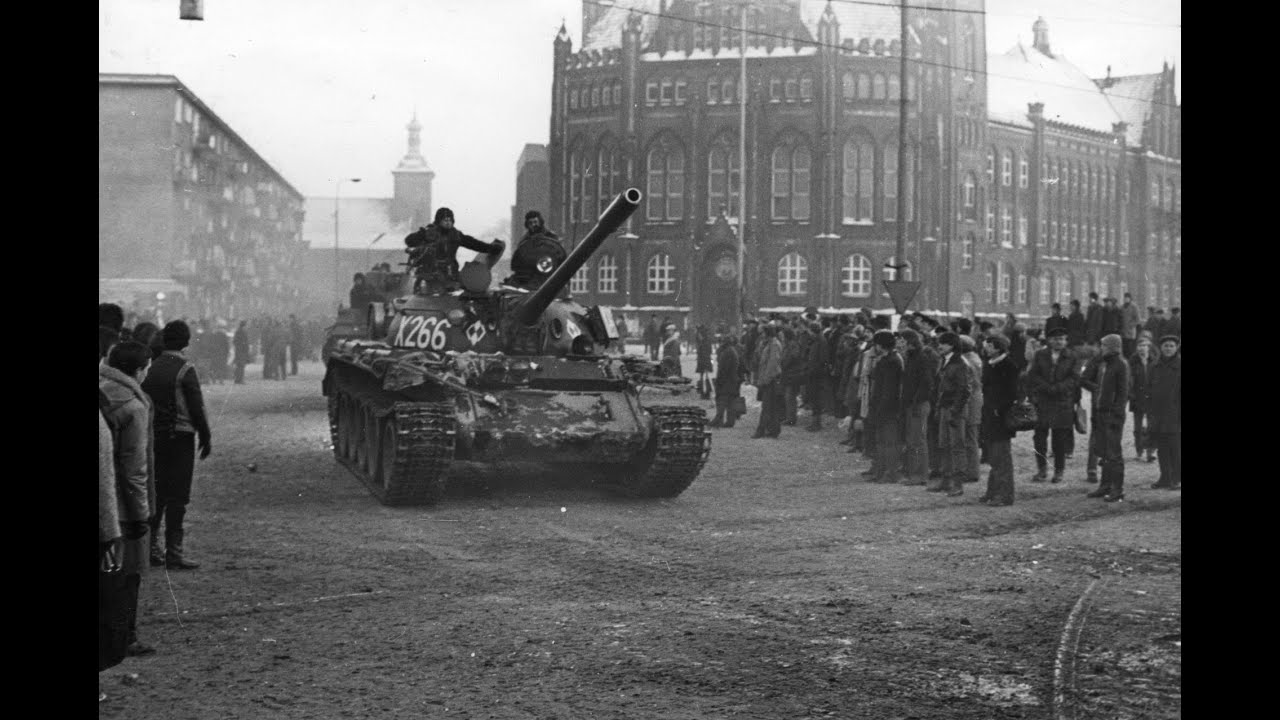
VIENNA — The seven-week-old experiment in Polish democracy was extinguished before dawn today, when units of the Polish People's Army and Internal Defense Forces, acting under the orders of the Defense Minister, Gen. Florian Siwicki, occupied the Council of Ministers building, the Sejm, the Belweder Palace, and the headquarters of the Solidarity trade union on Mokotowska Street in Warsaw, and arrested the Prime Minister, Tadeusz Mazowiecki, together with most members of his cabinet.
Lech Walesa, the Solidarity chairman, was seized at his home in Gdansk shortly after 4 a.m., according to family members reached by telephone before the lines were cut. Bronislaw Geremek, the Solidarity intellectual and minister without portfolio, was arrested at the Sejm. Adam Michnik, the editor of Gazeta Wyborcza, was taken into custody at the newspaper's offices, where the printing presses were disabled by soldiers wielding sledgehammers.
In a televised statement broadcast at 6 a.m. local time, Gen. Siwicki, in full uniform and visibly fatigued, announced the creation of a "Military Council of National Salvation," using the same Polish phrase, Wojskowa Rada Ocalenia Narodowego, employed by Gen. Wojciech Jaruzelski during the imposition of martial law in December 1981, and declared a "state of war" throughout the territory of the Polish People's Republic. He cited "irresponsible adventurism" by Solidarity, "open provocation against fraternal allies," and "the imminent danger of foreign intervention" as the grounds for his action.
President Jaruzelski did not appear in the broadcast. His whereabouts were not stated. Czeslaw Kiszczak, the Interior Minister and a longtime ally of Jaruzelski's, stood at Gen. Siwicki's right hand during the announcement.
The Mazowiecki government, sworn in only on June 19 in what was widely understood as a defensive response to the Moscow coup of two days earlier, had governed for less than 72 hours. Solidarity's parliamentary caucus had not yet been seated. The Round Table accords of April, under which the elections of June 4 had been held, were declared by Gen. Siwicki this morning to be "suspended in their entirety, pending review by competent state authorities."
Telephone, telex, and direct-dial international communications from Poland were severed at 3:30 a.m. local time. The borders with Czechoslovakia, East Germany, and the Soviet Union were closed to all traffic save military. The borders with Austria, through Czechoslovakia, and with the Federal Republic of Germany, by way of the GDR, were likewise closed. Polish airspace was shut to civil aviation. LOT Polish Airlines flights inbound to Warsaw were diverted to Frankfurt, Vienna, and Stockholm.
A small number of Solidarity figures appear to have eluded the initial sweep. Zbigniew Bujak, the underground organizer of the Solidarity years 1982-86, reached the United States Embassy on Aleje Ujazdowskie in the early hours of the morning and was granted refuge there. Similar reports circulated regarding the British, French, and Vatican legations, though none could be confirmed at the hour of this dispatch.
In Rome, the Vatican issued a statement of unusual severity. Pope John Paul II, the former Karol Cardinal Wojtyla of Krakow, was said by his spokesman, Joaquin Navarro-Valls, to have been "informed of the events in his homeland in the early morning hours, and to have spent the morning in prayer and in consultation." The statement called the arrests "an outrage against the conscience of Europe" and demanded the immediate release of Mr. Mazowiecki, Mr. Walesa, and "all those whose only offense has been to seek the peaceful self-government of the Polish nation by the methods of the ballot."
In Bonn, Chancellor Kohl summoned the Polish Ambassador and presented him a note demanding the immediate restoration of the Mazowiecki government. In Paris, President Mitterrand canceled a scheduled appearance to convene an emergency meeting of his cabinet. In Washington, the State Department recalled the United States Ambassador, John R. Davis Jr., for consultations.
President Bush, asked by reporters as he crossed the South Lawn whether the Polish events would influence American resolve in the Iranian crisis, replied: "It clarifies it."
SOVIET TROOPS CONTINUE DRIVE SOUTH
ANKARA — Soviet motorized columns, having transited the Iranian capital with no more than a brief halt, resumed their advance southward this morning along two axes, one toward the holy city of Qom, the other along the Tehran-Esfahan highway, even as the deadline of the American ultimatum drew toward expiry, and with no diplomatic indication from Moscow that any halt was contemplated.
Western military observers in Turkey said the lead mechanized elements were now estimated to be approaching the outskirts of Qom by mid-afternoon and to have passed the city of Saveh, 80 miles southwest of Tehran, by midday. A second column, smaller in size and believed to consist of a reinforced motor rifle regiment with attached helicopter assets, was on the road from Tehran toward Kashan, with its apparent objective the city of Esfahan and ultimately the Khuzestan oilfields.
A third Soviet movement, separate from the main thrust and originating from the Caspian port of Bandar-e Anzali, was described by an unnamed Western intelligence official in Ankara as advancing along the coastal plain toward the city of Rasht and thence southward in the direction of Qazvin and Hamadan, suggesting Soviet planners intended to seize the western Iranian highlands and the approaches to Iraq before American forces could establish positions north of the Zagros range.
Soviet forces have made no contact with the lead reconnaissance elements of the American 101st Airborne Division (Air Assault), which the Pentagon said yesterday had established forward operating bases at Bam and at Kerman, in the central desert of Iran. The two armies are presently separated by no fewer than 400 miles of road, none of it easily traversable, and by the great salt waste of the Dasht-e Kavir.
The political character of the territory now under Soviet control remained obscure. The Tudeh Party's "provisional revolutionary government," in Tabriz on Sunday, has transferred itself to Tehran and been installed, under Soviet bayonets, in the chamber of the Majlis. Ehsan Tabari, the elderly Tudeh leader, is gravely ill. Real authority, Western diplomats said, plainly resided with Col. Gen. Igor Rodionov, the Soviet commander identified as overseeing the Iranian operation, and through him with the Emergency Committee in Moscow.
In Qom, the seminaries were closed and the bazaar shuttered. Of the Grand Ayatollahs, only Ayatollah Hossein-Ali Montazeri, dismissed by Khomeini in March and held under house arrest since, was confirmed still in the city. The others were variously placed in Mashhad, in Najaf, in Karbala, and in flight.
PEOPLE BEGIN TO FLEE US, EUROPEAN CITIES AS FEAR OF NUCLEAR WAR SPREADS

NEW YORK — A wave of fear without recent precedent on this side of the Atlantic, and on the other, sent hundreds of thousands of Americans and Europeans onto the highways yesterday and through the night, in scenes recalling the worst days of the Cuban missile crisis and, for some older citizens, the air-raid drills of the early 1950s.
In the United States, the heaviest movements came on the Interstate routes leading from New York, Washington, Philadelphia, Los Angeles, and the Bay Area toward inland and rural destinations. The New York State Thruway was at "holiday-weekend volume" by sundown Wednesday, the State Police said, and remained so through the night, with the worst congestion at the Tappan Zee and Bear Mountain bridges. The Pennsylvania Turnpike westbound from Valley Forge was moving at 15 miles an hour at points. Gasoline stations in Frederick, Md., and Hagerstown had run dry by midnight.
Supermarkets in metropolitan areas reported a buying surge of bottled water, canned goods, batteries, and bottled fuel beginning Wednesday afternoon and intensifying through Thursday morning, with several chains imposing per-customer limits. The American Red Cross, in a statement, urged citizens to "remain calm, remain at home where possible, and refrain from actions that compromise the supply of essential goods to your neighbors." The Federal Emergency Management Agency, asked whether civil defense measures had been activated, replied only that "appropriate prudent steps are under way."
Air travel out of the country, particularly to destinations in the Southern Hemisphere, was sold to capacity through the weekend. A Pan American flight from John F. Kennedy to Auckland, by way of Los Angeles, was carrying 312 passengers in a 290-seat aircraft, the carrier said, the difference accommodated "creatively."
In Western Europe, the scenes were more pronounced still. The autobahns westward from West Berlin and from the inner-German border were solid with private cars from late Wednesday evening, in some cases at a standstill. Rail services from Hamburg and Hanover to the Netherlands ran extra trains, all of them filled. The French Ministry of the Interior, in a brief statement, asked residents of the eastern departments to "consider the wisdom of remaining where they are." Swiss authorities reported a sharp uptick in inquiries regarding the country's public fallout shelters, of which it possesses places for the entirety of its population.
In London, the underground stations of the deeper Northern and Piccadilly lines saw informal gatherings of citizens through the night, families with children sleeping on platforms in scenes reminiscent of the Blitz. A Home Office spokesman declined to confirm whether the Government had reissued its 1980 civil defense pamphlet, "Protect and Survive," but several local councils had begun distributing photocopies of unknown provenance.
In the Soviet Union itself, despite the curfew and the blackout of independent press, the Helsinki bureau of Reuters reported telephone accounts from Leningrad of long lines outside the railway stations and a panic purchase of salt, sugar, and matches. In Moscow, where troops control the streets, the situation was quieter, though one Western correspondent, in a dispatch reaching the Associated Press, reported that "the metro is full at all hours, in all directions, and no one seems quite to know where they are going."
The Director-General of the World Health Organization, Dr. Hiroshi Nakajima, in a statement from Geneva, called on all parties to preserve civilian medical infrastructure and to observe the Geneva Conventions with respect to the wounded.
In a separate development, the price of gold on the London market closed today at $612 the ounce, an increase of $94 over Wednesday's close, the largest single-day movement since the metal was decoupled from the dollar in 1971.
JUNE 23, 1989
AMERICAN AIRCRAFT SHOT DOWN OVER ESFAHAN
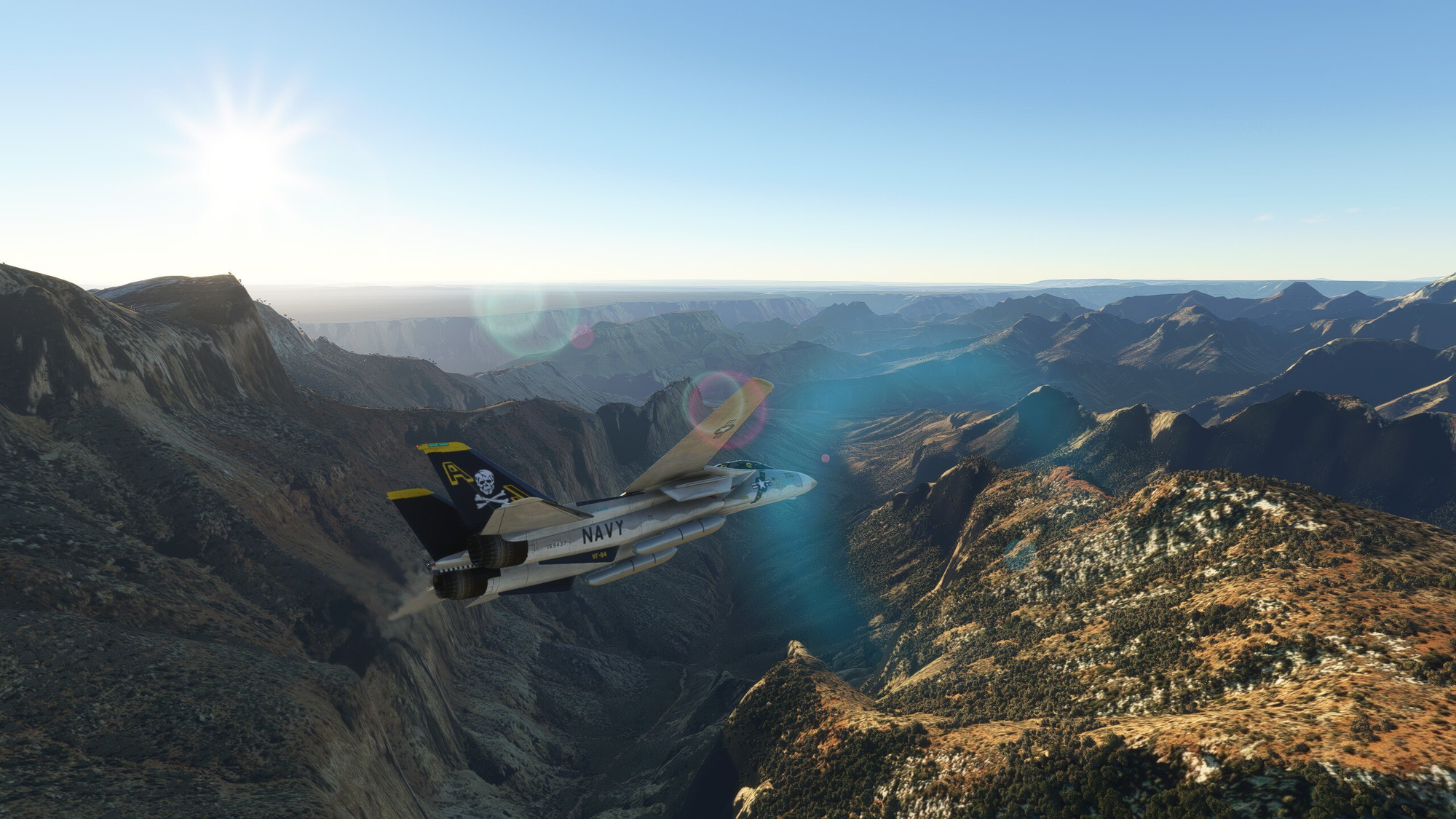
ABOARD U.S.S. INDEPENDENCE — An F-14A Tomcat fighter of Squadron VF-33, on a high-altitude reconnaissance mission over the central Iranian city of Esfahan, was shot down at approximately 9:40 a.m. local time today by what Pentagon officials identified as a Soviet S-300 long-range surface-to-air missile. It is the first downing of an American military aircraft by Soviet weapons since the Vietnam War.
The aircraft, carrying a Tactical Airborne Reconnaissance Pod (TARPS) and operating at approximately 32,000 feet, had been tasked with photographing the disposition of Soviet armored forces entering Esfahan from the north and northwest. According to Navy officials briefing reporters aboard the carrier, the Tomcat was struck while completing a second photographic pass over the city, in what appeared to have been a long-range engagement by an S-300 battery deployed by the Soviets within the perimeter of the captured airbase at Khatami, twenty miles southeast of the city.
The two-man crew was identified as Lt. Cmdr. Robert E. Pennington, 34, of Norfolk, Va., the pilot, and Lt. Michael S. Watson, 28, of Pensacola, Fla., the radar intercept officer. The wingman, a second F-14 from the same squadron flying combat air patrol for the reconnaissance flight, reported "two good chutes" descending into terrain south of Esfahan, but was unable to remain in the area in the face of additional missile launches and was directed by his controller to withdraw. Search-and-rescue resources were not, at the hour of this dispatch, in a position to attempt a recovery, the men's location lying nearly 700 miles from the nearest American forward base.
President Bush was informed of the loss at 1:47 a.m. Washington time, while in the residential quarters of the White House. The President made brief telephone calls to Mrs. Pennington at her home in Virginia Beach and to Mrs. Watson in Pensacola before returning to the Situation Room, where he remained through the small hours of the morning.
Marlin Fitzwater, the President's press secretary, in a statement issued at 7 a.m., declared: "The Soviet Union has now fired upon and brought down an American military aircraft conducting lawful operations in defense of a sovereign nation invaded without provocation. This was not an accident. It was not a misidentification. It was a deliberate act of war by the so-called Emergency Committee in Moscow against the United States of America. The President's response will be made known in due course, and at a time of his choosing."
In Moscow, Tass distributed a brief statement from the Soviet Defense Ministry boasting of the destruction of "an American aggressor aircraft violating the peaceful airspace of the lawful Iranian government." The statement made no reference to the fate of the crew, and gave no answer to repeated inquiries by Western correspondents at the Foreign Ministry as to whether the airmen had been captured. The American Ambassador in Moscow, Jack F. Matlock Jr., was received by the Soviet Foreign Minister Bessmertnykh shortly after noon Moscow time, and emerged from the Foreign Ministry building at Smolenskaya-Sennaya Square without speaking to reporters.
In the United States Senate, Sam Nunn, the chairman of the Armed Services Committee, requested through the Majority Leader an immediate joint session of the Congress for a presidential address, "should the President desire one." The leadership of both parties in both chambers was summoned to the White House for an 11 a.m. meeting. Defense Secretary Cheney, asked by a reporter outside the West Wing whether the President would now seek a declaration of war, said that he had no announcement to make and that the question was one for the President.
DEMONSTRATION IN EAST BERLIN PUT DOWN BRUTALLY BY SOVIET TROOPS, NO EAST GERMAN TROOPS SEEN
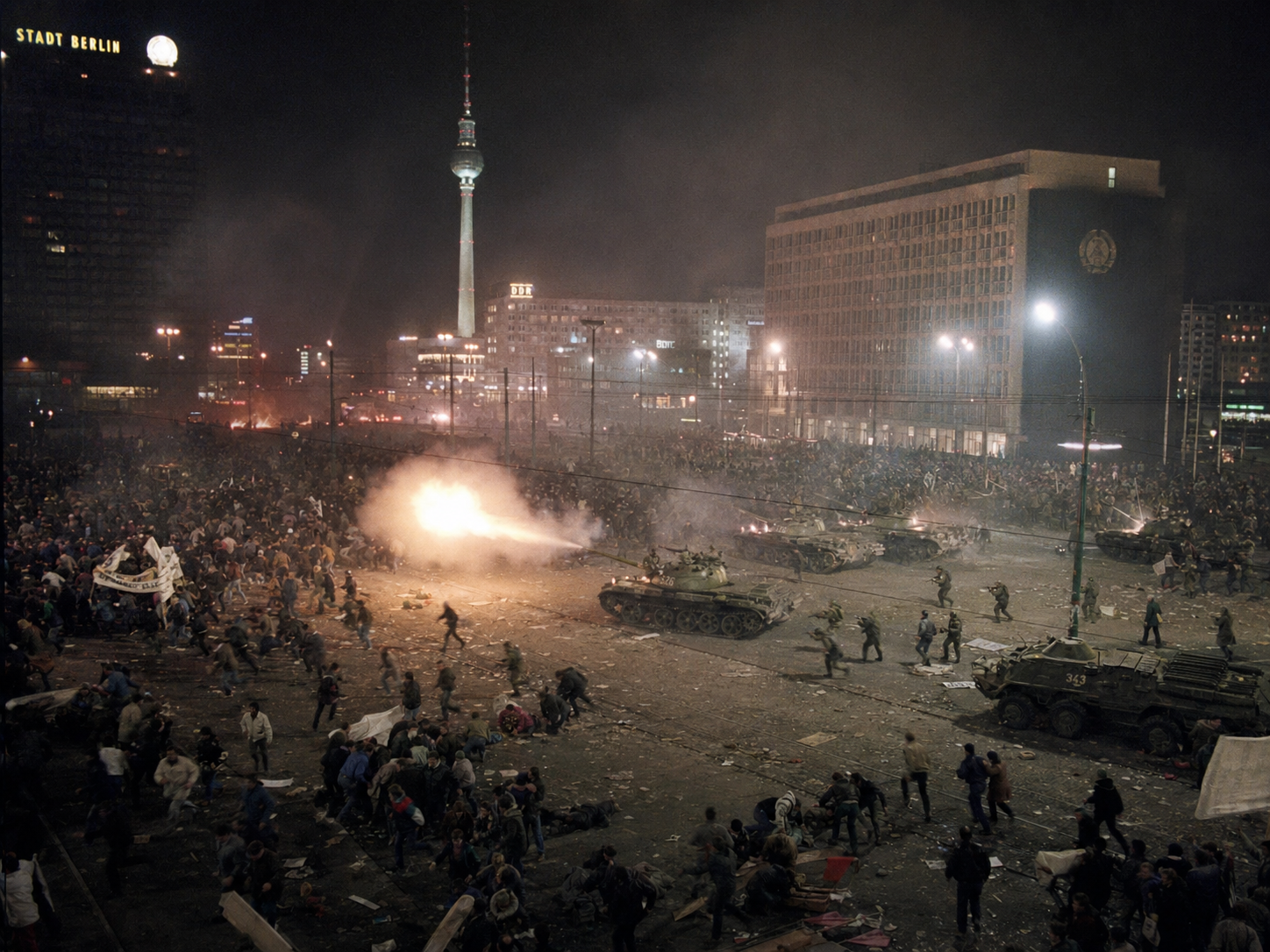
WEST BERLIN — Soviet armored forces of the Group of Soviet Forces, Germany, and they alone, moved against an enormous demonstration in the heart of East Berlin this evening, opening fire with tank cannon and small arms upon a crowd estimated by Western correspondents on the rooftops along Unter den Linden at upwards of 100,000 persons, and leaving the great square at Alexanderplatz, by morning, in the words of one West German radio reporter, "empty, and lit, and not quiet."
The demonstration, called for the early evening by an underground network of East Berlin pastors, university students, and reform-minded officials of the East German League of Culture, had grown through the afternoon to fill Alexanderplatz, the Marx-Engels-Platz, the Lustgarten before the Berlin Cathedral, and the length of Unter den Linden as far west as the Brandenburg Gate, where the demonstrators were halted only by the eastern face of the Berlin Wall. The demands of the crowd, conveyed in handwritten banners and in a declaration read repeatedly through bullhorns, were the restoration of Mr. Gorbachev to his offices in Moscow, the lifting of all restrictions on travel between the two German states, and the immediate resignation of those East German authorities who had concealed the recent flight of Erich Honecker and the assumption of his offices by Egon Krenz, the Politburo member previously responsible for security and youth affairs.
For the first three hours of the demonstration, the East German People's Police (Volkspolizei) and the State Security forces (Stasi) were present in numbers but did not act. The National People's Army (Nationale Volksarmee), and in particular the units of the 1st Motorized Rifle Division at Potsdam-Eiche and the 8th Motorized Rifle Division at Schwerin, which under standing arrangements would have been called upon for civil disturbance duties in the capital, never appeared. Western military observers in West Berlin said, on the basis of signal intercepts whose substance could not be independently verified, that the Defense Minister of the German Democratic Republic, Gen. Heinz Kessler, had issued a deployment order to both divisions in the late afternoon, and that a number of subordinate NVA commanders, including the chief of staff of the Potsdam-Eiche division, had failed to act upon it. By dusk, the fuel and ammunition stocks of two of the implicated barracks had been placed under seal by the divisions' own officers, and the road gates secured against entry as well as exit.
What entered Alexanderplatz at approximately 9:20 p.m., as the long midsummer twilight at last began to fade, was a Soviet tank battalion of T-80 main battle tanks and a regiment of motorized infantry of the 6th Guards Motor Rifle Division of GSFG, accompanied by personnel of the Soviet Military Police. They came from the east, by way of the Karl-Marx-Allee, having staged from the Soviet garrison at Karlshorst.
What followed has been recorded, in part, by the cameras of West German ARD and ZDF television crews positioned on the upper floors of the Hotel Stadt Berlin and the Park Inn, and by the still photographers of three Western news agencies. Tank cannon fire was directed against a column of demonstrators on the south side of the Alexanderplatz, demolishing two trolleybuses and the facade of a department store within which an estimated several hundred persons had taken refuge from earlier rifle fire. Coaxial machine-gun fire was directed against the crowd in front of the Marienkirche. Small-arms fire from the Soviet motorized infantry was directed indiscriminately against fleeing civilians in the streets adjoining the square. By the testimony of one West German cameraman, who has requested that his name be withheld, "an action of a kind that we do not have words for, in our language, since 1945."
By midnight, the square had been cleared. Estimates of the dead, in dispatches reaching West Berlin via the few telephone lines still functioning, ranged from "many hundreds" to "more than a thousand." A field hospital established within the East Berlin university clinic at Charite was overwhelmed by 11 p.m. The morgue facilities of the city were inadequate to the casualty count, and a refrigerated rail siding at the Lichtenberg freight yards was being prepared for the receipt of the dead.
In West Berlin, the Governing Mayor, Walter Momper, declared a state of "civic emergency" and called the citizens of the western half of the city to remain indoors. Crowds nevertheless gathered in the thousands at the Brandenburg Gate, on the Western side, listening through the night to the sounds of intermittent gunfire and the rumble of armor from the East. By 2 a.m., West Berlin police and the Bundesgrenzschutz had begun to receive Eastern citizens who had managed to scale the Wall, or to climb beneath it through the storm sewer system, in numbers not seen in the twenty-eight years since the Wall was erected. They were given coffee, blankets, and, in many cases, the embraces of strangers.
Chancellor Kohl, in a statement issued at 1 a.m. from the Federal Chancellery in Bonn, called the events at Alexanderplatz "a crime against the German people, against Europe, and against humanity," and confirmed that the Federal Republic had recalled its Ambassador from Moscow. Foreign Minister Hans-Dietrich Genscher, departing Cologne-Bonn airport for Brussels and an emergency NATO foreign ministers' meeting, was photographed wiping his eyes as he boarded his aircraft. He declined to take questions.
In Moscow, the Soviet government was silent.
US RESERVES BEGIN TO MOVE TO EUROPE
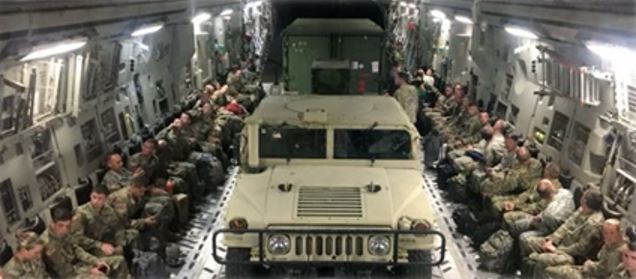
WASHINGTON — President Bush signed an executive order shortly after midnight today authorizing, under Title 10 of the United States Code, the involuntary recall to active duty of as many as 200,000 members of the Selected Reserve and the activation of the Civil Reserve Air Fleet.
The first National Guard and Reserve units to receive activation orders, at hours ranging from 2 to 5 a.m. eastern time, included the 48th Infantry Brigade of the Georgia Army National Guard at Macon; the 256th Infantry Brigade of the Louisiana Army National Guard at Lafayette; the 116th Cavalry Brigade of the Idaho Army National Guard at Boise; and the 197th Infantry Brigade at Fort Benning, the active brigade tasked with rounding out the 24th Infantry Division (Mechanized) on its move to Europe. Air National Guard fighter wings in seventeen states received simultaneous activation orders, including the 119th Fighter Interceptor Group at Fargo, N.D., flying the F-4D Phantom; the 174th Tactical Fighter Wing at Syracuse, N.Y., flying the F-16A; and the 188th Tactical Fighter Group at Fort Smith, Ark., flying the F-16A. Naval Reserve aviation squadrons at Willow Grove, Pa., Atlanta, Ga., and Dallas, Tex., were placed on 24-hour notice to deploy. The Marine Corps Reserve was, in the language of the office of the commandant, "directed to anticipate the requirements of the Marine Corps."
The first lift movements began at 6 a.m., as Civil Reserve Air Fleet aircraft, Boeing 747 and Lockheed L-1011 wide-bodies belonging to Pan American World Airways, Trans World Airlines, Northwest Airlines, and United, appeared at Dover Air Force Base in Delaware, McGuire AFB in New Jersey, and Travis AFB in California to begin the airlift of the lead elements of the 24th Infantry Division (Mechanized) from Fort Stewart, Ga., and of the III Corps from Fort Hood, Tex. It was the first activation of the Civil Reserve Air Fleet in its 38-year history. Heavy equipment for the deploying formations is to be drawn from the four POMCUS depots in West Germany, at Mönchengladbach, Kaiserslautern, Pirmasens, and Zutendaal in Belgium, where the equipment of as many as six American divisions has been prepositioned since the early 1980s for precisely such a contingency.
Concurrently, the heavy lift of the Military Airlift Command, the C-141B Starlifters of the 437th Military Airlift Wing at Charleston, S.C., the C-5A and C-5B Galaxies of the 60th MAW at Travis and the 436th MAW at Dover, surged to a sortie rate the system has never before sustained. KC-10 and KC-135 tankers of the Strategic Air Command were placed on continuous orbits over the Atlantic to support the bomber and fighter movements. The Pentagon spokesman, Pete Williams, reading from a prepared statement, said that "by midnight tonight, two American mechanized brigades, one airborne brigade combat team, and four tactical fighter wings will have moved or commenced movement to airfields in the Federal Republic of Germany, Belgium, the Netherlands, the United Kingdom, and Italy."
The destinations on the European side included, in addition to the principal American bases at Frankfurt, Ramstein, Rhein-Main, Spangdahlem, Lakenheath, and Aviano, several West German civilian airports, Hahn, Hannover, and Stuttgart-Echterdingen, opened to American military traffic by emergency arrangement with the Federal government overnight.
The Defense Production Act of 1950, last invoked at meaningful scale during the Korean War, was activated by the President in a separate executive order, with provisions for the priority allocation of fuel, transport capacity, and certain industrial materials to the requirements of the Department of Defense. American railroads were notified, industry sources said, to begin the staging of military equipment trains from Fort Hood, Fort Stewart, Fort Riley, and Fort Carson toward the East Coast ports of Norfolk, Charleston, and Bayonne, where the Ready Reserve Force of the Maritime Administration, a fleet of 96 cargo and roll-on/roll-off vessels held in inactive status against precisely such an emergency, was being raised to operational status, the breakout having begun at midnight.
In Stuttgart, Gen. John R. Galvin, the Supreme Allied Commander Europe, addressed an extraordinary meeting of NATO Military Committee representatives and announced that the Alliance had moved to the second-highest level of military readiness, designated "Simple Alert," for the first time in its forty-year history. The highest level, "General Alert," is, by NATO doctrine, "indistinguishable from the eve of war."
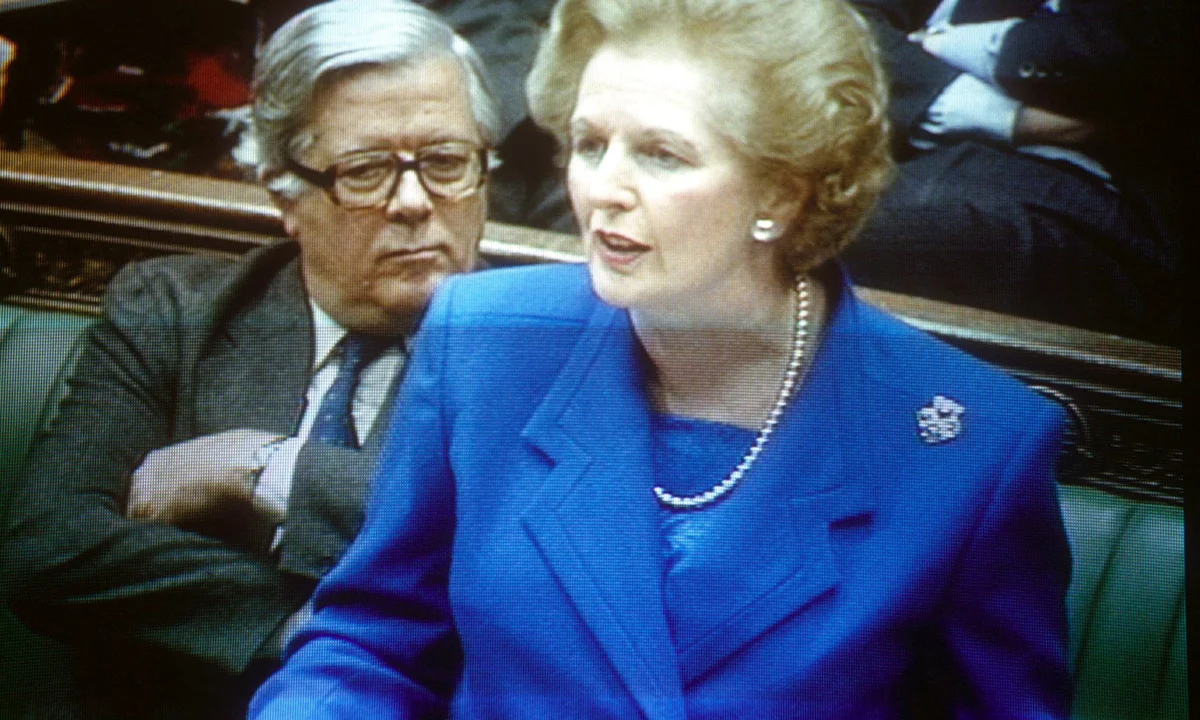
In London, Prime Minister Thatcher, in a statement to the House of Commons, announced the recall of regular reservists of the British Army of the Rhine and the dispatch of additional Royal Air Force squadrons to the Continent. Defence Secretary George Younger confirmed that the Tornado strike squadrons of RAF Strike Command had been dispersed to alternate airfields, and that the Royal Navy's Polaris ballistic missile submarines were "in such postures as the Government considers appropriate to the situation." In Paris, President Mitterrand, in a televised address that has no known precedent in the Fifth Republic, announced that France, though long withdrawn from the integrated military command of NATO, would "stand with her Atlantic allies in this hour, fully and without reservation," and confirmed that elements of the Forces Aériennes Stratégiques, including the Mirage IVP bombers carrying the air-to-surface nuclear missile ASMP, had been placed at heightened alert. The exact nature of that alert, in particular as it concerned the French independent nuclear deterrent, was not stated.
In a separate development, the United States Strategic Air Command was reported by aviation observers in the vicinity of Offutt Air Force Base, Neb., to have raised its alert posture to the second-highest of the Pentagon's five Defense Conditions, DEFCON 2, the level last reached during the Cuban Missile Crisis of October 1962, and never since.
June 24, 1989
US STRIKES SOVIET ARMOR COLUMN MOVING TOWARDS US UNITS, AIRBASE BELIEVED TO HOST SOVIET AIR FORCE WING
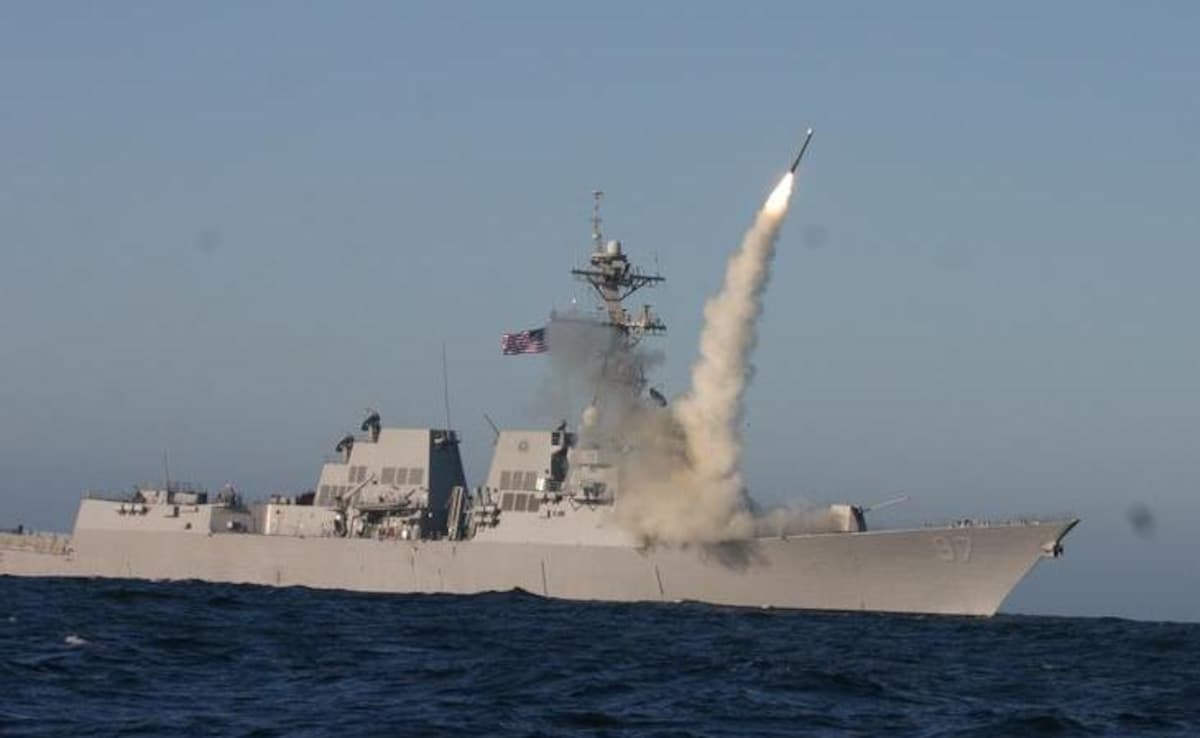
WASHINGTON — In the early hours of this morning, 47 hours after a Soviet S-300 missile brought down an American F-14 over Esfahan, the United States carried out a series of co-ordinated air and missile strikes against the Soviet airbase from which that engagement was directed and against a Soviet armored column advancing in the direction of American positions in the central Iranian desert, in what the Pentagon described as "the opening phase of a co-ordinated American military response to Soviet aggression in Iran."
The principal strike, executed shortly after 2 a.m. local time at Khatami air base southeast of Esfahan, was opened by an aircraft category whose existence the Pentagon publicly acknowledged only in November of last year, the F-117A "Nighthawk," the so-called stealth fighter of the 4450th Tactical Group at Tonopah Test Range Airfield in Nevada. Pentagon officials, in a 7 a.m. briefing, confirmed that six F-117As, deployed by way of an undisclosed forward base, struck the air operations center, the SA-10 missile control bunker, and the hardened aircraft shelters housing what American intelligence had identified as a regiment of Soviet MiG-29 fighters of the 33rd Fighter Aviation Regiment, transferred to Iran from its peacetime base at Wittstock in the German Democratic Republic. The Nighthawks employed laser-guided 2,000-pound bombs against each target. The Pentagon said that "all aircraft expended ordnance, all aircraft returned safely."
The strike on the airbase was preceded, by approximately twelve minutes, by 28 BGM-109 Tomahawk land-attack cruise missiles fired from the destroyer U.S.S. Fife and the cruiser U.S.S. Bunker Hill in the Gulf of Oman. The Tomahawks, in their first combat use, were directed against the radar arrays of the SA-10 site, the runways and taxiways of the airbase, and fuel and ammunition storage at three additional locations. The Pentagon said preliminary battle damage assessment, conducted in the hour after the strike, indicated "extensive damage to the targeted facilities and effective neutralization of the air-defense threat at Esfahan."
Concurrently, a separate strike package consisting of 18 A-6E Intruders and F/A-18C Hornets of Carrier Air Wing Six, flying from the U.S.S. Independence and supported by EA-6B Prowler jamming aircraft, attacked elements of the Soviet 4th Combined Arms Army identified by reconnaissance as the lead regiment of the 75th Motor Rifle Division, then advancing south of the city of Yazd toward the screening positions of the American 101st Airborne Division at Bafq. The Pentagon said the column had been "dispersed and substantially destroyed" by air-delivered cluster munitions and Maverick missiles, with secondary explosions consistent with the destruction of fuel and ammunition vehicles observed at multiple points along a 14-mile stretch of the Yazd-Kerman highway. American aircraft losses in the engagement were given as one A-6E, downed by a shoulder-fired SA-14 missile while egressing the target area at low altitude. The crew, identified as Lt. James L. Carragher and Lt. (j.g.) Daniel P. Boucher, ejected and were recovered within ninety minutes by a Combat Search and Rescue team operating from Bandar Abbas.
A third strike, conducted in the same window by six B-52G bombers of the 2d Bombardment Wing operating from Diego Garcia and refueled by KC-10 tankers of the 22d Air Refueling Wing, dropped conventional ordnance on a Soviet logistics complex established at the captured airfield at Doshan Tappeh in eastern Tehran. The Pentagon described the target as "a major node of the Soviet line of communications into Iran." Damage assessment was incomplete at the hour of the briefing.
In Moscow, the Emergency Committee announced through Tass that Soviet forces had "repulsed an act of barbarous aggression," and claimed the destruction of "a number of American aircraft," a figure that grew in subsequent broadcasts from four to seven to twelve. No Soviet broadcast acknowledged damage at Khatami or at any other site. A communique read at noon by the Soviet Ministry of Defense did, however, declare that "consequences of the gravest character must now follow," and warned that Soviet armed forces had been authorized "the full range of measures provided to them by Soviet doctrine."
The Pentagon spokesman, Pete Williams, asked at the close of the morning briefing whether the strike represented the limit of the American response or its beginning, replied that he would characterize it as a response, and that he had nothing further.
The fate of Lt. Cmdr. Pennington and Lt. Watson, the two-man crew of the F-14 lost on Friday, remained unknown. The Pentagon said it had no information to indicate either officer was in Soviet custody, but neither did it have information to the contrary. A Pentagon official, asked whether Khatami had been chosen for retaliation in part because the airmen were believed to be held there, replied: "We chose Khatami because Khatami fired the missile that brought them down."
BUSH APPEARS BEFORE CONGRESS, MAKES WAR POWERS RESOLUTION DECLARATION
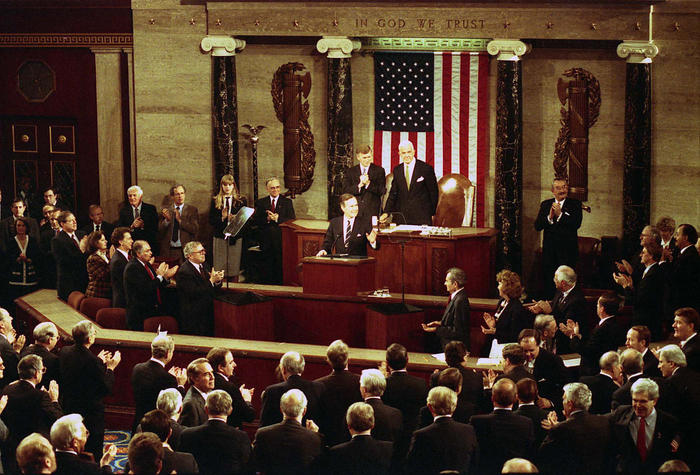
WASHINGTON — President Bush, appearing this evening before a joint session of the Congress in the chamber of the House of Representatives, formally notified the legislative branch under the War Powers Resolution of 1973 that American armed forces had been introduced into hostilities with the armed forces of the Soviet Union, and asked the Congress to enact, by joint resolution, an authorization for the use of United States armed forces "to repel and to defeat the aggression of the so-called Emergency Committee in Moscow against the Iranian nation, against the Polish nation, against the German nation, and against any other nation upon which the said Committee may yet make war."
The address, delivered at 8:34 p.m. and lasting 27 minutes, was met with applause whose duration and unanimity, in the recollection of veteran Capitol observers, had been equalled in this chamber only by the speech of Roosevelt of December 8, 1941. Members of both parties stood as the President entered, and stood again at his departure. Speaker Foley and Vice President Quayle, presiding, sat behind him.
The President began by reading the names of those Americans killed or whose fate was unknown in the four days since the war began: Lt. Cmdr. Robert E. Pennington and Lt. Michael S. Watson, missing over Esfahan; the two airmen of the A-6E recovered alive at Bafq; the names of three Marines killed by Soviet long-range artillery at the perimeter of Bandar Abbas in the early hours of the morning, of whose deaths the President's audience learned for the first time. He spoke each name slowly, and paused after each. The chamber was, in the description of one correspondent in the gallery, "more silent than I have ever heard it."
"My fellow Americans," the President continued, "and members of the Congress: I have not asked you here this evening for a declaration of war. I have considered it. I have weighed it. I have rejected it, and I shall give you my reasons.
"A declaration of war would dignify with the title of government a clique of men in the Kremlin who have seized power by force, who have murdered Boris Yeltsin in the snow of a Moscow park, who have buried we know not how many Lithuanians in the streets of Vilnius, who have shot down the people of Berlin in the square that bears the name of Alexander, who have laid violent hands upon Mikhail Gorbachev, the lawful President of the Soviet Union. The men of the so-called Emergency Committee are not a government. They are a junta."
Here the President stopped, and looked up from his text, and did not return to it for some seconds.
"I sat with that man. Five weeks ago. As a friend. And they have laid hands on him."
"The United States does not declare war against juntas. The United States dismantles them.
"I ask therefore, by joint resolution and not by declaration, that this Congress authorize the President of the United States to employ the armed forces of the United States as he shall judge necessary and appropriate to bring about the prompt and unconditional withdrawal of all Soviet forces from the territory of Iran; the prompt and unconditional restoration of the lawful government of the Polish People's Republic, headed by Tadeusz Mazowiecki; the prompt and unconditional release from custody of every Soviet, Polish, German, Czechoslovak, Lithuanian, Latvian, Estonian, and Iranian citizen now detained for the offense of seeking the self-government of his own country; and the prompt and unconditional release of Mikhail Sergeyevich Gorbachev to the offices to which he was lawfully elected by the Congress of People's Deputies of the Soviet Union."
The President went on, in language his aides said had been worked over by his own hand through the late afternoon, to describe the operations conducted by American forces in the previous twelve hours; to confirm that the Strategic Air Command had been raised to DEFCON 2; to confirm that he had today authorized the activation of additional reserve components and the transfer of further regular forces to Europe; and to acknowledge, in a passage that drew the longest single ovation of the evening, "the steadfastness of our allies, of Britain, of France, of the Federal Republic of Germany, of Canada, of Italy, of the Netherlands, of Belgium, of Luxembourg, of Denmark, of Norway, of Iceland, of Portugal, of Greece, and yes, of Turkey, who shares an unhappy frontier with the present source of the trouble in our world."
The President closed:
"We did not seek this hour. We did not desire it. We have not in the lifetime of any of us in this chamber sought a war with the Russian people, nor do we seek one now. The Russian people are not our enemies. They are, today, in this terrible moment, our fellow captives. The men in the Kremlin are the captors of us all. We shall set the captives free, and we shall do it together, and when it is done we shall return to our homes and our families and our peaceful pursuits, knowing that we have once again, by the grace of God and the strength of free men, kept the candle alight.
"Thank you. May God bless the United States of America, and may God bless those, of every nation, who tonight require His protection."
The chamber rose for the third time as the President turned to leave. The standing ovation was timed by a Senate aide at six minutes and forty-one seconds.
Senate Majority Leader George J. Mitchell announced shortly after the President's departure that the Senate would convene at 9 a.m. tomorrow to take up the requested joint resolution, and that Republican and Democratic leaders had agreed upon a single managers' bill, to be debated under a unanimous consent agreement limiting amendments and providing for a final vote not later than midnight Saturday. Speaker Foley announced parallel proceedings in the House. Both leaders predicted passage by overwhelming majorities. Sen. Robert C. Byrd of West Virginia, the President pro tempore, offered to suspend the customary requirement of three readings. Sen. Mitchell, asked by a reporter whether he expected any opposition, replied: "I expect honorable men to vote their consciences. I expect, when they have done so, that the resolution will pass."
PROTESTS TURN INTO RESISTANCE IN POLAND, EAST GERMANY, CZECHOSLOVAKIA
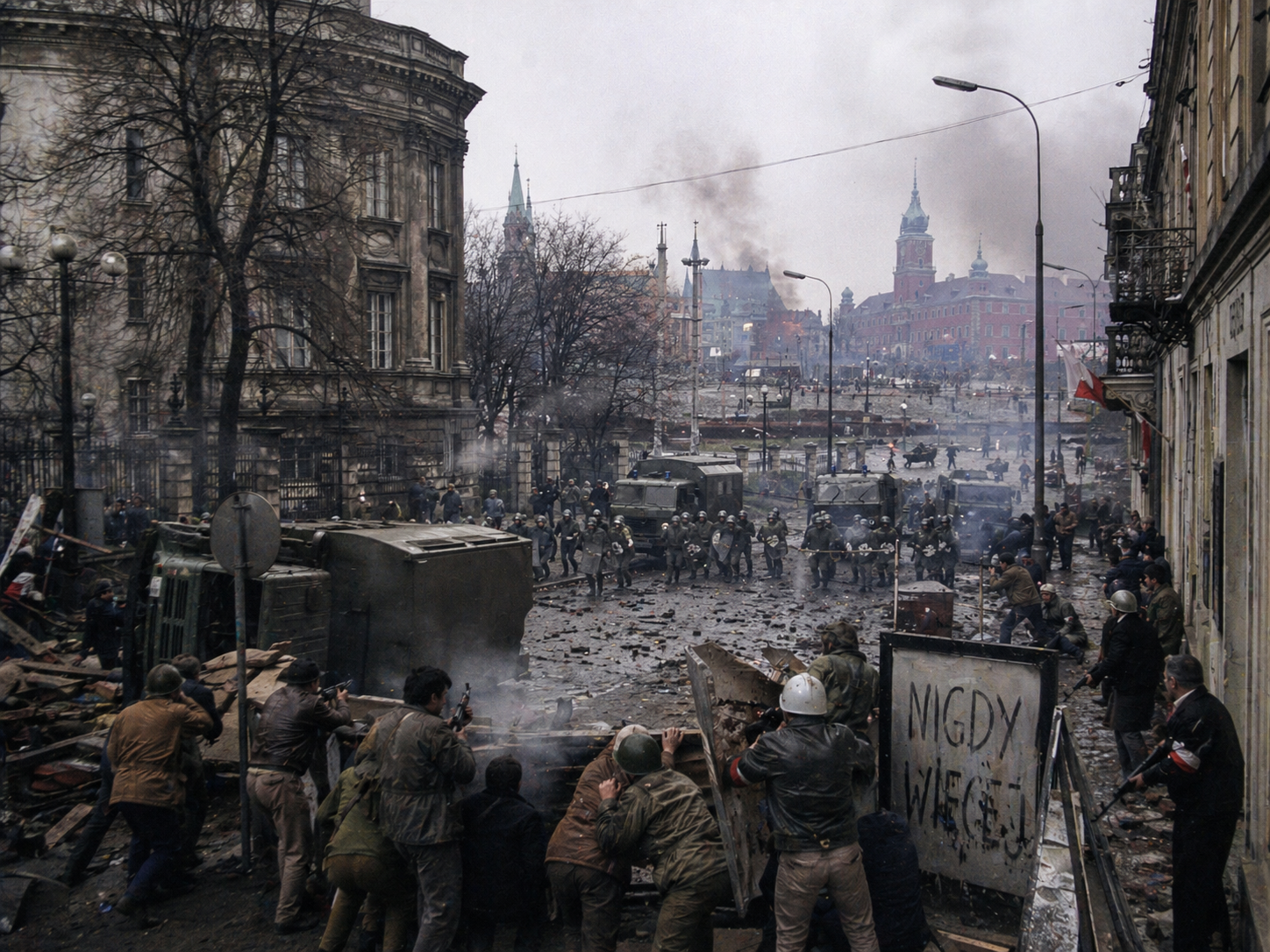
VIENNA — The wave of demonstrations that has swept the capitals of Eastern Europe in the week since the Moscow coup passed today, in three of those capitals, across a threshold that had not been crossed in any of them since the Hungarian rising of 1956: the threshold from protest to organized armed resistance against a Communist state.
In Warsaw, Western embassies on Aleje Ujazdowskie reported continuous small-arms fire through the morning from the direction of the Royal Castle and the Old Town, where a force of unknown size, thought to consist of former officers of the Polish Army loyal to the deposed Mazowiecki government together with veterans of the Solidarity underground of the 1980s, has seized and held a number of buildings against attempts at recapture by units of the Internal Defense Forces and the ZOMO motorized police. Polish state radio and television, which since dawn have broadcast nothing but classical music and the daily address of Gen. Siwicki, made no reference to any disturbance in the capital. The British Embassy reported, however, that as many as 2,000 civilians had taken refuge in the parish churches of the Old Town overnight, that food was being distributed to them by the priests, and that Solidarity tricolors had been raised from the towers of St. John's Cathedral and St. Martin's at first light. The whereabouts of Zbigniew Bujak, the underground organizer who reached the United States Embassy on the night of the coup, were said by the embassy to be "no longer here."
The fighting in Warsaw was described by one Western diplomat reaching the Vienna bureau of Reuters by telephone: "Militarily it is nothing. Politically it is everything, because once again there is shooting in the streets of Warsaw, and once again the Polish People's Army has produced no answer but more shooting." Reports, none of them confirmed, suggested that elements of the 6th Pomeranian Airborne Brigade at Krakow and of the 12th Mechanized Division at Szczecin had refused orders to deploy against the resistance, and had been confined to their barracks by the decision of their own officers. The Defense Ministry in Warsaw made no comment.
In East Berlin, the disintegration of the German Democratic Republic, which began with the refusal of the National People's Army to fire upon its own citizens at Alexanderplatz on Friday evening, today became plain. Soldiers of the NVA Wachregiment "Friedrich Engels," the ceremonial unit responsible for the changing of the watch at the Neue Wache war memorial on Unter den Linden, marched at noon in formation and in uniform from their barracks at Adlershof to the Brandenburg Gate, where their commanding officer, an Oberstleutnant whose name has not been confirmed, ordered the gates of the Wall opened from the eastern side. The Volkspolizei manning the checkpoint, after a hesitation reported by one West Berlin correspondent as lasting "perhaps fifteen seconds, perhaps a minute, perhaps the length of forty years," stepped aside.
Within an hour, the citizens of East Berlin were passing through the Brandenburg Gate by the thousand, and West Berliners were passing in the other direction with embraces, with tears, with bottles of Sekt, and with the small flags of every Western country and of none. By evening, similar scenes had been reported at Checkpoint Charlie, at Bornholmer Strasse, at Heinrich-Heine-Strasse, and at the pedestrian crossing on Friedrichstrasse, where a Soviet armored unit attempting to redeploy from the Karlshorst garrison toward the Wall was blocked by a crowd of perhaps 30,000 East and West Berliners, and compelled, after some hours, to withdraw without firing. Whether the order to withhold fire originated with the unit commander, his division commander, or the headquarters of the Group of Soviet Forces, Germany, was not known.
The whereabouts of Egon Krenz, the East German leader installed in succession to Erich Honecker on the day of the Moscow coup, were not known this evening. The Defense Minister, Gen. Heinz Kessler, has been taken into protective custody by his own subordinates at Strausberg headquarters, and is cooperating with what was variously described as "a transitional command" and "a soldiers' council." Markus Wolf, the chief of the Stasi's foreign intelligence directorate until his retirement in 1986 and a known reformer, was seen this afternoon in conversation with a deputy of the West German Foreign Minister Genscher at a private residence in Pankow. Erich Mielke, the 81-year-old chief of the Stasi proper, has barricaded himself within Stasi headquarters at Normannenstrasse with several hundred loyal officers, and is destroying files.
In Prague, where demonstrations on Wenceslas Square through the week had grown from thousands to tens of thousands and today, by the estimate of Western correspondents present, to upwards of half a million, the regime of Milos Jakes has ceased to exercise effective control of the Czechoslovak capital. The Czechoslovak People's Army, the second-largest of the Warsaw Pact armies after the Soviet, did not move against the demonstration. The People's Militia, the armed factory militia that has historically served as the regime's praetorian guard, voted in open assembly in three separate Prague factories to refuse orders to deploy. Vaclav Havel, the playwright and Charter 77 signatory released from prison only in May, addressed the crowd from the balcony of the Melantrich publishing house at 6 p.m., flanked by Alexander Dubcek, the deposed reformer of the Prague Spring of 1968, who had not been seen in public in Prague in twenty-one years. Havel told the crowd: "Truth and love must triumph over lies and hatred." Dubcek, weeping, said only: "I am home."
In Bratislava, in Brno, in Plzen, in Ostrava, in Kosice, similar scenes were reported. Sources within the Czechoslovak Foreign Ministry told Western correspondents that Mr. Jakes and several members of the Politburo had this evening departed Prague for an undisclosed location, and that Premier Ladislav Adamec had begun consultations with representatives of Charter 77 and of the Civic Forum movement, founded only this morning in the auditorium of the Cinoherni Klub theater, regarding "an orderly transfer of authority."
In Bucharest, by contrast, President Nicolae Ceausescu, in a speech of unusual length and fury, condemned "the criminal adventures of imperialist agents in fraternal socialist countries" and pledged that "the people of Romania, under the leadership of their Communist Party, shall not waver." In Sofia, the government of Todor Zhivkov maintained silence. In Budapest, where the Hungarian Socialist Workers' Party has been since May moving openly toward multiparty elections, Prime Minister Miklos Nemeth opened the country's borders to all Czechoslovak, Polish, and East German citizens "without formality, without condition, without delay."
In Moscow, the so-called Emergency Committee has been in continuous session for more than thirty hours, according to sources within the Foreign Ministry.
IN BAGHDAD, A VERY QUIET SADDAM HUSSEIN HOSTS KUWAITI AMBASSADOR
BAGHDAD — President Saddam Hussein of Iraq, who has not appeared in public or made any public statement since the Soviet invasion of Iran six days ago, received the Ambassador of the State of Kuwait at his guest palace on the Tigris this afternoon for a meeting that the official Iraqi News Agency put at three hours, that sources within the Iraqi Foreign Ministry put closer to five, and concerning the substance of which neither government has been willing to disclose anything.
The Ambassador, accompanied by the Kuwaiti military attaché and a single political officer, arrived at the palace shortly after 2 p.m. He left after dark, carrying with him a sealed envelope, and proceeded directly to the airport at Al Muthanna, where he departed for Kuwait City aboard an aircraft of the Kuwaiti Air Force, having declined, through his press attaché, to take questions from the small number of Western journalists who had gathered at the perimeter of the field.
The meeting was the third Mr. Hussein has held in 48 hours with senior representatives of the Arab governments of the Persian Gulf. Sources within the Iraqi Ministry of Foreign Affairs, speaking on terms of strict anonymity, indicated that an emissary of King Fahd of Saudi Arabia had been received on Thursday evening, and that the Foreign Minister of the United Arab Emirates had been received yesterday morning. In each case, the Iraqi readout was substantially identical to today's: a meeting of unspecified length, on subjects of "fraternal Arab concern," of which "the substance shall not be disclosed."
The Iraqi armed forces have, since the Soviet invasion of Iran, taken no action of which any indication has reached Western intelligence services. No mobilization has been ordered. No reservists have been called. No Iraqi armored or mechanized formation has departed its peacetime garrison. The Iraqi Air Force has flown its normal training schedule. The four divisions of the Iraqi army deployed along the Iranian frontier, a frontier whose nearer side the Soviet Union now occupies, and whose further side the Soviet Union would seem rapidly to be approaching, remain, by all indications, in routine garrison.
Saddam Hussein himself has been seen by the Iraqi public exactly once since June 18: in a single still photograph, distributed by the official news agency on Wednesday, depicting him at his desk in military uniform, attending to papers. The photograph was undated. Tariq Aziz, the Foreign Minister, has appeared at the Foreign Ministry on each working day but has issued no statement. Izzat Ibrahim al-Douri, the Vice Chairman of the Revolutionary Command Council, has not been seen.
Western diplomats in Baghdad were inclined to read the Iraqi posture as one of "characteristic ambiguity." A senior European diplomat, speaking on background, observed: "Saddam Hussein has spent eight years fighting Iran, six months trying to extract money from the Saudis and the Kuwaitis, and a lifetime preparing not to be on the losing side of any conflict. He is doing none of those things this week. He is sitting in his palace. He is receiving ambassadors. He is saying nothing."
In Riyadh, in Cairo, in Damascus, and in Amman, the silence of Baghdad was the most discussed silence in a region of unusual silences. President Mubarak of Egypt spoke twice today by telephone with Mr. Hussein, the second of those calls lasting more than an hour. The content of the calls was not disclosed.
JUNE 25, 1989
US AND SOVIET TROOPS CLASH IN SOUTHERN IRAN, NO WORD ON OUTCOME

WASHINGTON — In what the Pentagon described tonight as "a substantial engagement of arms between the regular forces of the United States and of the Soviet Union," elements of the 101st Airborne Division (Air Assault) clashed with the leading regiment of a Soviet mechanized division in the open desert north of the city of Bafq, in central Iran, beginning shortly after dawn local time today and continuing in scattered actions until past nightfall.
Few details of the engagement, of its outcome, or of the casualties incurred on either side were available at the hour of this dispatch. Pentagon officials, in a midnight briefing of unusual brevity, declined to identify the Soviet formation involved beyond confirming that it was a motor rifle regiment of the 4th Combined Arms Army of the Soviet Transcaucasus Military District, that it was equipped with the T-72 main battle tank and the BMP-2 infantry combat vehicle, and that it had been advancing south on the Yazd-Kerman highway when intercepted. They confirmed the participation, on the American side, of two attack helicopter battalions of the 101st Aviation Brigade flying the AH-64A Apache, of the divisional artillery, and of dismounted infantry of the 1st Brigade Combat Team in screening positions along the road and in defilade among the low ridgelines that flank it.
Maj. Gen. J. H. Binford Peay III, the commanding general of the 101st, directed the engagement personally from a forward command post established overnight at a salt flat designated only as "Objective ANVIL," approximately 40 miles south of the contact point. Of the Soviet field commander, no information was offered.
Sketchy accounts of the action reached the wire services over the course of the day from a small pool of correspondents traveling with the division, who were permitted to file under unusually tight constraints. The first Apache engagements began at 5:47 a.m. local time, the helicopters rising from cover in the predawn light to engage the lead Soviet armored elements with AGM-114 Hellfire missiles at ranges of five to seven kilometers. Multiple secondary explosions, consistent with the destruction of T-72 tanks, were observed within the first 15 minutes of the engagement. The pool report, filed at 9 a.m. and cleared by Army public affairs officers shortly before noon, described "a column on the desert floor that no longer moves except as wreckage burns."
The Soviet response, when it came, was swift and substantial. Mi-24 attack helicopters of the army's organic aviation regiment, operating in pairs, engaged the American helicopters at low altitude beginning at approximately 6:30 a.m. Soviet artillery, believed to consist of 2S3 self-propelled 152mm howitzers and BM-22 multiple rocket launchers, opened fire on the suspected American positions across a 20-kilometer front, suppressing the dismounted infantry and forcing the Apache battalions to displace to alternate forward arming and refueling points. ZSU-23-4 Shilka antiaircraft guns and SA-13 short-range surface-to-air missiles, integrated with the Soviet column, engaged American helicopters at multiple points. The pool report referred, without elaboration, to "the loss of American aviators." The Pentagon, in its midnight briefing, declined to confirm or deny aircraft losses, citing "operations still in execution."
By midafternoon the action had broken into a series of dispersed engagements across an expanse of desert estimated at 600 square kilometers. Apache flights and Soviet helicopter elements maneuvered against each other over open terrain. Soviet motor rifle battalions, dismounting from their BMPs in the face of the antiarmor fire, attempted to close on the American screening positions on foot. Tactical air support, in the form of A-10 Thunderbolt II aircraft of the United States Air Force operating from a forward strip at Bandar Abbas, arrived over the battlefield in the late morning and again in the late afternoon. By dusk the firing had largely subsided, the Soviet column had ceased its forward movement, and the American forces had withdrawn approximately 30 kilometers to the south.
In Moscow, the Emergency Committee broadcast claims through Tass of the destruction of "tens of American helicopters" and of "the rout of an American airborne brigade." No accompanying imagery was provided. The Soviet broadcast made no mention of casualties on its own side.
In Washington, Mr. Williams, asked at the close of his briefing to characterize the day's outcome, said that the engagement was continuing, that battle damage assessment was incomplete, and that he would not characterize it further. Asked a second time, he said the families of the men engaged would hear the names from their own commanders and not from a podium.
A senior Pentagon official, speaking on background after the briefing, was less reserved. "We hit them harder than they hit us," the official said. "But we hit them with our best, and they hit us with what they had on the road. That's something to think about. That's something we are thinking about."
SOVIET MISSILE STRIKE ON DIEGO GARCIA SHOT DOWN BY NEW "PATRIOT" MISSILE BATTERY
DIEGO GARCIA, British Indian Ocean Territory — A salvo of fourteen Soviet long-range air-launched cruise missiles, fired at this remote Anglo-American base in the central Indian Ocean from the cabin doors of Tu-95 strategic bombers operating at the limit of their unrefueled range over the northern Arabian Sea, was engaged and largely destroyed by a battery of MIM-104 Patriot surface-to-air missiles in the first combat employment of the Patriot system, and the first interception of a strategic weapon in flight by any defensive system.
The strike, which Pentagon officials said had been detected in its earliest phases by an E-3 AWACS aircraft on continuous patrol over the central Indian Ocean and by an over-the-horizon radar facility on the Australian mainland, was launched at approximately 11:20 local time by a flight of six Tu-95MS Bear-H bombers identified by the AWACS as having staged from the Soviet airbase at Mozdok in the northern Caucasus, transited Iranian airspace, refueled in flight from Il-78 tankers operating from Mehrabad, and reached a launch point approximately 1,800 nautical miles north of Diego Garcia before releasing their ordnance and turning north for return.
The fourteen AS-15 Kent cruise missiles released, each carrying a conventional high-explosive warhead by the Pentagon's later assessment, descended upon launch to low altitude and proceeded toward Diego Garcia at approximately 500 knots, navigating, in the manner of their American Tomahawk counterparts, by reference to internal terrain-comparison and inertial guidance. Their flight time, after release, was approximately three hours and forty minutes. They were tracked through that flight, almost continuously, by the AWACS, by the destroyer U.S.S. Spruance positioned 200 miles north of the atoll on radar picket duty, and in the final phase by the AN/MPQ-53 phased-array radar of Battery A, 2d Battalion, 7th Air Defense Artillery, a Patriot battery transferred from Fort Bliss, Texas, by C-5 transport over the previous 36 hours, and declared operational at Diego Garcia, in what its commander would later describe as "uncomfortably good time," at 6:30 a.m. local on the morning of the strike.
Two F-15C Eagle fighters of the 71st Tactical Fighter Squadron, vectored from Diego Garcia to engage the inbound missiles in their terminal phase, accounted for two of the cruise missiles by AIM-7 Sparrow shot at the eastern edge of the engagement envelope. A third was destroyed by an AIM-9M Sidewinder fired from one of the same aircraft at closer range.
The remaining eleven missiles entered the engagement zone of the Patriot battery shortly before 3 p.m. local time. The battery, commanded by Capt. Margaret S. Holloway, 29, of Hampton, Virginia, engaged each of the inbound missiles with two Patriot interceptors fired in salvo. Pentagon officials, citing preliminary analysis from the battery's automated engagement record, reported that ten of the eleven incoming missiles were destroyed in the air at altitudes between 500 and 8,000 feet, at ranges of between four and twenty-eight kilometers from the battery position. The eleventh missile descended to wave-top altitude at the limit of the battery's engagement envelope and impacted the lagoon approximately three nautical miles short of the airfield, detonating in shallow water without inflicting material damage.
Diego Garcia's runway, fuel storage, ammunition storage, and the six B-52G bombers of the 2d Bombardment Wing then standing on the airfield were undamaged. No American or British personnel were injured. A single Patriot interceptor failed in flight and fell into the sea ten kilometers from the launcher; the malfunction is under investigation. The Patriot battery expended 22 of its 32 ready missiles in the engagement.
In a Pentagon briefing convened within the hour, the Secretary of Defense, Richard B. Cheney, appeared in person beside the Patriot program manager, Brig. Gen. Charles W. McManus of the United States Army Missile Command, to confirm the result.
"This morning the Soviet government attempted to destroy a base of the United States, manned by Americans and our British allies, with weapons of mass effect launched at trans-oceanic range," Mr. Cheney said. "This afternoon, by the skill of American soldiers and the excellence of American technology, those weapons lie at the bottom of the Indian Ocean. Capt. Holloway's battery expended twenty-two missiles to stop eleven. That is the arithmetic of the war the Soviet government has chosen, and I would ask the American people to consider it."
In Mozdok, the home base of the Soviet 184th Heavy Bomber Aviation Regiment from which the strike package had originated, three of the six Tu-95s that had returned from the mission were destroyed on the ground at 7:14 p.m. Moscow time by Tomahawk cruise missiles fired from the U.S.S. Mississippi, a nuclear-powered cruiser then in the eastern Mediterranean, in the first American strike on Soviet soil. The remaining three aircraft of the strike package, the Pentagon said, had not yet returned from the mission and were considered "unlikely to do so." Pentagon officials, asked whether the Mozdok strike represented retaliation or coincidence, replied that the United States did not engage in coincidences.
IN SOVIET UKRAINE, A RESISTANCE GROWS
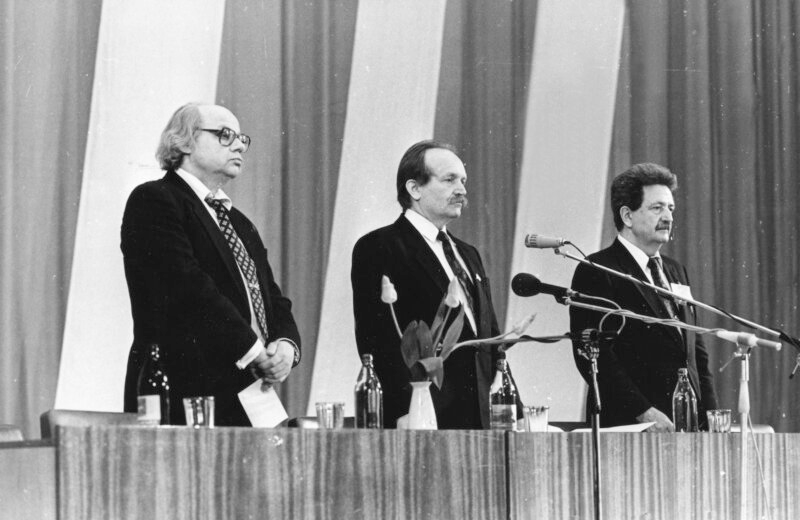
LVIV, Ukrainian S.S.R. — Across the western half of this republic of 52 million souls, in cities whose names have figured in the chronicles of Eastern European resistance for half a millennium and in factories and coal mines whose workers had been thought, in the orthodoxy of Communist scholarship, to be the regime's most loyal constituency, an organized resistance to the rule of the so-called Emergency Committee in Moscow has emerged in the eight days since the coup, and has by today reached such a scale that Western diplomats in Moscow described it, in conversations with this correspondent over a circuitous telephone connection through Helsinki, as "the most serious challenge to Soviet authority inside the Russian state since 1956."
In Lviv, the largest city of western Ukraine and the spiritual capital of the territories annexed to the Soviet Union from Poland in 1939, demonstrations have taken place daily since June 19. The People's Movement of Ukraine for Restructuring, known as Rukh, a federation of writers, scientists, and former political prisoners that until two weeks ago had been operating in semi-tolerated illegality and that today held its founding congress in open defiance of the new Soviet authorities, in the Ivan Franko opera house, has, in the assessment of one Western consular officer in the city, "become in a fortnight the de facto political authority of western Ukraine, while the Communist Party of Ukraine has retreated to its buildings, drawn its blinds, and ceased to receive telephone calls."
The Rukh congress, attended by approximately 1,100 delegates from across the republic, elected the poet Ivan Drach as its chairman and the journalist and former political prisoner Vyacheslav Chornovil as the chairman of its Lviv organization. It adopted by acclamation a program demanding the immediate restoration of Mr. Gorbachev to office in Moscow; the convocation of a sovereign Ukrainian Constituent Assembly; the recognition of the Ukrainian Greek Catholic Church, suppressed since 1946; the prosecution of those responsible for the Famine of 1932-33 and for the disposal of contaminated material from the Chernobyl disaster of 1986; and the unconditional withdrawal of all Soviet armed forces from the territory of Iran. The blue and yellow flag of the short-lived Ukrainian People's Republic of 1918, banned for seventy-one years in this city, flew over the opera house through the proceedings.
In Kyiv, the response of the Communist Party of Ukraine has been markedly different from the response in the streets. The First Secretary, Volodymyr Shcherbytsky, the last of Brezhnev's viceroys and for seventeen years the most reliably hard-line republican leader in the Soviet Union, has declined four direct telegrams from Moscow demanding that he authorize the dispatch of internal troops against the demonstrations in the western republics. Sources within the Central Committee said he addressed a closed plenum yesterday in terms that, while stopping well short of breaking with Moscow, refused unequivocally any role for Ukrainian militia in operations outside the republic. Demonstrations on Kreshchatyk Boulevard, in front of the Verkhovna Rada, have grown each day; an estimated 200,000 persons gathered today in support of Rukh's program, and were neither dispersed nor obstructed by the Kyiv militia.
In the Donbas, the coal basin of eastern Ukraine, wildcat strikes that began on Wednesday at the Yasynuvatska-Hlyboka mine in Makiivka have spread through the week to encompass, by today, an estimated 180 mines and 380,000 miners across the Donetsk and Luhansk regions. The miners' loyalty has been a foundation stone of Communist legitimacy since the 1920s. The miners' strike committees, organized in defiance both of the official trade unions and of the local party authorities, have issued a six-point program closely paralleling the Rukh program but adding to it specifically economic demands: the right to sell a portion of mine output for hard currency, the right to elect mine directors, and the immediate cessation of subsidies for what the strike committees described as "the army of occupation in Iran." Coal deliveries from the Donbas to the steel mills of Mariupol, Zaporizhzhia, and Kryvyi Rih ceased tonight.
In Kharkiv, in Dnipropetrovsk, in Odesa, in Mykolaiv, in Kherson, in Simferopol, demonstrations of varying size and increasing organization have occurred each day. In Sevastopol, the home port of the Soviet Black Sea Fleet, the situation is tense but stable; the Fleet Commander, Adm. Mikhail Khronopulo, has ordered all crews confined to ships and shore leave indefinitely suspended, and has refused a demand from Moscow that ships of the Black Sea Fleet be sortied to bombard demonstrations on the Crimean coast.
The Soviet Carpathian Military District, headquartered in Lviv and commanding three armies, the 13th at Rivne, the 38th at Ivano-Frankivsk, and the 8th Tank Army at Zhytomyr, has not moved against the demonstrations. The District commander, Col. Gen. Viktor Skokov, has not been seen in public since June 18. His subordinates, when reached by Western correspondents, have confined themselves to remarks about training schedules and summer maneuvers. A Ukrainian conscript of the 24th Iron Division, encountered by this correspondent at a checkpoint outside Lviv, was asked whether he would obey an order to fire upon Rukh demonstrators. He looked at the question for some moments. He said: "I am not going to fire upon my mother's funeral. I am from Ternopil. My mother is here, in this city, today."
POPE GIVES ADDRESS PRAYING FOR PEACE AND JUSTICE
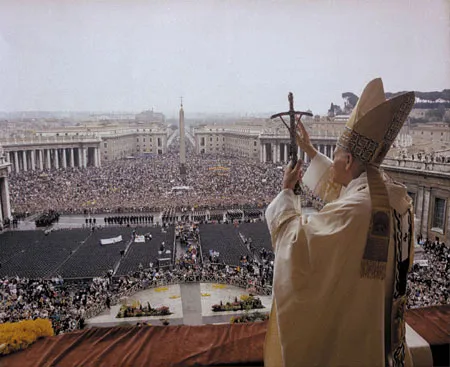
VATICAN CITY — Pope John Paul II, in an address from the central balcony of St. Peter's Basilica that drew to the square below an estimated 500,000 souls and that was simulcast by the broadcasting authorities of every nation on earth save the Soviet Union, the People's Republic of China, the German Democratic Republic, the Polish People's Republic under its present authorities, North Korea, Mongolia, Iran, Albania, and Romania, prayed today for peace and for justice in the war that has overtaken the Eastern half of his continent, and called upon the men in the Kremlin to surrender the office they had usurped, to release the captives they had taken, and to restore the world to "that fragile peace which we, who lived as you and I have lived, dare not call good but dare also not call little."
The Holy Father, visibly aged by the events of the past eight days, spoke for forty-one minutes in five languages, Italian, Polish, German, Russian, and English. He opened with the words with which he had opened his pontificate eleven years ago: Nie lękajcie się! "Be not afraid!" The crowd in the square, which had been silent in the heat of the late Roman afternoon, took up the words after him, in Polish, and chanted them for nearly a minute before he could continue.
He read aloud the names of forty-seven persons. Tadeusz Mazowiecki, Lech Walesa, Bronislaw Geremek, Adam Michnik, Jacek Kuron, of Poland. Vytautas Landsbergis, of Lithuania. Boris Yeltsin, who could no longer be released from any captivity but the grave. Andrei Sakharov, whose whereabouts since the coup had not been confirmed. Mikhail Sergeyevich Gorbachev, "the lawful President of the Soviet Union, our brother in the dignity of his office and in the dignity of his suffering." The first thirty-eight names of the dead at Alexanderplatz that the West Berlin authorities had been able to confirm. The names of Lt. Cmdr. Robert Pennington and Lt. Michael Watson of the United States Navy, "whose mothers do not know tonight whether to mourn them or to hope." He prayed for each.
He addressed himself in turn to the constituencies of the war.
To the Polish people, in Polish, he said: "My countrymen. The hour you have known once before, you know again. The lessons of that hour are not abolished. The Church is with you. I am with you. Be not afraid."
To the Russian people, in Russian, a language he had labored to acquire in middle age and that he spoke, by the testimony of those who knew him, with an unembarrassed Slavic accent, he said: "Brothers and sisters of the Russian land, of the land of Sergei of Radonezh and of Andrei Rublev. The men who hold your country in their hands today are not Russia. Russia is the babushka in the church at Sergiev Posad lighting a candle for her grandson at the front. Russia is the soldier in central Iran who has not been told why he is there. Russia is the worker in Magnitogorsk who has not been told the truth about anything in many weeks. To these the universal Church extends tonight every consolation and every prayer. For the others, I have a different prayer."
To the German people, in German, he said: "The wall between you cannot stand. It has not stood. By the mercy of God which is greater than any wall, it has begun to fall, and at the foot of it, in the square that bears the name of Alexander, there lie tonight in their blood those who have caused it to fall. Pray for them. Pray for those who killed them. Pray for the unity of your nation in justice and in peace."
To the American people, in English, he said: "You who hold in your hand the strength that is now to be employed: I say to you what I have said to all the world. Be not afraid. But I say also: be not unafraid. The strength of arms is given to nations as a trust, not as a possession. Use it as a trust. Use it for that for which it is given, and for nothing else, and not one hour longer than it is required. The God of the prophets sees your hand upon the sword. He will not ask why you took it up. He will ask how you laid it down."
To the men of the so-called Emergency Committee, returning to Russian, he said: "I do not address you as a head of state, for I am not. I do not address you as a soldier, for I am not. I address you as a man and as a priest. I say to you: lay down what you have taken. Restore the lawful government of the Soviet Union. Return your soldiers to their barracks. Open the prisons you have filled. There is yet time. Tomorrow there may not be. As priest I tell you: the door of repentance is, by the mercy of God, never quite closed, but only the foolish man assumes that it shall remain open at his convenience. Do not be foolish men."
He closed in Latin, with the Da pacem Domine of the ancient liturgy, the prayer for peace in our days because there is none other who fights for us but only Thou, our God. The square answered him in Latin. The bells of every church in Rome rang.
In Warsaw, on the underground frequencies of Solidarity, the address was rebroadcast in full, in Polish, three times before midnight. In East Berlin, where the Soviet jamming of Western radio had collapsed with the regime in the previous 24 hours, RIAS broadcast the German passages on continuous loop. In Moscow, on the BBC Russian Service and the Voice of America, the Russian passages were broadcast clear, the jamming of Soviet authorities having, on this evening, also faltered.
JUNE 26, 1989
WAR POWERS JOINT RESOLUTION PASSES, 96-4 SENATE 410-18 HOUSE
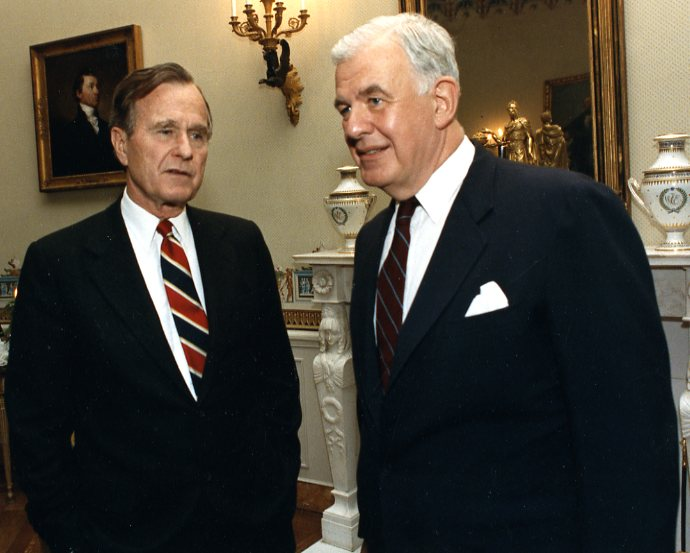
WASHINGTON — The Congress of the United States today authorized the President to employ the armed forces of the country against the so-called Emergency Committee in Moscow, and signaled, in the breadth of its assent and the substance of its debate, that the political branch had committed itself to the present war as fully as the executive that has led it.
The Senate, convening at 9 a.m. and adjourning shortly after 6 p.m., adopted Senate Joint Resolution 173 by a vote of 96 to 4. The House of Representatives, sitting in continuous session from 10 a.m. through the early evening, passed the identical measure 410 to 18. The President, in the East Room of the White House at 8:45 p.m., signed the bill into law in the presence of the Cabinet, the leadership of both houses, the Joint Chiefs of Staff, and the family of Lt. Cmdr. Robert E. Pennington, the senior of the two F-14 aviators missing over Esfahan since Friday and confirmed today, by a Pentagon spokesman, to be in Soviet custody.
The four senators voting in the negative, Mark O. Hatfield, Republican of Oregon; Howard M. Metzenbaum, Democrat of Ohio; Tom Harkin, Democrat of Iowa; and Quentin N. Burdick, Democrat of North Dakota, addressed the chamber in turn during the late afternoon. Sen. Hatfield, a Quaker who has voted against every appropriation for hostilities in his quarter-century in the Senate, spoke for fourteen minutes and concluded: "I do not vote against the men of the 101st Airborne Division. I vote against the cup that was offered to them, and that I would have refused to drink myself, and that I cannot bring myself today to bless." Sen. Metzenbaum spoke briefly of his service in the war against Hitler and of his unwillingness to permit even the present provocation to extend the doctrine of presidential war-making "by another inch upon ground watered with American blood."
The eighteen members of the House voting in the negative were all Democrats. They included the longtime peace-caucus chairman Ronald V. Dellums of California, who entered into the record the names of every American killed in Iran since the deployment began; Patricia Schroeder of Colorado, who said she voted against the resolution because she believed the President should have asked for a formal declaration of war; John Conyers Jr. of Michigan; George W. Crockett Jr., also of Michigan; Henry B. Gonzalez of Texas; and Pete Stark of California. Mr. Dellums, in remarks closing for the opposition, said: "I shall be on the wrong side of this vote, and I shall be on the right side of the Constitution."
Senate Majority Leader George J. Mitchell, in the closing speech for the resolution, observed that no measure of comparable consequence had been adopted by the Senate without a single absent member since the declaration of war against Imperial Japan on December 8, 1941. Senate Minority Leader Robert Dole of Kansas, the wounded veteran of the 10th Mountain Division and the only senior leader of either party to have suffered combat wounds in the present century, spoke immediately after the Majority Leader. He spoke for less than three minutes. He said: "I would not be standing on this floor today, except for those who served beside me in 1945. They had no resolution. They had a duty. We have today done a small fraction of what they did, and I am not satisfied that we have yet done enough."
Speaker Foley, gaveling the final House vote at 6:14 p.m., did not bring his gavel down hard.
President Bush, signing the bill at 8:45, used a single pen, which he gave to the widow of Lance Cpl. James R. Aldine of Springdale, Arkansas, killed at Bandar Abbas on Saturday morning by Soviet long-range artillery. The President said only: "We will bring him home, ma'am, and the others. Beginning tonight."
Within the hour the President's authority under the resolution was further confirmed in private by an additional set of measures: a National Security Directive raising the readiness of the strategic forces of the United States to a level the Pentagon would not specify; the deployment of the 24th Infantry Division (Mechanized), now closed at the POMCUS sites in West Germany, to forward assembly areas; and the issuance to American forces in theater of new rules of engagement, the substance of which the Pentagon described only as "considerably broadened."
In London, Bonn, Paris, Rome, and Ottawa, allied governments issued statements of approval. In Tokyo, the government of Prime Minister Sosuke Uno announced an emergency Cabinet meeting for the morning. In Moscow, the so-called Emergency Committee made no immediate response. The Tass evening news bulletin, monitored in Helsinki, made no reference to the American congressional action.
SOVIET TROOPS HALT THEIR ADVANCE IN IRAN AS JUNTA CONSIDERS ITS NEXT MOVES, DEALS WITH REPORTED INTERNAL DIVISIONS
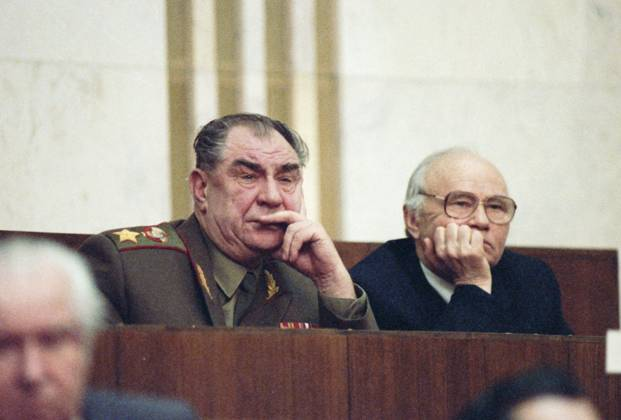
ISTANBUL — Soviet armored and motorized forces, which since June 19 had advanced from the Soviet frontier the length of Iran without interruption, came today to a halt. From the salt-flat country south of Yazd to the western highlands above Hamadan to the coastal road approaching the oil city of Ahvaz, the columns of the Soviet 4th Combined Arms Army and of the airborne and air-assault formations operating ahead of them ceased their forward movement, dispersed off the highway shoulders into hasty defensive perimeters, and began the work of resupply, of casualty evacuation, and, by every indication available to Western intelligence services, of waiting.
The halt came forty-eight hours after the engagement at Bafq in which the United States 101st Airborne Division inflicted significant losses upon the lead Soviet motor rifle regiment, and twenty-four hours after the destruction by American cruise missiles of three Soviet strategic bombers at Mozdok. It is the first such pause since the operation began. Pentagon analysts and Western diplomats in Ankara offered competing interpretations of its significance, dividing roughly between those who believed the Soviet command had halted in order to consolidate logistically before resuming the advance, and those who believed the halt represented a political signal originating in Moscow itself.
A senior Western intelligence official in Ankara, speaking on condition of anonymity, described the operational picture as one of "a great army at the end of a long string." The Soviet line of communication, the official noted, runs from Baku through Astara along a single coastal road, much of it now subject to harassment by what appear to be irregular Iranian elements not previously seen, and from Nakhchivan through Julfa across the difficult country of Iranian Azerbaijan. Soviet fuel and ammunition stocks in the Iranian theater, the official estimated, were sufficient for "another five days of advance, perhaps a week, but not for sustained engagement against a peer adversary." The strikes at Doshan Tappeh on Saturday and at Khatami yesterday, the official added, had eliminated "the larger part of the forward fuel stockpile of the entire operation."
But the second interpretation, that the halt is at least in part political, drew increasing weight from a series of unusual reports reaching Western governments through diplomatic channels in the course of the day.
The Foreign Minister of the Soviet Union, Aleksandr Bessmertnykh, who has not been heard from in public since June 21 and who absented himself from the meetings of the Emergency Committee after June 23, made personal contact yesterday evening with the British Ambassador in Moscow, Sir Rodric Braithwaite, by telephone from a private apartment, according to sources within the British Foreign Office, and requested that the British Government convey to the Government of the United States a single sentence: that the situation in Moscow was "more fluid than the appearance of it." Mr. Bessmertnykh declined further communication and did not appear at the Foreign Ministry today.
Marshal Sergei F. Akhromeyev, the personal military adviser to Mr. Gorbachev and a figure of immense personal prestige within the Soviet General Staff, addressed a closed meeting of the senior officers of the Stavka, the Supreme High Command summoned into existence by the Emergency Committee on June 23, in terms that one source present described as those of a soldier speaking finally as a soldier. His remarks, of which no reliable text exists, were said by that source to have included the words: "We have been ordered to do what cannot be done, in a country we cannot hold, against an army we cannot defeat, while our own country burns behind us. The men who have given us these orders are not soldiers, and they have no idea what they have asked." At the conclusion of the meeting, the Marshal was escorted from the room by personal security of the Chairman of the K.G.B.
Vladimir A. Kryuchkov, the K.G.B. chairman and the figure increasingly identified by Western analysts as the operational driver of the Emergency Committee, has appeared on Soviet television three times in the past twenty-four hours, twice longer than any other member of the junta. His remarks have grown noticeably sharper. In an evening broadcast he denounced "the cowardice of those who, having entered upon a great work, lose heart at the first sound of distant gunfire," and warned of "stern measures, suitable to the seriousness of the moment, against any quarter from which such cowardice may proceed." He named no names.
Anatoly Lukyanov, the figurehead chairman of the Emergency Committee, was reported by Tass this evening to have been "indisposed" and to have transferred the conduct of the day's business to Mr. Kryuchkov and to the Defense Minister, Marshal Yazov. The nature of the indisposition was not specified. The Soviet Ambassador in Washington, Yuri Dubinin, spent the morning at the residence of the Apostolic Pro-Nuncio in Washington, the Most Reverend Pio Laghi, in conversation of unspecified character, State Department sources said.
In the Pentagon, the night-watch officer of the National Military Command Center, in a posture statement issued at 11 p.m. and cleared for limited release, summarized the day in the Iranian theater in a single line: "No forward movement observed after 1400Z. Cause not assessed."
SOVIET TROOPS IN GERMANY MOVE TOWARDS BORDER
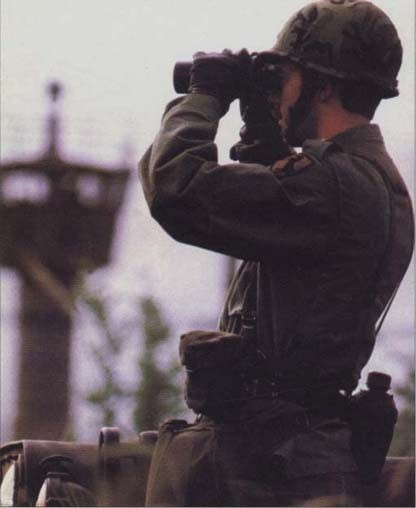
BONN — In a development which Western military authorities described as the most ominous of a week without precedent, units of the Group of Soviet Forces, Germany, the largest and most powerful Soviet field force outside the borders of the Soviet Union itself, comprising five armies, 19 divisions, 338,000 men, and approximately 4,200 main battle tanks, began this morning a co-ordinated movement out of their peacetime garrisons toward the inner-German frontier, in what the Supreme Headquarters Allied Powers Europe in Casteau, Belgium, designated by mid-afternoon as "the principal threat axis of the present conflict."
The movement was first detected by the West German Federal Border Guard observation post at Helmstedt-Marienborn, which reported at 4:30 a.m. local time the passage westward of an unbroken column of T-80 tanks of the 47th Guards Tank Division, departing its garrison at Hillersleben in the direction of the autobahn approaches to the border. By daylight, similar movements had been confirmed by NATO airborne radar and by West German signals intelligence at all five army headquarters of GSFG: the 1st Guards Tank Army at Dresden, the 2nd Guards Tank Army at Fürstenberg-an-der-Havel, the 3rd Shock Army at Magdeburg, the 8th Guards Army at Weimar-Nohra, and the 20th Guards Army at Eberswalde-Finow. The movement, in its scale and character, corresponded to the doctrinal pattern designated in NATO planning documents as "Stage Three" of a Soviet concentration for offensive operations against the central front of the alliance, a pattern long studied, often gamed, and never before observed.
Of particular concern to NATO planners were the movements of the 8th Guards Army out of its garrisons at Weimar, Erfurt, and Nohra, on an axis directed unambiguously toward the so-called Fulda Gap, the historic invasion route from the Thuringian basin into the Hessian heartland of West Germany, defended on the NATO side by the United States V Corps and by the German III Corps. The 8th Guards Army, the most studied and the most feared of the GSFG armies, contains four divisions of the highest readiness in the Soviet ground forces: the 27th Guards Motor Rifle Division at Halle, the 39th Guards Motor Rifle Division at Ohrdruf, the 79th Guards Tank Division at Jena, and the 57th Guards Motor Rifle Division at Naumburg. By mid-morning today, all four divisions were on the march.
Concurrently, NATO airborne early-warning aircraft of the 552nd Airborne Warning and Control Wing, on continuous patrol since the weekend, reported a marked increase in the number of Soviet tactical aircraft operating from forward air bases in the German Democratic Republic, at Wittstock, Damgarten, Werneuchen, Allstedt, Köthen, Welzow, and Finsterwalde, and a corresponding reduction in normal training-pattern activity. Soviet jamming of NATO communications frequencies, which had been intermittent through the previous days, became continuous after 11 a.m. local time and remained so through the evening.
Yet the movement, for all its scale and for all its menace, was not without ambiguity. Western military observers in West Germany, and in particular the senior staff of Gen. John R. Galvin at SHAPE, studied through the day a number of features of the GSFG concentration that did not entirely accord with the doctrine they had so long expected to see executed against them.
The movement was, in the first instance, partial. The two divisions of the GSFG most heavily reinforced from the Soviet interior in the past 72 hours, the 32nd Guards Tank Division at Jüterbog and the 25th Tank Division at Vogelsang, remained in their garrisons. The pre-positioned ammunition stockpiles of GSFG, dispersed at known locations across the GDR, were not, by NATO assessment, being broken out at the rate that doctrine required for offensive operations. Bridge-laying engineer formations, essential to the rapid crossing of the Werra and the Weser in any westward advance, were observed moving, but moving rearward, away from the frontier, in the direction of the Polish border. The reasons for this movement were the subject of intense analysis at SHAPE through the evening, and were not yet understood.
The political situation in the rear of GSFG, moreover, can hardly have been ignored by its commanders. The German Democratic Republic, by every indication available to Western intelligence, has effectively ceased to exist as a functioning state. The Volkspolizei have stopped reporting. The Stasi headquarters at Normannenstrasse remains in the hands of Erich Mielke and his loyal officers, who continue, by the testimony of refugees, to destroy paper, but exercises authority over nothing beyond its own walls. The National People's Army has not received a coherent order in 72 hours. The civilian population of the country, in numbers reaching the millions, is in motion, toward the Western border, toward the West Berlin sector boundaries, and in some places toward the GSFG garrisons themselves, to inquire of Soviet sergeants the status of brothers and fathers conscripted into NVA units now no longer reporting.
The commander of the Group of Soviet Forces, Germany, Col. Gen. Boris V. Snetkov, has issued, in the past 24 hours, three separate orders of the day to his troops, of which the texts have been recovered by NATO intelligence. The orders enjoin discipline. They forbid fraternization with the local population. They forbid, with unusual emphasis, the discussion of news from the Soviet Union. They do not, in any of their three iterations, mention the prospect of offensive operations against NATO forces.
In Bonn, Chancellor Kohl met through the day with the West German cabinet, with Defense Minister Gerhard Stoltenberg, with Gen. Klaus Naumann of the Bundeswehr, and with the Federal President, Richard von Weizsäcker. In Brussels, the North Atlantic Council met in continuous session. In Washington, the Pentagon would say only that the President had been advised, that the Joint Chiefs were assembled, and that "appropriate measures of every character" had been taken or were under consideration.
A senior NATO officer, asked by a correspondent of the Frankfurter Allgemeine Zeitung at the close of business at SHAPE whether the alliance now stood at the brink of war upon its central front, replied: "We have always stood there. Tonight we stand a little closer. Ask me again tomorrow."
WALESA GIVES ADDRESS OVER REBEL RADIO, "YOUR ENEMIES ARE NOT POLES, THEY ARE RUSSIANS"
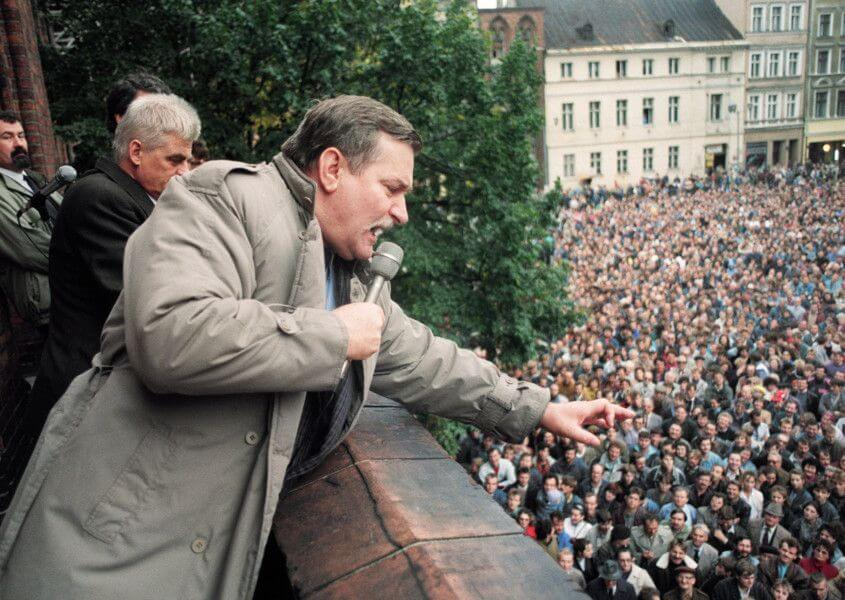
VIENNA — Lech Walesa, the chairman of the Solidarity trade union, the recipient of the 1983 Nobel Peace Prize, and the prisoner whom the so-called Military Council of National Salvation in Warsaw has held incommunicado at an undisclosed location since the early hours of June 22, was confirmed late tonight to be neither incommunicado nor, by every indication, in the custody of the Council, having delivered at 8 p.m. local time a fifteen-minute address in his unmistakable voice over the underground broadcasting facilities of Radio Solidarność, the clandestine network constructed during the martial law years of 1982-86 and reactivated, by means and through hands not yet publicly known, in the four days since the Council's coup.
The address, picked up on shortwave by monitoring stations in Vienna, in West Berlin, and at the BBC Caversham Park facility in Berkshire, and rebroadcast within the hour by the Polish Service of Radio Free Europe in Munich, represented the first public communication by Mr. Walesa since the night of his arrest, and the first sustained challenge by a figure of his stature to the legitimacy of the Council and to the obedience of the Polish armed forces. It was delivered, by the testimony of the recording, in conditions of considerable simplicity: a single voice, a single microphone, the faint sound of what may have been wind, and once, midway through, the distant barking of a dog.
Mr. Walesa opened with the customary salutation of his union. "Brothers and sisters of Solidarity. Brothers and sisters of Poland. This is Lech, and I am still here, and so are you, and so is Poland."
He spoke at first of his arrest, of his removal from his home in Gdansk in the early hours of Thursday, of his transfer through three locations, of his escape, which he refused to describe, saying only that "those who arranged it have asked me not to thank them publicly, and so I shall not, and let it be remarked that this is the first time in my life I have been asked not to talk, and the first time I have agreed." He spoke of the friends still held: of Mazowiecki, "the gentlest man God ever placed at the head of a government, and ours for seventy-two hours, and he shall be ours again"; of Geremek; of Michnik, "who is, I am told, doing in his cell what he has done in every cell, which is to write, and we shall read what he has written, in due course, in the freedom we shall give him"; of Kuroń.
He turned then to the Polish armed forces, and the substance of his address, the substance for which it will be remembered, began.
"I speak now to the Polish soldier. To the boy in the barracks at Krakow, at Wroclaw, at Szczecin, at Bialystok, at Gdynia, at Lodz. I speak to the officer in his quarters. I speak to the general at his desk. I am a Pole, and you are Poles, and we are all of us, in this hour, what our fathers and grandfathers were in their hours: men under arms in a Polish land, deciding whom we shall serve.
"I shall make it easy for you. I shall tell you whom you shall not serve, and then I shall tell you the rest.
"You shall not serve General Siwicki. He has put on the uniform of the Polish soldier in order to serve another army, in another capital, that has never in its history wished Poland anything but the grave. You shall not serve General Kiszczak. He has spent his life imprisoning Poles on behalf of foreigners, and he is doing it tonight, and he will not stop until you stop him. You shall not serve the man called Jaruzelski, wherever he may be, alive or dead, willing or otherwise; he had his chance to be a Pole among Poles, and he has spent it, and there is none left to him.
"And now, the rest. Your enemies are not Poles, brothers. Your enemies are not Poles. They are Russians. They have always been Russians. In 1772 they were Russians. In 1830 they were Russians. In 1863 they were Russians. In 1920, when by the grace of God and by the genius of Pilsudski we drove them from the gates of Warsaw, they were Russians. In 1939, when they came again with Hitler, they were Russians. In 1944, when they sat on the eastern bank of the Vistula and watched the Home Army die in the streets of Warsaw, they were Russians. In Katyn, where my uncle and yours lie in the same forest, they were Russians. In 1956, in 1968, in 1981, they were Russians. They are tonight, in the Kremlin, in the uniform of soldiers who do not know yet that they are dead men, Russians.
"And the Pole who fights for them is not, in that hour, a Pole. He is something else. He is a thing the Russian has made out of him. He need not remain that thing. The uniform he wears is Polish. The land beneath his boots is Polish. The mother who weeps for him is Polish. The God who watches him decide is the God of the Poles. He may, at any hour of any day, in any barracks of this country, lay down the order he has been given by a foreigner and take up the order he has been given by his country, which is to defend her.
"I do not ask you, brothers, to mutiny. I do not ask you to fire upon your officers. I ask you a simpler thing. I ask you to do nothing. I ask you to remain in your barracks. I ask you to find that your truck has no fuel, that your rifle has no ammunition, that your boots are at the cobbler's, that your orders are not clear. I ask you, the officer, to find that the telephone is out of order, that the dispatch did not arrive, that the company is at gunnery practice and cannot be recalled in time. I ask you, the general, to find that the situation requires further study, and that you shall report your findings in due course, and that in the meantime no Pole shall be ordered to shoot another Pole, and no church shall be entered, and no shipyard shall be cleared, and no priest shall be arrested, and no child shall be left fatherless on your authority. Do this, and you shall be a Polish soldier, and your great-grandchildren shall name their sons after you.
"Do otherwise, and you shall be what the Russians have asked you to be, and the children of the Poles whom you have killed shall come for you in the years that come, as the children of the Poles whom others killed have come for those others, in their hour. And the night shall come when, in your bed, in the dark, you shall remember whom you served, and the memory shall not let you sleep, and you shall envy the men you killed.
"I shall sign off now. I shall say to you what I have said in every hour of my life: that God loves Poland, and that Poland is not yet lost so long as we yet live. Jeszcze Polska nie zginęła. God bless you. God bless Poland. Solidarność zwycięży."
The recording ended with the opening bars of Mazurek Dąbrowskiego, the Polish national anthem, played on a single piano.
By midnight, sources within the Polish Embassy in Vienna, monitoring transmissions from the Warsaw Pact military communications net, reported a marked increase in the number of Polish Army units reporting equipment failures, training requirements, and other reasons for inability to execute orders received from the Defense Ministry. The 6th Pomeranian Airborne Brigade at Krakow, ordered overnight to deploy a battalion to Warsaw, answered that its aircraft were unserviceable and that its parachutes were "in inspection." The 1st Warsaw Mechanized Division at Legionowo, a unit raised from the streets of the capital and named for them, declined an order to enter the Old Town. The cathedral bells of Krakow, of Czestochowa, of Gdansk, of Wroclaw, and of Poznan rang at midnight for an hour, by no order of any state.
In the Vatican, the Holy Father was reported to have stayed up listening.
(Part Two: The Missiles of July)
(Part Three: Writer's Notes)
(Part Four: Finis Omnia Rerum - The Dark Ending)