The Third World War II: The Missiles Of July
As reported by the media of the day.
(Part One: The Guns of June)
June 27, 1989
WAR BREAKS OUT IN EUROPE AS MASSIVE SOVIET FORCE INVADES GERMANY; MASSIVE AIR BATTLES OVER GERMAN SKIES
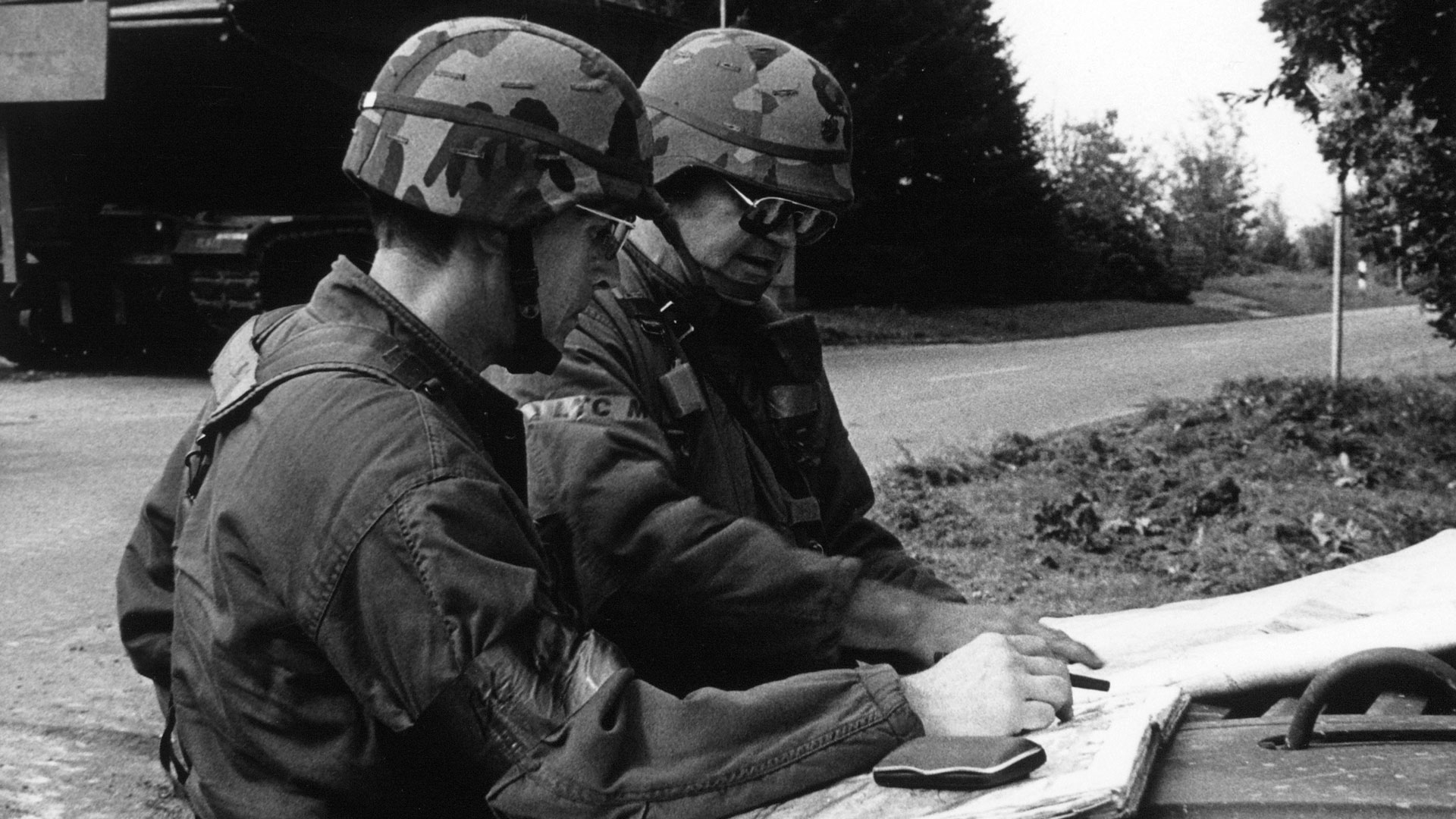
BONN — At 4:14 a.m. Central European Time today, ten days and seven hours after the seizure of power in Moscow by the self-styled Emergency Committee, the Group of Soviet Forces, Germany crossed the inner-German frontier in a co-ordinated offensive across a front of 280 kilometers, opening upon the soil of Western Europe a war that the populations of two continents had hoped, with diminishing conviction over the past week, might yet be averted.
By midnight tonight the offensive had been, in the words of the Supreme Allied Commander Europe, Gen. John R. Galvin, "checked along the entirety of its axis of advance, at a cost in human life and in materiel that has no precedent in the history of this alliance, and at a result whose meaning the historians of the next century will study and the soldiers of this one will not soon forget." Soviet ground forces had advanced no further than 25 kilometers beyond the frontier at any point. Soviet air forces had been driven, according to NATO's Allied Air Forces Central Europe, from the contested airspace over the Federal Republic. The price of the day, on both sides, had been catastrophic.
The Air Battle
The campaign opened, twenty-three minutes before the ground assault, with what the United States Air Force would later describe as "the largest single offensive air operation conducted by any nation since the operations against Japan in August 1945" — a co-ordinated strike by an estimated 1,400 aircraft of Soviet Frontal Aviation, Long-Range Aviation, and Naval Aviation, against the main NATO airbases of the Federal Republic of Germany, the Low Countries, the United Kingdom, and Italy. The strike package, rising from forward bases across the German Democratic Republic, Poland, the western military districts of the Soviet Union, and from the bomber fields of the Soviet Arctic and the Kola Peninsula, was directed against 47 fixed installations across NATO Europe. Its objective, in Soviet doctrine, was the destruction on the ground of the tactical air forces upon which the alliance depends for the defense of the central front.
It miscarried at every level.
The strike was detected in its earliest assembly phases by the United States Air Force's E-3 Sentry airborne early warning aircraft of the 552nd Airborne Warning and Control Wing, on continuous patrol since June 23, and by signals intelligence collection that has been, in the words of one NATO official, "extraordinarily fortunate this past week, for reasons that will perhaps be discussed at greater length in another generation." NATO interceptors, on cockpit alert at every active forward operating base since the Mozdok strikes of June 25, were airborne at every base across the alliance within seven minutes of the warning. By the time the leading Soviet strike packages crossed the inner-German frontier at high altitude shortly after 4 a.m., they were being engaged, at long range, by F-15C Eagles of the 36th Tactical Fighter Wing at Bitburg, by F-4F Phantoms of the German Luftwaffe, by Tornado F.3 interceptors of the Royal Air Force, by F-16As of the Royal Netherlands Air Force, and by Mirage 2000C interceptors of the French Armée de l'Air operating, for the first time in the postwar history of the Republic, in fully integrated co-ordination with NATO's air defense system.
NATO air officers at Ramstein and High Wycombe, reached in the late evening, called it the most lopsided air engagement in the history of modern aviation.
Approximately 900 Soviet aircraft were destroyed in the air over the course of the day. The losses encompassed every category of the Soviet inventory committed to the strike: MiG-29 and Su-27 escort fighters, Su-24 Fencer strike aircraft, Su-25 Frogfoot ground attack aircraft, Tu-22M Backfire medium bombers operating from bases in Belarus and Ukraine, Tu-95 and Tu-160 Blackjack strategic bombers operating in the unaccustomed role of stand-off cruise missile carriers from the Arctic. The entire operational fleet of the Tu-160 Blackjack — sixteen aircraft, the most modern strategic bomber in the Soviet inventory and a system the United States had publicly identified as the cornerstone of Soviet long-range aviation — was committed to the strike, and the entire operational fleet was destroyed, in the air or in the recovery phase of its mission, by F-15s and F-14s vectored against the bombers across the North Sea, the Norwegian Sea, and at the limit of NATO radar coverage above the Arctic Circle.
NATO air-to-air losses, against this immensity, were described by Gen. Galvin at his evening press conference at Casteau as "negligible." A single F-15C of the 32nd Tactical Fighter Squadron from Soesterberg, in the Netherlands, was lost over the North Sea in circumstances that may have included a midair collision with a Soviet aircraft it was engaging. A French Mirage 2000C was lost over Lower Saxony to fratricidal engagement by a NATO surface-to-air missile, the pilot recovered alive. A Tornado F.3 of No. 11 Squadron, Royal Air Force, was lost over the southern North Sea, the crew ejected and recovered. The total NATO air-to-air combat losses of the day, as confirmed at the close of business, stood at three aircraft and one airman.
The Soviet aircraft that did succeed in penetrating to their assigned targets — perhaps 200 of the 1,400 launched — inflicted significant damage on the ground at a number of NATO airfields, principally at Bitburg, at Hahn, at Spangdahlem, at Twenthe, at Volkel, and at Geilenkirchen. Approximately 200 NATO aircraft were destroyed or rendered non-operational on the ground, the great majority transport, support, and second-line aircraft of lower readiness. The hardened aircraft shelters that have characterized NATO basing since the early 1980s — much disparaged in their cost, and never before tested — performed in nearly every case to specification.
The destruction of the Soviet strike force was such that, by midmorning, the second wave of the planned operation, assembling at forward bases across the German Democratic Republic and Poland, did not depart its hardstands. By midafternoon, what remained of Soviet Frontal Aviation in Germany had been driven onto the defensive over its own airfields. By the evening, NATO strike aircraft were operating at will above the GSFG rear areas, and had begun the systematic destruction of Soviet air-defense radars, command posts, fuel depots, and forward bridging assets across the GDR.
The Ground Battle
The ground offensive, opening at 4:37 a.m., was directed along three axes corresponding to the doctrinal expectations of NATO planners across forty years.
In the north, three divisions of the 3rd Shock Army of GSFG crossed the frontier in the Lüneburg Heath sector north of Helmstedt, on the historic North German Plain axis toward Hannover, against the British I Corps and the West German I Corps of NORTHAG. In the center, the four divisions of the 8th Guards Army crossed in the Fulda sector toward the Hessian heartland, against the United States V Corps of CENTAG. In the south, two divisions of the 1st Guards Tank Army out of Dresden moved through the Hof corridor toward Bavaria and the U.S. VII Corps. By 7 a.m., elements of a Soviet motor rifle regiment, unaccompanied by any East German forces, had entered West Berlin from the Soviet sector and proceeded to the Allied Kommandatura, where the small American, British, and French garrisons of the city — by the standing orders of the Allied governments, deployed not as a defending force but as a tripwire — surrendered after symbolic resistance, the senior officer of each garrison having broken his sword in the presence of his Soviet counterpart.
The ground campaign in West Germany proper unfolded otherwise.
In the Fulda sector, the lead division of the 8th Guards Army, the 79th Guards Tank Division, encountered upon crossing the frontier the prepared positions of the United States 11th Armored Cavalry Regiment, the Blackhorse, supported by the 3rd Armored Division and by tactical aviation including AH-64A Apache attack helicopters of the 6th Cavalry Brigade and A-10A Thunderbolt II close-air-support aircraft of the 81st Tactical Fighter Wing. By midmorning the 79th Guards Tank Division had ceased to function as an organized formation. Its commander, Maj. Gen. Vladimir A. Sorokin, was killed in his command vehicle at approximately 9:30, according to intercepted communications. The 39th Guards Motor Rifle Division, attempting in the early afternoon to pass through the wreckage of the 79th and to continue the advance, was halted approximately 18 kilometers inside the federal territory and was, by evening, in the early stages of withdrawal toward the frontier.
In the Lüneburg sector, the 10th Guards Tank Division, advancing against the British 1st Armoured Division and elements of the U.S. 2nd Armored Cavalry Regiment, achieved the deepest Soviet penetration of the day — 25 kilometers, to the village of Bahrdorf — at a price its surviving officers will not, as one NATO intelligence officer put it, "willingly recount in the years remaining to them." The 10th Guards Tank Division, the most decorated armored formation in the Soviet ground forces, with battle honors stretching from Stalingrad to Berlin, ceased to exist as a divisional organization shortly after 4 p.m. The 30th Guards Motor Rifle Division, ordered to pass through and to continue the advance, declined the order. The text of its commander's response, as intercepted at SHAPE, was reported by one source as: "There is nothing through which to pass."
The defending NATO forces did not escape unscathed. The U.S. 2nd Armored Cavalry Regiment, in the Fulda sector, suffered casualties on a scale not experienced by an American formation of its size since the closing engagements of the Korean War. The West German 5th Panzer Division, holding the right flank of the British I Corps in the Lüneburg sector, lost in killed, wounded, and missing approximately one-third of its divisional strength, NORTHAG reported, including its commanding general, Generalmajor Klaus Reinhardt, killed when his command vehicle was struck by Soviet artillery in the late morning. The 1st Battalion, the Royal Tank Regiment, holding the village of Brome against repeated assault by elements of the 10th Guards Tank Division, lost 38 of its 57 Challenger tanks engaged.
NATO casualty estimates issued at midnight gave killed-in-action figures of 1,840 American, 920 British, 1,470 West German, 280 Dutch, 60 Belgian, and 40 French. Wounded figures were given as approximately three times the killed-in-action totals. The total of NATO killed for the day exceeded any single day's losses by the alliance in any preceding conflict.
NATO put Soviet ground losses at approximately 22,000 killed, an unknown but substantially larger number wounded, and prisoners of war — chiefly from disintegrated forward elements of the 79th Guards Tank Division and the 10th Guards Tank Division — totaling at the close of business approximately 4,200 men.
The Collapse Of The Warsaw Pact
Across the rear of the offensive, the political assumption upon which the entire Soviet operation had been constructed — that the armies of the Warsaw Pact, however reluctant, would broadly perform the missions assigned to them in the Soviet plan of campaign — collapsed in the course of the day with a comprehensiveness that no Western intelligence service had been prepared to anticipate.
Of the six East German divisions of the National People's Army nominally available to the Soviet command, two — the 11th Motor Rifle Division at Halle and the 8th Motor Rifle Division at Schwerin — refused orders to deploy and remained in their barracks under the authority of officers' councils improvised in the early morning hours. Two — the 4th Motor Rifle Division at Erfurt and the 9th Panzer Division at Eggesin — disintegrated, the troops simply walking from their positions in the direction of their homes. The remaining two were committed to the offensive in supporting roles and performed indifferently, the NVA's 7th Panzer Division refusing toward midmorning to advance further than the frontier itself.
Of the five Polish divisions nominally constituting the Polish Front of the Soviet plan, none crossed the frontier into the German Democratic Republic. The 11th Armored Cavalry Division at Zagan ordered its tanks parked. The 5th Mechanized Division at Gubin reported, in language audible to Western intelligence, that its trains were not yet ready. The 12th Mechanized Division at Szczecin reported that "the Polish Army does not at this time engage in operations against the German people." The Polish Defense Ministry in Warsaw, dispatching peremptory orders for movement, received in reply the equivalent of silence.
Of the three Czechoslovak divisions in the second strategic echelon, all three remained in their garrisons in Bohemia and Moravia, the political situation in Prague having advanced overnight to the point at which the Czechoslovak Defense Ministry had ceased to issue orders to its own field formations. Hungarian forces, formally allocated to the southern strategic direction, made no movement of any character.
The Soviet second-echelon armies — the 28th Combined Arms Army at Brest in the Belorussian Military District, the 7th Tank Army at Borisov, and the 5th Guards Tank Army at Bobruisk — had been, since the morning of June 25, on movement orders toward Poland and onward to the GDR. Their movement, by the evening of the 27th, had been redirected. Western intelligence placed the 28th Combined Arms Army detraining at Bialystok, in northeastern Poland; the 7th Tank Army at Lublin; the 5th Guards Tank Army at Warsaw itself, where its lead elements were observed entering the city at sundown and proceeding to the government buildings, the railway stations, and the broadcasting facilities. The Group of Soviet Forces in Germany would receive, on this day, no second-echelon reinforcement.
The Country Behind the Lines
The civilian population of the Federal Republic of Germany, on whose soil the war was now being fought for the first time since 1945, was in motion in numbers that the federal authorities, in a midnight communiqué from the Interior Ministry, declined to estimate beyond "the millions." The autobahn network westward of the Rhine was solid with private automobiles. The rail stations of every western German city dispatched extra trains throughout the day toward the French and Belgian and Dutch frontiers. The French government opened its border without formality, in language echoing that of the Hungarian opening to refugees from the East three days earlier, and dispatched military and Red Cross personnel to the frontier crossings to assist with the reception. The Dutch and Belgian governments did the same.
In Berlin, fallen this day after twenty-eight years, the population of the western half of the city — three of whose Allied garrisons had surrendered in the early morning — gathered through the day at the Brandenburg Gate, at Checkpoint Charlie, at Wittenbergplatz, in the great squares of the divided city, in numbers and in silence that defied description.
In Bonn, Chancellor Kohl addressed the nation on television at 10 p.m., his voice unsteady, and confirmed the reports of the day. He read, slowly, the names of the German towns through which the front line of the war now ran. He thanked, by name, the United States, the United Kingdom, France, the Netherlands, Belgium, Canada, Denmark, and Norway. He concluded: "Tomorrow we shall begin to bury our dead. We shall begin also to make Germany whole. The two are not separate works. May God help us, and may God help the Russian people, with whom we have, even tonight, no quarrel."
In Moscow, the Tass evening broadcast announced "successes of the Soviet armed forces in the western strategic direction" and called for the assembly of all Communist Party committees throughout the country at 9 a.m. tomorrow morning to "consider the situation."
IN IRAN, BOTH SIDES HOLD IN PLACE, WAITING
ABOARD U.S.S. INDEPENDENCE — The Iranian theater of operations, which a week ago appeared to be the main locus of the Soviet-American war and which today became plainly its secondary front, entered tonight upon a posture of mutual immobility, with neither Soviet nor American ground forces undertaking offensive operations of consequence, and with both sides devoting the day to consolidation, to the evacuation of casualties, and to the close observation of events upon the German central front, 3,000 miles to the northwest, upon which the larger fortunes of both armies have, since 4 a.m. Central European Time, now plainly come to depend.
Gen. H. Norman Schwarzkopf, the Central Command commander, in his daily morning briefing at the forward headquarters at Riyadh, advised reporters that "the Iranian theater is, as of this morning, neither the main theater nor the decisive theater of this war. It has become a holding theater. We shall hold." Asked whether American forces in Iran would be ordered to advance, the General replied: "We shall hold. The men in Moscow have begun a war in Germany that they will not finish. When that is understood by them, the disposition of forces in Iran will be a subject of negotiation. Until then, we shall hold what we have, we shall protect what we have taken, and we shall keep the strait open. That is the mission today. That is the mission tomorrow."
The Soviet 4th Combined Arms Army, halted since June 26 along the line Yazd-Hamadan-Ahvaz, made no forward movement today. Western intelligence reports indicated that its forward fuel and ammunition stocks were being consolidated at intermediate depots; that its casualties from the Bafq engagement of two days previous, estimated by Pentagon analysts at 4,000 killed and wounded, were being evacuated by helicopter to medical facilities in the rear and onward by Il-76 transport to the Soviet Union; and that no replacement personnel or replacement equipment had reached the theater in the previous 48 hours, the Soviet strategic airlift fleet being committed in its entirety to the support of the operation in Germany.
The Tudeh Party "provisional revolutionary government" in Tehran issued no proclamations today. Its nominal head, Ehsan Tabari, died overnight of natural causes at the age of 73, the BBC Persian Service reported, citing sources within the Soviet diplomatic community in the Iranian capital. No successor was announced. The Soviet military command in Tehran, headed by Col. Gen. Igor Rodionov, had placed the Iranian capital under direct military administration pending "the establishment of stable civilian arrangements," the same sources said. Gen. Rodionov was further reported to have ordered the cessation of all activities of armed Tudeh militants in the city, several of whom had on the previous evening become engaged in firefights with elements of the Iranian Revolutionary Guard Corps not yet effectively suppressed in the southern districts of the capital. The general's order, monitored by Western intelligence, included the unusual injunction that "the Soviet armed forces are not in Iran to settle the political disputes of Iranians among themselves."
In the southern theater, the United States 101st Airborne Division (Air Assault) and the 24th Infantry Division (Mechanized), now closing on its theater assembly area in eastern Saudi Arabia after its trans-Atlantic deployment, did not engage Soviet forces. American positions at Bafq, Kerman, Bandar Abbas, and Chah Bahar were reinforced through the day. The 7th Marine Expeditionary Brigade conducted limited patrolling north and west of Bandar Abbas without contact. The U.S.S. Theodore Roosevelt battle group, having transited the Suez Canal and the Bab-el-Mandeb in the previous 48 hours, took station this morning in the Arabian Sea, doubling the carrier strike capability available to Central Command.
A senior American intelligence officer aboard this ship, asked by a pool reporter whether the Soviet halt represented exhaustion or political calculation, replied: "It represents both, and they are at this point the same thing."
CHINA EXPRESSES "GRAVE CONCERN" AT HOSTILITIES
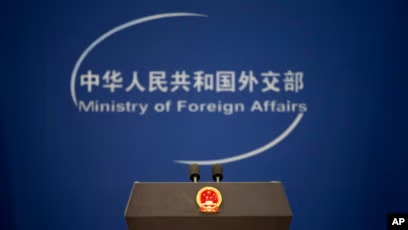
BEIJING — The Government of the People's Republic of China, which since the seizure of power in Moscow ten days ago has maintained a public silence of a comprehensiveness remarkable even by the customary standards of its diplomacy, broke that silence today in a statement of 184 Chinese characters, issued through the Xinhua News Agency at 6 p.m. local time, that expressed the Chinese Government's "grave concern" at the outbreak of armed hostilities between the Soviet Union and the United States, called upon "all parties" to "exercise the utmost restraint," and advocated "the resolution of disputes between great powers through the methods of peaceful negotiation rather than the methods of military confrontation."
The statement was attributed to a spokesman of the Ministry of Foreign Affairs and was not delivered in person. It was rebroadcast on Central People's Radio on the 8 p.m. evening news. It was followed by no commentary, by no editorial, by no further elaboration, and by no answer to the questions of the foreign correspondents who attempted, in the hours after its release, to obtain one.
The statement contained no reference to the Soviet invasion of Iran, no reference to the Soviet invasion of the Federal Republic of Germany, no reference to the Emergency Committee, no reference to Mr. Gorbachev, no reference to President Bush, no reference to the Atlantic alliance, no reference to the Warsaw Pact, no reference to the Polish Military Council, no reference to the German Democratic Republic, no reference to the Korean Peninsula, no reference to Taiwan, no reference to the Sino-Soviet frontier, and no reference to the situation in the Chinese capital itself, where the events of June 4 in Tiananmen Square had been followed in the intervening twenty-three days by a process of consolidation under the new leadership of General Secretary Jiang Zemin whose nature and direction remained, to outside observation, opaque.
It was, in the assessment of every Western diplomat in Beijing reached for comment, the most carefully empty statement of the year.
A senior Western ambassador, speaking on background and at length, offered the following analysis: "It is a statement that says nothing. That is its purpose. It says nothing because Beijing has not yet decided what to say. It has not yet decided what to say because it has not yet decided which of three propositions is most likely to be true at the close of business one week from today: that the Soviet Union shall have suffered a defeat from which it will not soon recover; that the Soviet Union shall have suffered a defeat from which it will not ever recover; or that the Americans, having brought the Soviet Union to its knees, shall now turn the apparatus of their concern upon the next great Communist power within their reach. Until Beijing has resolved which of these is the case, Beijing will say nothing of consequence. It will, in the meantime, say things like 'grave concern.'"
In Washington, the State Department spokeswoman, Margaret D. Tutwiler, asked by a reporter whether the United States had any reaction to the Chinese statement, replied: "We have noted it. We are in continuing diplomatic contact with the Government of the People's Republic of China. We take note of its expressed concern, which we share. We have nothing further at this time."
In Taipei, in Seoul, in Tokyo, in Hanoi, in Pyongyang, in New Delhi, the statement was studied with interest. None of those capitals issued, in response, any statement of its own.
The 38 divisions of the Chinese People's Liberation Army deployed along the Sino-Soviet frontier in Manchuria, in Inner Mongolia, and in Xinjiang, were reported by Western intelligence sources late tonight to have undergone, in the course of the past 24 hours, an unannounced upward adjustment in their state of readiness, to which the Soviet Far Eastern Military District had not yet responded.
SOVIET FOREIGN MINISTER BESSMERTNYKH DEFECTS, APPEARS IN LONDON, DESCRIBES IRAN INVASION AS "INSANE KGB PLAN BY LOW RANKING OFFICERS THAT BROUGHT DOWN THE SOVIET GOVERNMENT"
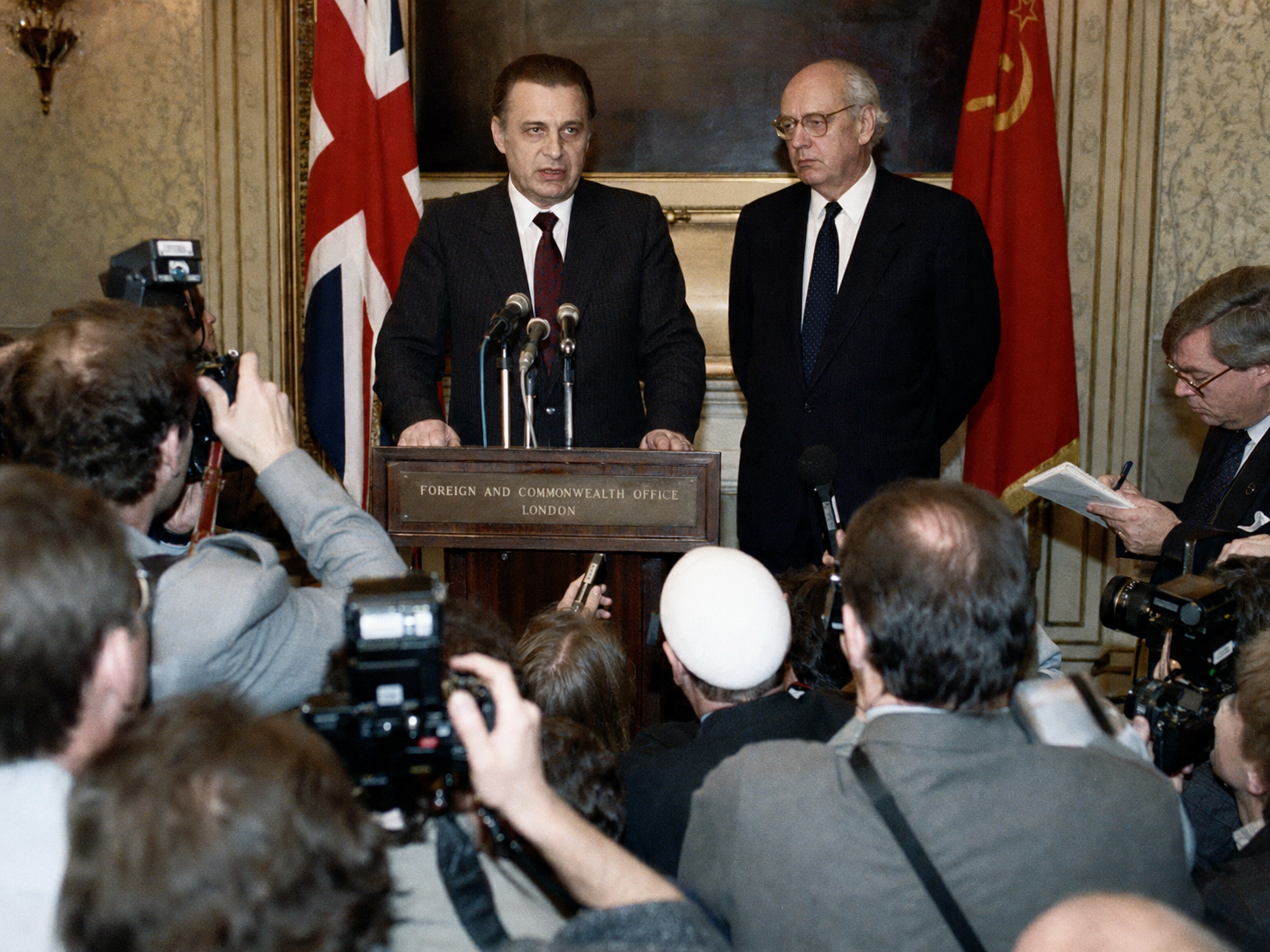
LONDON — Aleksandr A. Bessmertnykh, the Foreign Minister of the Soviet Union, appeared in the late afternoon today at a podium in the Locarno Suite of the British Foreign and Commonwealth Office on King Charles Street, in the company of the British Foreign Secretary, Sir Geoffrey Howe, and in the presence of an assemblage of foreign correspondents whose advance notice of the event had been measured in minutes, and confirmed in person, in his fluent English, what the world had through the day suspected and what the Soviet Union itself had not yet been told: that he had departed Moscow in the early hours of June 26 by means and through routes upon which he declined to elaborate; that he had reached the territory of the United Kingdom in the early hours of this morning by way of an undisclosed friendly capital; that he had requested and received the political asylum of Her Majesty's Government; that he repudiated the State Committee for the State of Emergency in the U.S.S.R. as an unconstitutional and criminal organization; that he recognized as the lawful President of the Soviet Union Mikhail Sergeyevich Gorbachev, "wherever he may at this hour be detained, and in whatever condition"; and that he had with him documents, observations, and accounts of which he proposed to make public, in the next three quarters of an hour, "a portion proportionate to the gravity of the moment, and the welfare of those whose lives remain in danger."
Mr. Bessmertnykh, 56, is a career diplomat and a former Soviet Ambassador to the United States. Mr. Gorbachev had appointed him Foreign Minister in May, in succession to Eduard Shevardnadze, on the recommendation of Anatoly Chernyaev. He addressed the press for forty-three minutes from a prepared statement, of which the following was the substance.
The plan to invade Iran, he said, "was not a plan of the Soviet Government. It was not a plan of the Politburo. It was not a plan of the Council of Ministers. It was not approved by the President of the Soviet Union, the General Secretary of the Communist Party of the Soviet Union, the Foreign Minister of the Soviet Union, or any constitutional organ of the Soviet state. It was a plan of the Committee for State Security, the K.G.B., devised at the level of the First Chief Directorate and the Eighth Department of the Second Chief Directorate, executed by mid-rank officers acting upon the personal authority of Vladimir Aleksandrovich Kryuchkov, and concealed from the leadership of the Soviet state until the moment at which its concealment was no longer possible, at which moment the leadership of the Soviet state was, by the same Kryuchkov, removed from office, in a coup d'etat planned not as the natural fulfillment of the Iran operation but as its emergency cover.
"I wish to be precise," he continued, "because precision is owed to the dead, of whom there are now many. The events of the past three weeks did not unfold in the order in which they have appeared to unfold. The death of Ayatollah Khomeini was not engineered by the Soviet Union; it was a natural death of an aged man, long anticipated. The assassination of President Khamenei, his designated successor, on June 5, in the course of the funeral procession, was not a natural event. It was carried out by an agent of the Tudeh Party of Iran, which had been since 1979 substantially infiltrated and at the senior levels controlled by the K.G.B., and the operation was conducted on the personal authority of Kryuchkov, with the knowledge of the Defense Minister Yazov, without the knowledge of the President of the Soviet Union or of any other organ of the Soviet state. The killing on June 18 of General Ali Shahbazi, the commander of the Iranian Army, was carried out by his own subordinates within the Iranian Revolutionary Guard Corps, who had been informed by K.G.B. channels — falsely — that General Shahbazi was himself a Soviet asset, and were thereby induced to remove him as a prelude to seizing the Iranian government themselves, by which act they substantially destroyed their own organization, which was the intended operational consequence. The 'invitation' issued by Ehsan Tabari from Tabriz on June 19 was drafted in Moscow on June 7. The Soviet armies that crossed the Iranian frontier on June 19 had been moving toward their assembly areas since June 1, six days before the death of Ayatollah Khomeini, on contingency orders that had been concealed from the General Staff under the rubric of summer maneuvers.
"This entire enterprise," Mr. Bessmertnykh said, "was conceived by men who had spent their working lives in the corridors of the Lubyanka, who understood the world in the categories of those corridors, who believed that an opportunity had presented itself in the Iranian succession to alter the strategic balance of the Eurasian continent in the Soviet favor by methods to which the Americans would be unable to respond, and who undertook this enterprise without consulting the Soviet armed forces in any meaningful way, without consulting the Soviet diplomatic service in any way at all, and without consulting the Soviet leadership for the simple reason that the Soviet leadership would have stopped them. They proceeded. They were discovered, on June 16, by the President of the Soviet Union, en route from his visit to Bonn, who in the course of his return flight had been informed by sources within the General Staff of the southern movements. They were confronted, by the President, on June 17, in the Kremlin, in a meeting at which I was not present and the substance of which I learned only later. They responded, on June 17, by deposing the President of the Soviet Union and announcing on June 18 the existence of an Emergency Committee. They had to invade Iran on June 19 because they had killed the Soviet Union to do it, and there was no longer a Soviet Union remaining to undertake any other action.
"This was not a Soviet operation. This was a coup against the Soviet Union by men of the Soviet Union's own security service, who could conceive of no other way out of the situation they had created.
"Mikhail Sergeyevich Gorbachev was, when last I had information, alive, and detained at a naval medical facility north of Murmansk. The conditions of his detention I do not know. I appeal, with all the strength remaining to me, for his preservation in life and for his restoration to his offices.
"As for myself, I have asked the British Government for the protection of an asylum to which my actions of these past ten days, taken at every juncture in defiance of the Emergency Committee, may be thought to entitle me. I have not asked it for myself. I have asked it for my wife, my daughter, and my granddaughter, who reached this country with me in the early hours of this morning. I shall return to my own country at the hour at which my own country once more exists. Spasibo. Da khranit nas vsekh Bog. (Thank you. May God preserve us all.)"
Sir Geoffrey Howe, in a brief statement following Mr. Bessmertnykh's, confirmed that asylum had been granted; that the British Government recognized Mr. Gorbachev as the lawful President of the Soviet Union; that Her Majesty's Government had been in continuous consultation with its allies, and in particular with the Government of the United States, regarding the substance of Mr. Bessmertnykh's account; and that "the substance of his account is, as of this hour, the working basis of the policy of Her Majesty's Government toward the present situation in Moscow."
President Bush, reached at the White House for comment, said only: "Mr. Bessmertnykh has given us today the truth. We owe him our gratitude. We owe his country, in its present captivity, our continued resolution. The men in the Kremlin tonight are not the Soviet Union. They are her abductors. We shall, as we have said, set the captives free."
In Moscow, the Tass evening news bulletin made no mention of the Foreign Minister's appearance in London. The Soviet Embassy in London, asked for comment, did not answer its telephone.
June 28, 1989
SOVIET FORCES FALL BACK IN DISORDER INTO EASTERN GERMANY, NATO FORCES IN PURSUIT; GALVIN: "WE SHALL NOT STOP UNTIL ALL EUROPE IS FREE"
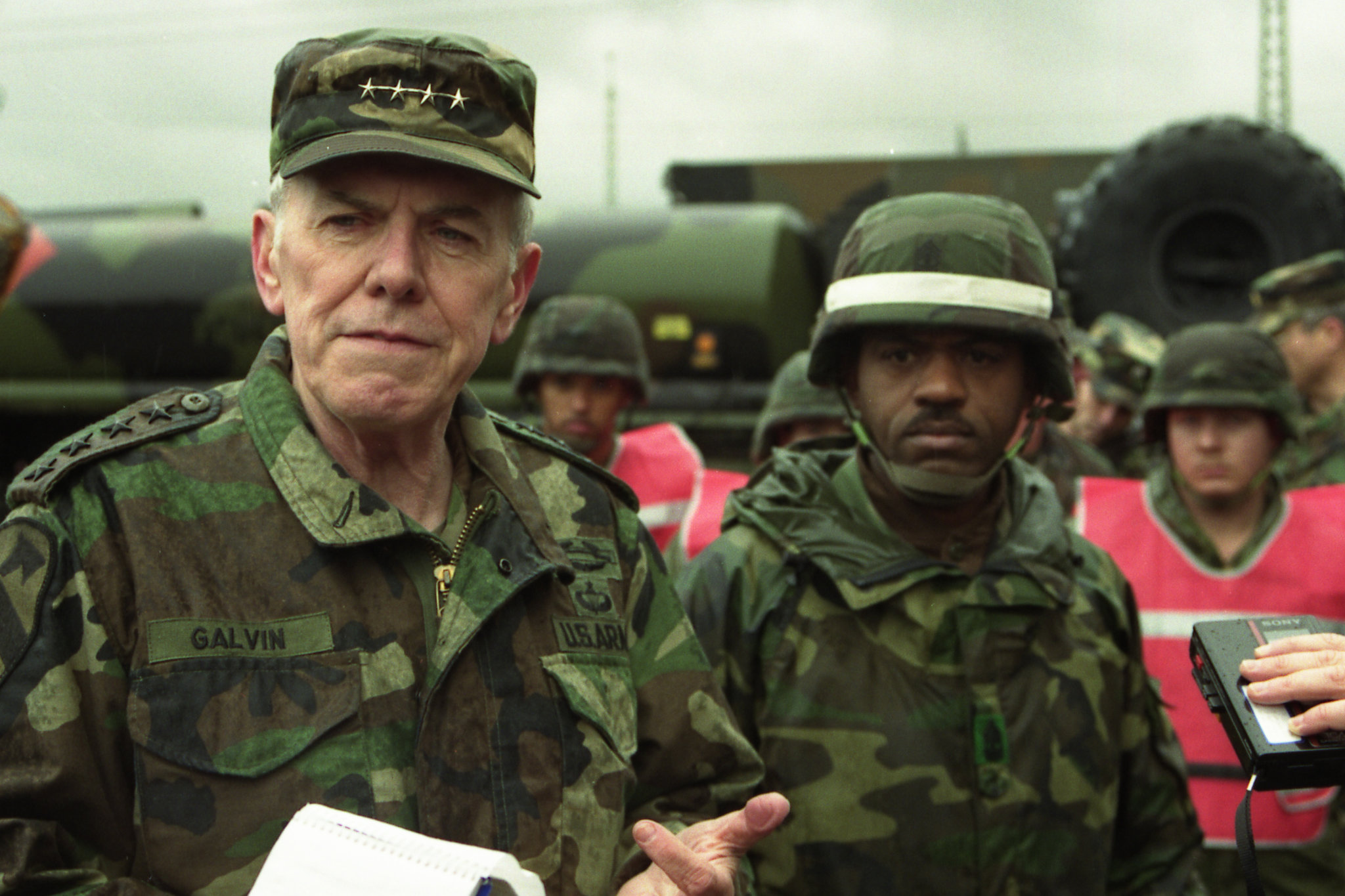
BONN — In a development that the senior commanders of the Atlantic alliance had not, by their own admission, considered probable forty-eight hours ago, the armies of the Group of Soviet Forces, Germany this morning broke contact with the formations of the alliance along the inner-German frontier and commenced a withdrawal eastward into the territory of the German Democratic Republic that, by the close of business today, had become a rout.
Gen. John R. Galvin, the Supreme Allied Commander Europe, in a press conference at his forward headquarters here this evening that lasted seventy-eight minutes and that drew correspondents from every member nation of the alliance, confirmed the development, described its scale, and announced the decision of the alliance to which it had given rise.
"At approximately 0540 hours Central European Time this morning," Gen. Galvin said, "elements of the United States V Corps in the Fulda sector reported that Soviet forces in their immediate front were no longer present. By 0700 hours similar reports had been received from the British I Corps in the Lüneburg sector, from the German III Corps, from the United States VII Corps in the Hof corridor, and from the Belgian and Dutch corps in the second tactical echelon. The Soviet Group of Soviet Forces, Germany, in the course of the night of the 27th to the 28th of June 1989, withdrew from the Federal Republic of Germany.
"It did so, in the first instance, under cover of darkness, in good order. By midmorning today the order had not held. Soviet rear-guard formations engaged in counterattack toward the village of Sangerhausen, in the German Democratic Republic, were observed to disintegrate under the air-delivered fires of the United States 3rd Armored Division and the close air support of the United States Air Force. By midafternoon Soviet armored vehicles in numbers exceeding three hundred had been counted abandoned along the highway between Eisenach and Erfurt, in many cases with their engines still running. By the evening, the Soviet 8th Guards Army, against which yesterday the United States V Corps held the Fulda Gap at a cost which the soldiers of that corps and their families shall not forget, had ceased, in any meaningful organizational sense, to exist.
"I shall not characterize what we are observing as a retreat. The Group of Soviet Forces, Germany, this evening, is not retreating. It is dissolving."
Gen. Galvin then announced that he had this afternoon, "in continuous consultation with the political authorities of the alliance and upon the explicit authorization of every member government," issued orders for NATO ground and air forces to cross the inner-German frontier in pursuit of withdrawing Soviet formations, to secure objectives of military significance within the territory of the German Democratic Republic, and "to liberate, by means of arms but with the minimum violence consistent with the accomplishment of that mission, the territory and the population of the German Democratic Republic from the occupation of foreign forces."
"The Federal Republic of Germany," Gen. Galvin continued, "has, in the past hours, communicated to the alliance through the Federal Government in Bonn a position which it is the privilege of this command to honor. The German people are one people. The territory of Germany shall not, by the choice of any government here represented, remain divided one hour longer than the Soviet armed forces remain present upon any portion of it. The peoples of the German Democratic Republic, of the Polish People's Republic, of the Czechoslovak Socialist Republic, of the Hungarian People's Republic, of the People's Republic of Bulgaria, and of the Socialist Republic of Romania are, by the long verdict of every standard the alliance has held since its foundation, no less entitled to the freedoms enjoyed by the peoples of Western Europe than were the peoples of France, of Italy, of Greece, and of the western half of Germany itself in the year 1945. The alliance does not propose to extend its membership to those nations by force of arms. The alliance does propose to extend to those nations, by such force of arms as may be required and not one ounce more, the elementary preconditions of national self-determination, of which the most fundamental is the absence of foreign armies upon their soil.
"Therefore, gentlemen of the press, I say to you what I have said this evening to my commanders. We shall not stop at the inner-German frontier. We shall not stop at the Oder-Neisse line. We shall not stop at the eastern frontier of Poland, nor of Czechoslovakia, nor of Hungary. We shall stop where the territory of the Soviet Union as constituted in 1939 begins, and we shall stop there because the alliance has no quarrel with the Russian people and no business upon their soil. We shall not stop until all Europe is free."
The General was asked by a correspondent of Le Monde whether the announced policy contemplated war upon the territory of the Soviet Union itself.
"It does not," Gen. Galvin replied. "The alliance has not been attacked by the Russian people. It has been attacked by a small number of men in Moscow who have already attacked the Russian people themselves. The Russian people, in the course of this present crisis, shall, by every measure available to the alliance, be assisted in regaining mastery of their own affairs. They shall not be invaded. They shall not be coerced. They shall accomplish what is required upon their own soil with their own hands."
By the close of business at SHAPE this evening, advance elements of the United States V Corps were reported in the German town of Bad Hersfeld; advance elements of the British I Corps in Helmstedt; advance elements of the United States VII Corps in Hof. The Soviet airfields at Wittstock, at Werneuchen, and at Allstedt had been overflown by NATO reconnaissance and were, in two of the three cases, abandoned. The Soviet supply depot at Wünsdorf, the headquarters of GSFG since 1945, was still occupied by Soviet personnel, the headquarters element of GSFG having departed in the early afternoon for an undisclosed location east of the Oder.
In Bonn, Chancellor Kohl, in an address to the Bundestag at 9 p.m., used for the first time in the postwar history of the Federal Republic the word Wiedervereinigung — reunification — without the customary qualifications and adverbs. He used it in a single sentence. He said: "It begins tomorrow."
The Bundestag rose. The Christian Democrats, the Social Democrats, the Free Democrats, and the Greens stood together. The applause continued for eleven minutes. The Chancellor, in the recollection of one correspondent in the gallery, did not look like a man who had won. He looked like a man who had lived to see what he had not allowed himself to expect to see.
KRYUCHKOV APPEARS ON SOVIET TELEVISION IN "ADDRESS TO THE WESTERN PUBLIC", WARNS OF NUCLEAR ESCALATION, OFFERS "HONORABLE CEASEFIRE IN PLACE ON ALL FRONTS"; MARSHAL AKHROMEYEV REPORTED SHOT IN CONTINUING PURGE OF LEADERSHIP
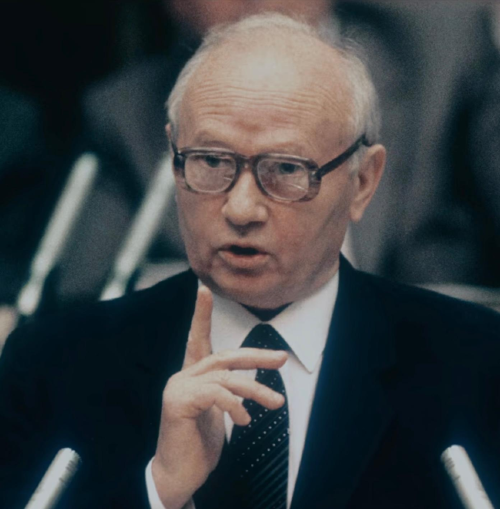
MOSCOW (via Helsinki) — Vladimir Aleksandrovich Kryuchkov, the chairman of the Committee for State Security of the U.S.S.R. and the figure whom every account reaching the West in the past 48 hours has identified as the operational author of the present war, appeared this evening at 8 p.m. Moscow time on the main television channel of the Soviet Union, in an address of twenty-two minutes' duration described in the program announcement as an "Address to the Western Public," and offered to the governments of the alliance an "honorable ceasefire in place on all fronts," coupled with what he characterized as "the most serious warning that has been issued in the postwar period concerning the consequences of further escalation upon the territory of the Soviet Union or its allies."
It was the first appearance of Mr. Kryuchkov upon Soviet television in his own person, identified by his own name and rank, since the formation of the Emergency Committee on the night of June 17. He spoke from a desk in what appeared to be an office of the K.G.B. headquarters at the Lubyanka, against a backdrop consisting of the flag of the Union of Soviet Socialist Republics. He read from a prepared text. Those familiar with his appearances at smaller venues over a long career found him perceptibly aged.
The address opened with what Mr. Kryuchkov described as "a clarification" of the events of the past eleven days. He acknowledged that "errors of execution" had been made in the conduct of "necessary measures undertaken in defense of the Soviet state and its allies." He acknowledged that "certain officers of the security services" had "exceeded their instructions" in the course of the operations in Iran. He acknowledged that "elements of the leadership" had been "removed from their posts" in the past 48 hours and that "investigations are continuing."
He turned then to the war.
"The Soviet armed forces," he said, "in the course of operations conducted upon the soil of the German Democratic Republic, have inflicted significant losses upon the aggressor. They have likewise sustained losses. The Soviet leadership, weighing the situation as it has developed, has determined that the further continuation of these hostilities serves no interest of the Soviet people, of the German people, of the Polish people, of the Iranian people, or of the peoples of the Atlantic alliance. The Soviet leadership therefore proposes, this evening, to the governments of the United States, the United Kingdom, the Federal Republic of Germany, France, and the other states arrayed against the Soviet Union, an immediate ceasefire upon all fronts, in place, with present positions to be held pending the convocation of a conference of all interested parties at a venue and a time to be agreed.
"This proposal is offered in good faith. It is offered without preconditions. It is offered in the interest of the preservation of human life and of the peace of the world. The Soviet leadership awaits the response of the Western governments with the gravest attention.
"In the absence of such a response, or in the event of further military operations upon the territory of the German Democratic Republic, the Polish People's Republic, the Czechoslovak Socialist Republic, the Hungarian People's Republic, or any of the other allied states of the Soviet Union, the Soviet leadership shall be compelled to consider the employment of measures of which the Soviet armed forces have not, in the conflict so far, made use. The Soviet Union possesses, as is well known, the means of defending its allies and itself by every category of weapon developed by modern science. The Soviet Union has not employed these means. It does not wish to employ them. It shall, however, employ them, if compelled by the further advance of foreign armies upon the soil of socialist nations, with the gravest consequences for all participants.
"The Soviet leadership trusts that the Western governments shall, upon reflection, recognize that an honorable ceasefire is preferable to the alternatives. The Soviet leadership shall await the reply of the Western governments until 12 noon Moscow time on the 30th of June. Thank you for your attention. Long live the Soviet Union. Long live peace among the peoples."
Mr. Kryuchkov did not appear to take questions. The Soviet television broadcast that immediately followed his address consisted of selected footage from previous Soviet nuclear weapons tests at Semipalatinsk in the late 1960s, accompanied by patriotic music, broadcast for approximately fourteen minutes before the channel returned to its scheduled programming.
In Washington, the White House issued within the hour a one-sentence statement: "The proposals of Mr. Kryuchkov are under examination by the Government of the United States and its allies." No further comment was offered.
In London, in Bonn, in Paris, in Brussels, and in Rome, governments declined comment pending consultation. Gen. Galvin, at SHAPE, asked by a correspondent whether the threats contained in Mr. Kryuchkov's address would alter the orders he had earlier in the evening issued for the pursuit of withdrawing Soviet forces, replied: "Those orders stand. They are operational orders. They shall be executed."
In a parallel development, unconfirmed and serious, Western intelligence sources reported in the late evening, citing communications intercepts and reports from sources within the Soviet Defense Ministry, that Marshal of the Soviet Union Sergei F. Akhromeyev — the personal military adviser to President Gorbachev, who had on June 26 addressed the Stavka in remarks deeply critical of the present war and who had subsequently been escorted from the meeting room by personal security of Mr. Kryuchkov — had been shot by firing squad upon the orders of a special tribunal convened at Lefortovo Prison in Moscow on the morning of June 28. The sentence was carried out at approximately 11 a.m. Moscow time. Marshal Akhromeyev was 66 years of age. He had served in the Soviet armed forces for 49 years, beginning as a marine infantryman in the defense of Leningrad in 1941. The Soviet Defense Ministry made no announcement.
The same sources reported that the Foreign Minister Bessmertnykh — whose appearance in London the previous afternoon Mr. Kryuchkov did not, in his address, mention — had been tried in absentia by the same tribunal and condemned to death; that the former premier Nikolai Ryzhkov had been arrested at his Moscow apartment in the early hours of this morning and his whereabouts since not disclosed; that the Politburo member Aleksandr Yakovlev, the architect of glasnost and a known intimate of President Gorbachev, had been arrested at his dacha at Zhukovka and removed to Lefortovo; and that a list of names had been transmitted from the Lubyanka to provincial K.G.B. directorates in the course of the day, the contents of the list undisclosed but its existence confirmed by multiple sources.
The chairman of the Emergency Committee, Anatoly Lukyanov, was said once again to be "indisposed." He has not been seen in public since June 24.
A senior Western intelligence analyst, asked late tonight whether the analyst regarded the nuclear threat in Mr. Kryuchkov's address as a serious operational possibility, replied: "I regard it as a man, who has lost a war on the German central front in less than a single day, who has lost a foreign minister in the past forty-eight hours, who has shot a marshal of the Soviet Union this morning, and who has tonight been compelled to read in his own voice a text he did not wish to read. Such a man is not in a position to start a nuclear war. He is in a position to threaten one. Whether he is also in a position to be obeyed by the men who would actually have to launch the missiles is the question. We do not know the answer to that question. I pray we never find out."
POLAND COLLAPSES INTO CHAOS AS POLES FIGHT SOVIET OCCUPYING FORCES; QUIET GERMAN PROTESTS IN BERLIN CONTINUE UNDER SOVIET WATCH
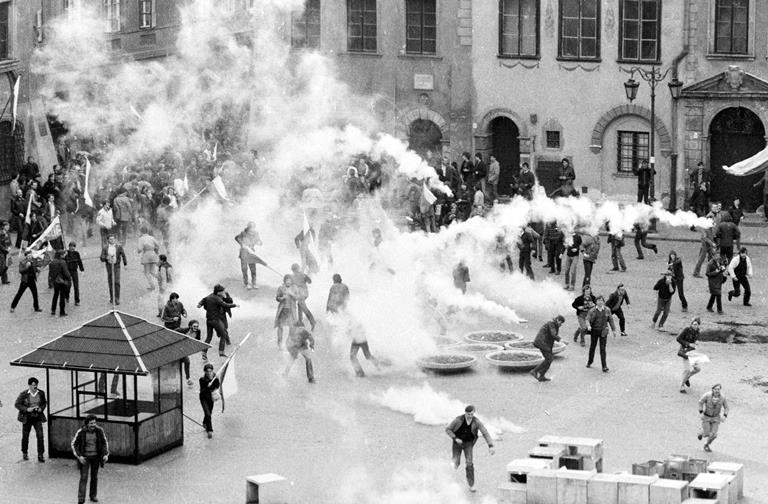
VIENNA — The territory of the Polish People's Republic, which entered upon this week as the seat of a constitutional crisis between an elected government and a military council, and which entered upon yesterday as the line of communication of a Soviet army of invasion upon the soil of Germany, entered upon today as the chief theater of armed resistance to Soviet authority anywhere in the territories of the Warsaw Pact.
The Soviet 5th Guards Tank Army, which the previous evening had entered Warsaw with its forward elements, undertook in the course of the night and the morning the systematic occupation of the Polish capital and of the major cities of the Polish western and southern voivodeships, in operations whose conduct, by the testimony of the journalists who were able to reach Vienna by road from Krakow before the western Polish frontier was sealed at midday, "did not resemble the entry of an allied army into a fraternal state and resembled instead an action of a kind for which the proper precedents must be sought not in the postwar period but in the years preceding it."
The fighting in Warsaw, which had begun on June 24 with the seizure of the Old Town by remnants of the lawful Mazowiecki government's military supporters and elements of the Solidarity underground, intensified through the day to encompass an estimated 30 percent of the urban area, by the count of Western journalists in the city. Soviet armored units, supported by detachments of the K.G.B.'s special-purpose units identified by their distinctive equipment as belonging to the Vympel and Alpha groups, undertook the systematic clearance of the Old Town district in operations beginning at 6 a.m. The operations involved the use of tank cannon and rocket-propelled flamethrowers against fortified buildings. The Royal Castle, restored only in 1984 after its destruction by the Wehrmacht in 1944, was burning by midmorning. St. John's Cathedral, the mother church of Warsaw, was entered by Soviet troops at 11 a.m., a Reuters correspondent reported, and became the site of fighting between Soviet personnel and an unknown number of armed Polish civilians who had taken refuge there with their families. The Cathedral was burning by 1 p.m. The Archbishop of Warsaw, Cardinal Józef Glemp, the Primate of Poland, who had taken refuge at the Cathedral on June 24 and from whose person the resistance had since drawn much of its moral authority, was, at the hour of this dispatch, of unknown fate. The Vatican Secretariat of State, in a statement issued at 6 p.m. Rome time, requested the prayers of the faithful for "all those who at this hour stand witness in the city of Warsaw."
Comparable operations were reported in Krakow, where Soviet forces undertook to clear the Wawel Hill and the Old Town from elements of the 6th Pomeranian Airborne Brigade — the Polish formation that had on the 24th declined to deploy against Solidarity demonstrators and had since become the operational nucleus of armed resistance in southern Poland; in Gdansk, where the Lenin Shipyard, the spiritual center of Solidarity since 1980, was by midmorning the scene of intense fighting; in Wroclaw; in Poznan; in Lublin. The Polish Catholic Church, by every report reaching the West, opened its sanctuaries to the population and was, in nearly every diocese, the only remaining functional civil authority. By evening, accounts had reached Vienna of Soviet operations against parish churches in numbers it was not yet possible to credit.
The 5th Guards Tank Army, in the course of these operations, suffered casualties on a scale that no Soviet formation employed in a constabulary role within an allied state had previously suffered. Polish armed resistance was conducted not by the Polish armed forces, which had ceased after Lech Walesa's address of June 26 to function as instruments of the Military Council, but by individual Polish soldiers acting upon their own initiative, by reactivated Solidarity underground networks of the 1981-86 period, by veterans of the wartime Home Army now in their sixties and seventies who had concealed weapons since the late 1940s for the use of grandchildren they had not, in their own youth, expected to have, and by ordinary Polish citizens taking up the small arms abandoned by Polish Army units that had refused to serve. The character of the resistance was such that the Soviet command, in the course of the day, requested and received from Moscow the diversion to Poland of an additional motor rifle division previously slated for the Iranian theater.
In the German Democratic Republic, by extraordinary contrast, the situation in the urban centers — and most particularly in East Berlin, in Leipzig, in Dresden, in Magdeburg, and in Rostock — has been throughout the day one of an unbroken and unarmed civic occupation of the public spaces by the population of those cities, conducted in the presence of substantial Soviet troop concentrations covering the withdrawal of GSFG forces eastward, and conducted, by every report reaching West Berlin, without a single shot fired by either side.
In East Berlin, where Soviet forces this morning withdrew the units that had on the 23rd conducted the massacre at Alexanderplatz, and where the Soviet rear-area headquarters at Karlshorst remained the last Soviet installation of weight in the city, an estimated 800,000 East Berliners gathered through the day at the Brandenburg Gate, at Alexanderplatz itself — now bearing in its center a field of candles burning amid wreaths of flowers — at the Marx-Engels-Platz, and along the Karl-Marx-Allee. They carried no weapons. They sang no songs. They simply stood. Soviet sentries at the Karlshorst perimeter and at intersections along the line of GSFG withdrawal observed them; they observed the Soviet sentries; neither moved. A West German correspondent of the Frankfurter Allgemeine Zeitung, granted access through the Friedrichstrasse crossing in the late afternoon, described "a city in which a hundred thousand persons stand at any one moment in any one square, and say nothing, and ask nothing, and demand nothing, and merely wait, and the soldiers of the largest army on earth move quietly through them as if not to disturb them, because they have understood that what they are walking through is no longer their city."
In Leipzig, the demonstrations took place at the Nikolaikirche and the surrounding streets, where they had begun in their organized form in the months preceding the present crisis under the direction of Pastor Christian Fuehrer. By 8 p.m. an estimated 250,000 persons were in attendance. Pastor Fuehrer, addressing the crowd from the steps of the church, said only: "We are still here. We have always been here. We shall be here tomorrow." The crowd, by the testimony of one Western correspondent, did not respond. It listened. It dispersed at 10 p.m. in silence, and reformed in the same place this morning, also in silence.
The contrast between the conduct of the Soviet 5th Guards Tank Army in Poland and the conduct of the withdrawing Group of Soviet Forces, Germany, in East Germany, was the subject of analysis among Western diplomats and journalists through the day. The most parsimonious explanation offered, by a West German diplomat reached in Vienna in the evening, was the following: "The Soviet command has assessed, correctly, that the Germans cannot be fought because they will not fight. The Soviet command has further assessed, less correctly but understandably, that the Poles can be fought because they will fight. The Soviet command, having lost in twenty-four hours an army upon the Elbe, is unwilling to lose in seventy-two hours another army upon the Vistula. Therefore the Soviet command has elected to be merciful to the Germans, who do not require mercy, and to be merciless to the Poles, who shall, in the verdict of every century in which I am competent to render judgment, never forget it."
SADDAM HUSSEIN SPOTTED IN RIYADH MEETING WITH SAUDI LEADERS AS IRAQI ARMY MOVES TO IRAN BORDER
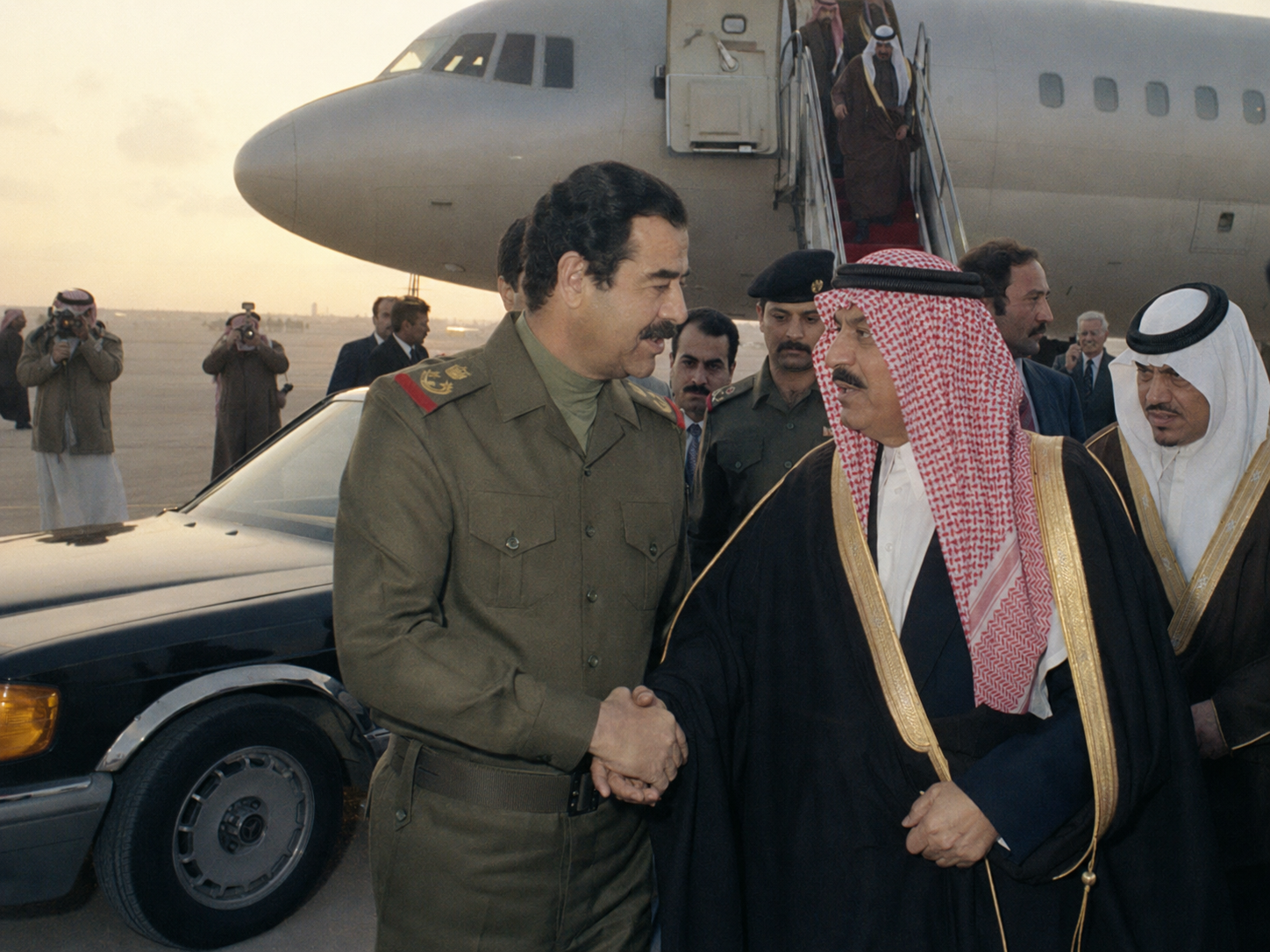
RIYADH — President Saddam Hussein of Iraq, who has not been seen outside the territory of his country in the eleven months since the conclusion of his eight-year war with Iran, who has not made any public statement of any character since the Soviet invasion of Iran on June 19, and whose movements through the past ten days have been the subject of intense and frustrated speculation in every chancellery from Cairo to Islamabad, arrived this morning shortly after 6 a.m. at King Khalid International Airport here aboard an unmarked Iraqi government aircraft, was met upon the tarmac by Crown Prince Abdullah bin Abdulaziz, was driven directly to the royal palace at Maazar, and is, at the hour of this dispatch, in continuous private session with King Fahd bin Abdulaziz Al Saud and the senior leadership of the Kingdom of Saudi Arabia, in a meeting whose existence the Saudi government did not confirm until 4 p.m. local time and whose substance the Saudi government has, at this hour, declined to disclose.
The visit, the first of any Iraqi head of state to the Kingdom in the modern history of either country, and the first occasion on which Mr. Hussein has set foot upon Saudi soil since his pilgrimage to Mecca as a young man in 1978, was preceded over the course of the past 72 hours by a series of preparatory communications conducted at the level of foreign ministers and senior royal counselors, through channels that included the personal mediation of President Mubarak, sources within the Egyptian Foreign Ministry confirmed. Mr. Mubarak had spoken with Mr. Hussein by telephone on no fewer than seven occasions in the previous five days. The Foreign Minister of Kuwait, Sheikh Sabah al-Ahmad al-Jaber al-Sabah, arrived in Riyadh at midmorning today, having traveled overland through the Eastern Province after a private meeting with Mr. Hussein in Baghdad on the previous evening — itself the first such meeting in two years, and the second since the conclusion of the Iran-Iraq war in August 1988.
Concurrently with Mr. Hussein's arrival in Riyadh, the Iraqi armed forces, which throughout the previous ten days had remained in their peacetime garrisons, undertook in the course of the night a co-ordinated movement of an order that had not been observed in the country since the early phases of the war with Iran. Six Iraqi divisions, including the Republican Guard armored divisions Hammurabi, Tawakalna, and Medina; the regular army's 3rd Armored Division; and the 5th and 10th Mechanized Divisions, departed their garrisons in the area of Baghdad and Basra in the early hours of the morning and were moving, at significant rates of advance, eastward toward the Iranian frontier, the U.S. Central Command and Western satellite reconnaissance reported — toward the Khuzestan border in the south, where the front lines of the Iran-Iraq war had run from 1980 to 1988, and toward the Mehran-Dehloran sector in the central frontier zone, where the Iraqi army had achieved its deepest penetrations of Iranian territory in 1980 and had been driven out by 1982.
The movements bore no resemblance to garrison redeployment, to summer maneuvers, or to the rotation of forces. They were the movements of an army concentrating to attack.
In the course of the day, Western intelligence services received and circulated a single document, of unverified provenance and consistent internal detail, purporting to be an Iraqi General Staff operational directive issued at 11 p.m. Baghdad time on June 27. The directive, addressed to the commanders of the deploying formations, instructed those commanders to advance, upon receipt of an unspecified signal, into the territory of Iran along three axes: in the south, toward the city of Ahvaz and the oil installations of Khuzestan, presently held by Soviet forces of the 4th Combined Arms Army; in the center, toward Kermanshah and Hamadan; in the north, toward the Iraqi Kurdish frontier and the Iranian city of Sanandaj. The directive specified, in language whose presence in such a document Western analysts described as without precedent, that the operations were to be conducted "in co-ordination with the armed forces of the United States of America and the Kingdom of Saudi Arabia," that "no engagement is to be initiated against forces identifying themselves as American or as belonging to other states of the Atlantic alliance," and that "the operational objective is the liberation of Iranian territory from Soviet occupation and the restoration of the Iranian people to the conduct of their own affairs."
The Saudi government this evening, in a brief statement read at 8 p.m. by the Minister of Information, Sheikh Ali al-Shaer, confirmed that "His Majesty King Fahd has this day received His Excellency the President of the Republic of Iraq, in the company of the Crown Prince of Kuwait and senior representatives of the United Arab Emirates, of the State of Bahrain, of the Sultanate of Oman, and of the State of Qatar, for consultations of fraternal character upon the situation in the region." The statement made no reference to the Iraqi troop movements. It made no reference to Iran, to the Soviet Union, or to the United States. It announced that "further communications shall follow, as occasion permits."
In Washington, the State Department spokeswoman, Margaret Tutwiler, asked at her evening briefing whether the United States had been informed of the Iraqi movements in advance, replied: "The United States has been in continuous diplomatic contact with the Government of Iraq through channels of long standing and in the company of friends and allies in the region, and the Government of the United States is well aware of the dispositions of the armed forces of Iraq at this time."
Asked whether the United States had requested or had been offered Iraqi participation in operations against Soviet forces in Iran, Mrs. Tutwiler replied: "The Government of Iraq is a sovereign government and shall make its own determinations regarding its own armed forces in light of its own assessment of its own interests."
Asked whether the United States approved of those determinations, Mrs. Tutwiler replied: "We are observing them with attention."
A senior Western diplomat in Riyadh, reached for comment in the late evening, offered the following observation. "Mr. Hussein has spent eleven days saying nothing, in a region that is normally not silent. He has spent the eleven days conducting consultations of which the substance is now becoming visible. He has elected, in the end, to come down on the side of the Atlantic alliance against the Soviet Union, in concert with the conservative Arab monarchies whose money he requires and whose political endorsement his future requires equally. He shall be paid for this — in money, of which he requires a great deal, and in political legitimacy, of which he has acquired today more than in the previous ten years. He has chosen the right side. The fact that there shall be a price to be paid in due course, by him or by us, for his having taken so long to choose, is a calculation for next month. Tonight he is a friend, and tonight he has six divisions on the road, and tonight that is what is required."
In Tehran, the Soviet command made no statement.
In the headquarters of the United States Central Command at Riyadh, where Gen. Schwarzkopf and his staff have been since 6 a.m. this morning in continuous session with Iraqi general officers whose names the United States Defense Department this evening declined to release, lights were burning past midnight.July 29, 1989
BUSH ADMINISTRATION REPORTEDLY AT ODDS WITH GALVIN ABOUT SCOPE OF ADVANCE; "EVENTS ARE RACING TOO FAR TOO FAST"; WEST GERMAN, BRITISH AND US TROOPS ENTER EAST GERMANY IN FORCE, 50 KM FROM BERLIN; SOVIETS IN DISARRAY AS NATO RULES THE SKIES
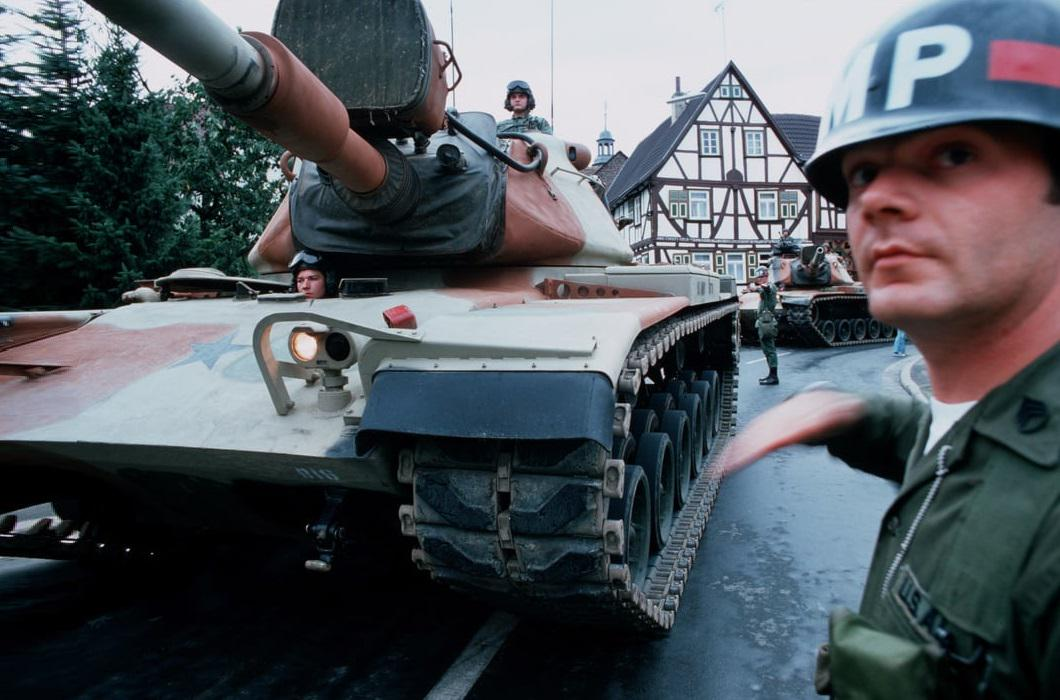
WASHINGTON — A breach of public significance opened today between the Bush Administration and the Supreme Allied Commander Europe, Gen. John R. Galvin, over the scope and the pace of the alliance's pursuit of withdrawing Soviet forces eastward across the territory of the German Democratic Republic, with senior White House officials, speaking on terms of unusual frankness to correspondents in the briefing rooms of the West Wing through the day, expressing what one official characterized as "very serious concern that events are racing too far too fast, in advance of decisions that the political leadership of the alliance has not yet had time to take."
The breach, the existence of which the White House did not on the record acknowledge but the substance of which the President's senior advisers were variously prepared to describe at length on background, came in the wake of military developments through the day that, as correspondents at SHAPE in Casteau, at United States Army Europe in Heidelberg, and in the field with the advancing NATO forces reported, had outrun every operational plan the alliance had previously contemplated.
Lead elements of the United States 1st Armored Division, attached to the United States V Corps for the pursuit phase, reached the East German town of Eisenach in the morning, the Thuringian capital of Erfurt in the early afternoon, and the Wartburg fortress overlooking the Werra valley by 5 p.m., Pentagon spokesmen said at the close of business. The British 1st Armoured Division, advancing on the northern axis with the British I Corps, entered Magdeburg without resistance in the late evening and established forward elements on the western bank of the Elbe. The West German III Corps, advancing in the center along an axis directed unambiguously toward East Berlin, had reached the town of Genthin, fifty kilometers west of the East German capital, a Bundeswehr spokesman in Bonn said at 9 p.m., with leading reconnaissance elements in contact with no Soviet forces of organized character through the day.
Above this advance the airspace of the German Democratic Republic was, in a midnight situation report distributed at SHAPE by Allied Air Forces Central Europe, "uncontested and effectively under the operational control of NATO airpower." The Soviet 16th Air Army, the largest Soviet tactical air formation in the GDR, ceased coherent operations in the course of the day. Soviet airfields at Wittstock, Damgarten, Werneuchen, Allstedt, Köthen, Welzow, Finsterwalde, and Brand-Briesen were overrun, abandoned, surrendered, or under direct NATO air attack. The GSFG headquarters at Wünsdorf, occupied at noon by elements of the West German III Corps, had been abandoned by Soviet personnel in the early morning hours, the Bundeswehr said, with documents found burning in the courtyard and a single Soviet major, identified by his unit insignia as a member of the operations directorate of GSFG, found dead in his office of a self-inflicted wound. Wünsdorf had been the seat of Soviet military authority in central Europe since the 8th of May, 1945. NATO held it before sundown on the 29th of June, 1989.
The civil population of the German Democratic Republic received the advancing NATO forces in conditions ranging from quiet hospitality in the rural districts of Mecklenburg and Brandenburg to the scenes in the Thuringian and Saxon cities of which one West German correspondent embedded with the U.S. 3rd Armored Division in Erfurt cabled to Hamburg the following: "There is a sound that the Federal Republic has not heard in any place in forty-four years. It is the sound of an entire German city in the streets, weeping. They are weeping at the sight of soldiers bearing the Federal eagle, and the Stars and Stripes, and the Union Jack, and the tricolor of France, and the flag of the Netherlands, and they are weeping not from grief and not from fear and not from anything that I am able in my profession to name, and I shall sit in this hotel tonight and I shall try to find for the editor of this newspaper the words for what I have seen today, and the editor of this newspaper shall, I expect, decline to print them, because there are no such words, and the things for which there are no words are not generally to be set down in the newspapers."
It was against this background that the public differences within the American government emerged.
The President, returning to the White House at 4 p.m. from Camp David, where he had spent the morning in consultation with National Security Adviser Brent Scowcroft, Secretary of State Baker, Secretary of Defense Cheney, the Chairman of the Joint Chiefs Adm. William J. Crowe Jr., and his personal foreign policy counsel — and from where, by the account of three senior officials, he had been in continuous and at moments difficult communication with the Prime Ministers of the United Kingdom and Canada, the Chancellor of the Federal Republic of Germany, and the President of France — convened immediately upon his return a meeting of the National Security Council that continued, with brief recesses, until shortly before 11 p.m.
The substance of the meeting, according to officials present and willing in the hours following to characterize its proceedings, concerned three matters in increasing order of difficulty: the response of the alliance to the ultimatum issued by Mr. Kryuchkov on the previous evening, expiring at noon Moscow time tomorrow; the question of whether NATO ground forces should cross from the territory of the German Democratic Republic into the territory of the Polish People's Republic, where the Soviet 5th Guards Tank Army had through the present day continued operations against Polish armed resistance of a character to which the newspapers of western Europe had begun to apply the word "atrocity"; and the question of the operational tempo of the present advance, which Gen. Galvin had announced the previous evening inside what can now be revealed to be East German territory and which had, in the course of the present day, exceeded every estimate the alliance's military authorities had themselves previously entertained.
A senior White House official, speaking on background after midnight, characterized the President's position thus: "The President is fully in support of Gen. Galvin's mission. The President wishes the Soviet armed forces removed from every inch of NATO's territory and every inch of the GDR's territory and every inch of the territory of every state that has been compelled to host them. The President's concern is not with the direction of Gen. Galvin's policy. The President's concern is with the velocity of it. We are, today, looking at lead American armored elements within fifty kilometers of East Berlin, having advanced one hundred and twenty kilometers in eighteen hours against an army that twenty-four hours ago we had assessed as the most formidable in the world. We are looking at the prospect of NATO forces upon the Oder-Neisse line within seventy-two hours, at the prospect of armed engagement with Soviet forces on the territory of the Polish People's Republic against a Soviet army that is, in Poland, not in retreat but in the conduct of operations that resemble those of the Wehrmacht in the same country in 1944, and we are looking at all of this in the context of an ultimatum from Moscow whose nuclear character expires at five o'clock Eastern time tomorrow morning. The President's question is not whether we should be doing what we are doing. The President's question is whether we are in a position to manage what we are doing. The events are racing too far too fast. The President believes that. The President has said so."
The official added: "The President has the very greatest respect for Gen. Galvin. The President is not at war with Gen. Galvin. The President is in dialogue with Gen. Galvin, as the political authority of the alliance is in dialogue with the military authority of the alliance, in the manner contemplated by the constitutions of every member nation. The dialogue is, in the present circumstances, vigorous. It will continue."
Gen. Galvin himself, reached in the late evening for response, declined to comment on the reported differences. He referred reporters to a single sentence of his briefing of the previous evening: "These orders stand. They are operational orders. They shall be executed."
A senior officer of his staff, asked whether the SACEUR had received from the political authorities of the alliance any direction modifying the orders he had issued on the evening of June 28, replied as follows. He spoke on terms of strictest anonymity, and turned to face his questioner with an expression the questioner reported in his cable as weary, amused, and harder than either: "Sir, the SACEUR has received no such direction. The SACEUR has received much advice. The SACEUR is, this evening, considering the advice. Good night, sir."
In Bonn, Chancellor Kohl spent much of the day in private consultation with the leaders of the Bundestag's parties, and committed himself at that meeting to a position aligned, in essential particulars, with that of Gen. Galvin. In Paris, President Mitterrand communicated to the White House in the late evening a position aligned with that of the West German Chancellor. In London, Prime Minister Thatcher, in a statement to the House of Commons at 4 p.m., used the phrase "we shall not falter, we shall not fail, we shall see this through to the end that has been begun." In Ottawa, Prime Minister Mulroney communicated to the White House his "complete support for the operational decisions of Gen. Galvin, and his hope that the political consultations within the alliance shall be conducted with the rapidity that the situation requires."
The President, at the close of the National Security Council meeting near midnight, authorized "the continuation of present operations under the existing rules of engagement, pending further consultation with allied governments tomorrow morning."
Gen. Galvin, the same officials confirmed, had been so informed.
IRAQI TROOPS ENTER SOUTHERN IRAN, MEET NO RESISTANCE; SOVIET FORCES REPORTED WITHDRAWING TO POSITIONS IN NORTHERN IRAN
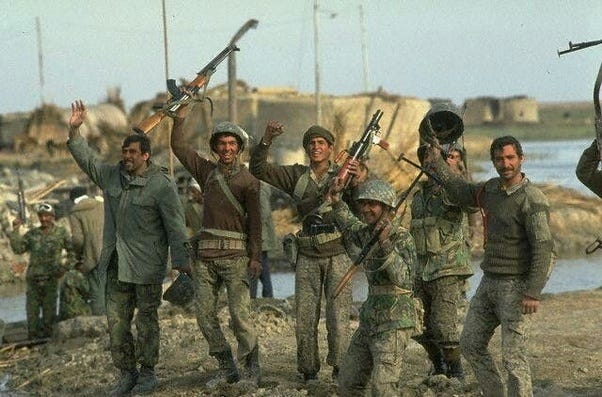
ABOARD U.S.S. INDEPENDENCE — The armed forces of the Republic of Iraq crossed the international frontier with the Islamic Republic of Iran in the early hours of this morning, on three axes corresponding closely to the operational directive whose existence had been reported the previous evening by Western intelligence services, and by midnight tonight had advanced in some places more than two hundred kilometers into Iranian territory without significant engagement and without — in any sector of the Iranian theater available to the observation of the United States Central Command — encountering the forces of the Soviet 4th Combined Arms Army, which had through the day been withdrawing toward the north.
The southern advance, conducted by the Republican Guard armored divisions Hammurabi and Medina supported by the regular army's 3rd Armored Division, crossed the Shatt al-Arab waterway and the southern frontier in the area of Khorramshahr at 4 a.m. local time, advanced through the largely undefended terrain of southern Khuzestan against an Iranian opposition consisting almost exclusively of fragmentary remnants of the Iranian Revolutionary Guard Corps unable or unwilling to offer organized resistance, and reached the outskirts of the oil city of Ahvaz by midmorning. Ahvaz, the largest city of Khuzestan and the capital of the Iranian oil industry, was entered without resistance shortly after 1 p.m., an Iraqi military spokesman in Baghdad said, the population having gathered at the main squares to observe the entry of Iraqi forces in conditions that one Iraqi correspondent of the Al-Thawra newspaper described as "neither hostile nor enthusiastic, but watchful, and disposed to wait." The same Iraqi correspondent reported that the senior Iranian civilian official remaining in the city, the deputy governor of Khuzestan province, met the Iraqi commander at the provincial headquarters and inquired only whether the city's water supply, fuel supply, and electrical generation would be maintained. He was assured that they would be.
The central axis, conducted by the Tawakalna armored division of the Republican Guard supported by the 5th Mechanized Division, crossed the frontier in the Mehran-Dehloran sector and advanced eastward through terrain that had been the most heavily contested of the Iran-Iraq war and that bore, in the testimony of every correspondent traveling with the column, the marks of that contest in unburied form. The advance reached the western approaches to Kermanshah by sundown, against no opposition from any organized military force, and halted there pending consolidation. The northern axis, conducted by the 10th Mechanized Division reinforced by elements of the Iraqi 1st Mechanized Division and operating in a sector politically sensitive on account of its proximity to Iraqi Kurdish territory, advanced more cautiously through difficult country toward the Iranian city of Sanandaj.
Concurrently with the Iraqi advance, the Soviet 4th Combined Arms Army, which had through the previous three days remained in static positions along the line Yazd-Hamadan-Ahvaz, commenced overnight a co-ordinated withdrawal northward, the United States Central Command said, abandoning its forward positions and consolidating along a defensive line extending from the Caspian coast at Rasht through the Alborz mountain passes north of Tehran to the Zagros foothills near Saqqez. Soviet forces in Tehran itself, the airborne and air-assault formations that had occupied the city on June 21, were withdrawing northward through the Karaj corridor in the direction of Qazvin and the Caspian. Soviet armored vehicles, fuel trucks, and engineering equipment were abandoned in considerable numbers along the line of withdrawal, in patterns consistent with the precipitate rather than the orderly evacuation of positions.
Central Command's intelligence directorate told correspondents aboard this carrier in the late evening that the Soviet command in Iran was undertaking the consolidation of its remaining combat power in the four northern provinces of the country — East Azerbaijan, West Azerbaijan, Gilan, and Mazandaran — for the purpose of defending the line of communication back into the Soviet Union itself, against the contingency that the United States, the Iraqi forces, or remnants of the Iranian armed forces should undertake operations to interdict that line. The Soviet 4th Combined Arms Army, the briefer continued, was no longer in any meaningful sense an army of invasion. It was an army of evacuation. The question that remained, at the close of business in the Iranian theater this evening, was whether the army of evacuation would be permitted to evacuate.
Gen. Schwarzkopf, in a press conference held aboard this ship at 6 p.m., addressed the question directly. "My orders from Washington are these. The Soviets can go home. We will not touch them on the way out, and I want that understood at every level of this command. There are conditions. They go in good order. They wreck nothing Iranian on the way — not a pumping station, not a bridge, not a power plant. They hand back our prisoners at the moment they cross the line, and I am talking about Lt. Cmdr. Robert Pennington and Lt. Michael Watson, United States Navy, missing since the twenty-third. And they take everything with them. No garrison. No enclave. No government left behind to run the place for them. No claim. Meet those and we do not fire a shot. Miss one and we do. I have told Gen. Rodionov's liaison officer exactly that. I want an answer by sundown tomorrow."
A correspondent of the New York Times asked the General whether the Iraqi advance had been co-ordinated with the United States Central Command in advance of the present day's operations. The General replied: "It has been the subject of detailed and continuous consultation between the United States Central Command and the Iraqi General Staff, beginning ninety-six hours ago and continuing as of this evening. The objectives of the Iraqi forces, the routes of their advance, the rules of engagement under which they operate, and the political conditions under which they shall withdraw upon the conclusion of operations have been the subject of full understanding between the two governments. I shall not be more specific than that."
A second correspondent asked whether the Iraqi forces would withdraw from Iranian territory upon the conclusion of operations.
The General paused. He replied: "That is a matter that lies beyond the operational responsibilities of this command and within the political responsibilities of the United States Government and the Government of Iraq, in consultation with the lawful authorities of the Iranian state, when those authorities are in a position to be consulted. I shall observe only that the Government of Iraq has communicated to the Government of the United States, in writing, in language whose substance has been provided to the Government of Saudi Arabia and to the governments of the cooperating Arab states, an undertaking that the present operations are conducted for the purpose of liberating Iranian territory from Soviet occupation, that they are not conducted for the purpose of acquiring Iranian territory for the Iraqi state, and that Iraqi forces shall withdraw from Iranian soil at such time as the political authorities of a restored Iranian state, in consultation with the cooperating powers, shall request that they do so. I take that undertaking at its word. I expect that the Government of the United States, and the cooperating governments, shall hold the Government of Iraq to its word. Beyond that I cannot at this hour say."
In Tehran, the Tudeh Party "provisional revolutionary government" ceased in the late evening to exist. Its senior officials, including those installed in the chamber of the Majlis on the previous Monday, had been evacuated by Soviet aircraft from Mehrabad airport in the course of the afternoon, in the direction of the Soviet city of Baku, Western intelligence sources said. The chamber of the Majlis was empty at sundown. The American Embassy compound, occupied by Soviet forces on June 21, was abandoned by them at midmorning, the Soviet flag lowered without ceremony and the buildings left in a condition of disorder but, by Soviet account, "without further damage." The Iranian Revolutionary Guard headquarters on Pasdaran Avenue, abandoned and partially burned on June 18 in circumstances never satisfactorily explained, remained abandoned and partially burned. The Speaker of Parliament Hashemi Rafsanjani, whose whereabouts had been the subject of contradictory reports for ten days, had arrived in the holy city of Qom from an undisclosed location in the south, the BBC Persian Service reported late tonight, and was in consultation with the senior surviving clerics of the city regarding "the matters that confront the Iranian people."
PEACE PROTESTS IN LONDON AND LOS ANGELES AS NUCLEAR SABRE RATTLED IN MOSCOW
LONDON — Protests of substantial size, in some quarters described as the largest political demonstrations seen in either city since the protests against the Vietnam War of the late 1960s and early 1970s, took place today in the centers of London and Los Angeles, drawing crowds estimated by the Metropolitan Police in London at upwards of 250,000 persons and by the Los Angeles Police Department at upwards of 180,000, and centered upon a single demand: that the governments of the United States and the United Kingdom accept the ceasefire proposal advanced by Mr. Kryuchkov on the evening of June 28, that NATO ground forces halt at the inner-German frontier, and that the alliance enter into negotiations with the Emergency Committee for the avoidance of nuclear war.
The London demonstration, organized within twenty-four hours by the Campaign for Nuclear Disarmament under its general secretary, Meg Beresford, in concert with the Society of Friends, the British Council of Churches, and a coalition of Labour Members of Parliament who declined to associate the parliamentary party with the protest, gathered in Hyde Park at noon and proceeded down Park Lane and along the Embankment to a final rally at Trafalgar Square, where the speakers addressed the crowd from beneath Nelson's Column. They included the historian E. P. Thompson, who has emerged from semi-retirement for the occasion; the Rt. Rev. Robert Runcie, the Archbishop of Canterbury, who spoke briefly and in the carefully constructed terms of pastoral concern that have characterized the public interventions of his primacy; the actress Vanessa Redgrave; the Labour M.P. Tony Benn; and Bruce Kent, the former general secretary of CND. The crowd was overwhelmingly orderly. Police arrests numbered fewer than thirty, none for offenses of violence.
Mr. Thompson, in remarks lasting eighteen minutes, said: "I have spent forty years arguing that the nuclear weapon makes the great power confrontation an unsuitable instrument of human politics. I have argued it from the bombing of Hiroshima to the cruise missile deployments of the early 1980s, and I shall argue it tonight in Trafalgar Square as the alliance to which my country belongs prepares to drive its armies across Europe in the direction of a Soviet government that has on the previous evening offered ceasefire and threatened nuclear war in alternation, and that may in either case be the kind of Soviet government against which the use of conventional military force is the worst, the most dangerous, the most blindingly proud course of action available to a Western statesman. I do not say that the men in the Kremlin tonight have any claim upon the patience of the Western public. I say only that the use of nuclear weapons against civilian populations would be a worse outcome than any present configuration of forces upon the German central front, and that any policy that increases the probability of such a use, however marginally, is a policy that the public of this country has a right to question, and that I shall continue to question, in such time as remains to me, in the conviction that the question is the most important that any man may put to the politics of his time."
Archbishop Runcie, addressing the crowd in his capacity as the senior cleric of the established church and in terms approved that morning by the General Synod's emergency standing committee, said: "I have prayed today, as the Holy Father has prayed in Rome on the previous Sunday, for peace and for justice. I find no contradiction between them. I find that they are exacting of those who hold them, and exacting in a particular fashion of those who hold them in the present hour. I ask the Government of Her Majesty to seek peace where peace may be sought without the abandonment of justice; to seek justice where justice may be sought without the destruction of peace; and to remember, in the conduct of policy through the next forty-eight hours, that the Christian conscience does not permit the rendering of either as a hostage to the other."
In Los Angeles, the demonstration assembled at MacArthur Park at 10 a.m. and proceeded along Wilshire Boulevard to a rally at the Federal Building in Westwood. The speakers included Tom Hayden, the California State Assembly member; the singer Jackson Browne; the actor Martin Sheen; the activist and former Roman Catholic priest Daniel Berrigan, who had traveled from New York for the occasion; and Helen Caldicott, the Australian-born physician who had through the early 1980s emerged as the most widely heard public advocate of nuclear abolition in the English-speaking world. Dr. Caldicott, in remarks of some duration and considerable emotion, addressed herself specifically to the question of the Kryuchkov ultimatum.
"The man in Moscow," Dr. Caldicott said, "is a tyrant. He has murdered Boris Yeltsin in a public execution. He has murdered the citizens of Vilnius and of Berlin. He has invaded Iran, and Germany, and made of Poland a graveyard. He is by any honest measure a worse man than Brezhnev or Andropov in their times, and there are among us those who shall say that no government formed by such a man may be the subject of negotiation by the civilized world. I do not disagree. I say only that he has, by his own statement upon the television of his country, threatened the use of weapons that, if used, shall not distinguish between the citizens of his country and the citizens of ours; that shall not distinguish between the soldiers of the alliance and the children of the West German towns through which the alliance is at this hour passing; that shall not distinguish between the Russian babushka in her village near Smolensk and the man at the desk in the Lubyanka who is, by the night's news, no longer entirely the master of the keys to the things he claims to control. I say that the use of such weapons would be a catastrophe of which the human race may not recover. I say that any policy that brings the use of such weapons closer is a policy that the citizens of the West are entitled to question, and to oppose, and to demand, in the language of the streets which is the only language that the politicians of any country reliably hear, that they reconsider. We are here in this square, in the city of Los Angeles, in the United States of America, on this Thursday afternoon, to ask the President of the United States to reconsider. He may, if he chooses, decline. He may not, if he chooses, decline to hear us."
Smaller protests of similar character were reported through the day in San Francisco, in Seattle, in Boston, in Chicago, in Madison, Wisconsin, and in New York, where a candlelight vigil at the Cathedral of St. John the Divine in Manhattan was attended by approximately 12,000 persons and led by the dean of the cathedral, the Very Rev. James Parks Morton. In Europe, demonstrations of various sizes were reported in Amsterdam, where the crowd in Dam Square was estimated at 60,000; in Stockholm; and in Copenhagen.
Conspicuously absent from any city of consequence was a demonstration in West Germany. The West German peace movement, which through the early 1980s had brought into the streets of the Federal Republic crowds of unprecedented size against the deployment of American intermediate-range missiles, had suspended all such activity for the duration of the present conflict, its surviving organizers told West German television, on the explicit grounds that the Federal Republic of Germany was, this week, the country at whose continued existence the Soviet government had this Tuesday morning struck. In any event, Germans were occupying themselves with caring for refugees from the front line, both East and West.
In Washington, the President's press secretary, Marlin Fitzwater, asked at the close of the day's regular briefing whether the President had a response to the demonstrations in London and Los Angeles, replied: "The President has the response of every President of the United States to the lawful exercise of the right of public assembly by the citizens of this country and of friendly countries. The President is grateful to live in a system of government in which such exercise is permitted. The President shall, in the hours immediately ahead, act, when he acts, with the gravity that the moment requires. He has nothing further at this hour and is going to bed."
June 30, 1989
NATO TROOPS ENTER BERLIN TO SCENES OF WILD JUBILATION; FIRST US TROOPS CROSS INTO POLAND; SOVIET FORCES IN TOTAL ROUT; KALININGRAD REPORTED UNDER ATTACK BY NATO BOMBERS
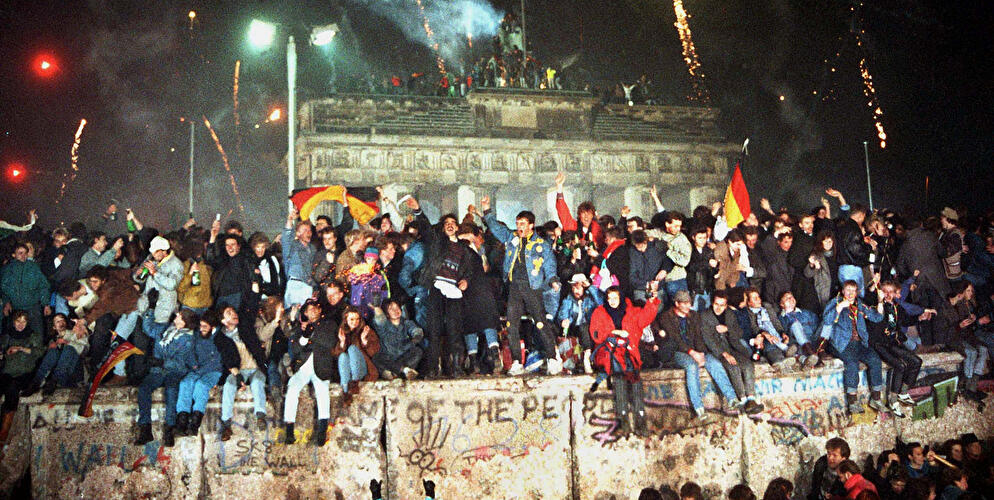
BONN — Lead elements of the Bundeswehr's 7th Panzer Division entered the city of Berlin from the west at 9:14 this morning, passing the eastern boundary of the British sector at the Brandenburg Gate against no resistance from any organized force, and were received in the streets of the eastern half of the city by crowds whose size the city authorities at the close of business declined to estimate beyond "a number of human beings sufficient to render the question of the number obsolete," in scenes of public emotion that the international correspondents present were uniformly unable to describe in language they themselves regarded as adequate, and that the Reuters correspondent of forty years' standing in this country, in his evening cable to London, declined to attempt.
The 7th Panzer Division was followed within the hour by leading elements of the United States 3rd Armored Division, advancing from the south through the suburb of Zossen, and by elements of the British 4th Armoured Brigade advancing from the southwest. Soviet forces in the city, consisting principally of the rear-echelon administrative and signals personnel of the Group of Soviet Forces, Germany, who had not been evacuated in the previous forty-eight hours, surrendered en masse at the Karlshorst headquarters at 11 a.m. The Soviet flag was lowered from the headquarters compound at 11:23 a.m. by a non-commissioned officer of the United States 1st Battalion, 36th Infantry Regiment, who was photographed by a correspondent of the Washington Post in the act of folding the flag, with care, and presenting it to a Soviet captain who stood at attention to receive it. The captain, asked by the correspondent through an interpreter what he intended to do with the flag, replied: "I shall send it home. It is, after all, our flag. It is not the flag of those who have lately employed it. It shall return to its country, and so shall I."
The eastern boundary of the city was crossed at 1 p.m. by elements of the Bundeswehr advancing toward the Oder. The Brandenburg Gate, throughout the day, was the subject of continuous traffic between the two halves of the city by the population of both. At 6 p.m., the Governing Mayor of West Berlin, Walter Momper, and the Lord Mayor of East Berlin, Erhard Krack — who had since the previous Sunday remained in his office, having declined to flee with the East German leadership and having presided through the past five days over the orderly maintenance of the city's basic services in the absence of any functioning central authority — met at the Gate in the presence of an estimated one and a half million Berliners and of a number of correspondents whose dispatches consist, in the main, of paragraph-length silences. Mayor Momper, embracing Mayor Krack, said: "Brother, you have held the city. We are home."
Mayor Krack, in a statement issued shortly afterward through the Berlin city hall on Alexanderplatz, declined the office that the population of the city had thrust upon him over the previous week. He announced instead the convocation, for July 4 — the choice of date, his statement noted, was "in homage to a republic whose example we may yet, in some measure, emulate" — of a constituent assembly of representatives elected by the districts of the city, "to determine, by the methods proper to a free people, the arrangements under which the city of Berlin and the German Democratic Republic shall be reconstituted, dissolved, or otherwise resolved into a German political order whose final form shall be the choice of the German people themselves and of no other."
In Bonn, Chancellor Kohl, in a statement issued at 9 p.m., declared the freedom of movement between the two halves of Germany "complete, as of this hour, and not subject to revision," and announced the immediate dispatch to East Germany of West German civil administrators, currency officials, and humanitarian relief, "in such measure as the Federal Republic possesses, and may be quickly summoned, against the necessities of the German people in those provinces in which the necessities have been longest deferred."
Into Poland
The crossing of the Oder-Neisse line by NATO ground forces, the question that had on the previous day been the subject of the disagreement within the Bush Administration and between the Administration and the Supreme Allied Commander, was decided in the early hours of this morning by what officials at SHAPE described as "a development of operational facts that overtook the deliberations of the political authorities, in conditions to which the conventional categories of operational discipline are imperfectly suited."
The 5th Guards Tank Army, which had through the previous three days conducted operations against Polish armed resistance in the cities of western Poland, withdrew in the course of the previous night from Wroclaw, Poznan, and Szczecin, and consolidated in defensive positions along the eastern bank of the Vistula in the area of Warsaw. The Polish armed resistance, in coordination with elements of the Polish armed forces that had over the preceding seventy-two hours emerged from the strategy of inactivity counseled by Mr. Walesa's broadcast of June 26 to assume an active role in the liberation of Polish territory, occupied during the morning the cities so abandoned and announced through the underground broadcasting facilities of Radio Solidarność the formation, in Poznan, of a "Provisional Government of National Restoration" headed by Mr. Walesa as President pro tempore, by Mr. Mazowiecki — whose freedom from custody had been secured by means upon which Mr. Walesa's announcement did not elaborate — as Prime Minister, and by a council of ministers drawn from the constitutional government of June 19 and from the political and intellectual leadership of the previous decade.
The Provisional Government of National Restoration, in its first communication, formally invited "the armed forces of the Atlantic alliance, in such numbers and with such dispatch as their commanders shall determine, to enter the territory of the Polish state for the purpose of completing the expulsion of foreign armed forces from that territory and of assisting the lawful authorities of the Polish state in the preservation of order and the protection of the population." The communication was transmitted at 6 a.m. local time to the headquarters of NATO at Casteau, to the headquarters of the United States Army Europe at Heidelberg, and to the offices of the Federal Chancellor in Bonn.
Lead elements of the United States 3rd Armored Cavalry Regiment, advancing on the northern axis from the area of Magdeburg, crossed the Oder-Neisse line in the area of Frankfurt-an-der-Oder at 11 a.m. and were met on the eastern bank by Polish irregular forces flying the Polish national colors. Lead elements of the West German III Corps crossed at Slubice at 1 p.m. By the close of business, NATO ground forces were in Poznan, in Wroclaw, and at the southern outskirts of Szczecin. Polish crowds of considerable size gathered at every major town through which the columns passed.
The Soviet 5th Guards Tank Army, having consolidated along the Vistula, did not on this day engage NATO forces. It had received orders from Moscow whose substance was not yet known, Western intelligence said in the late evening, but whose effect was a continued pause in operations of any character.
The Air War, and Kaliningrad
In the air, NATO operations through the day extended for the first time to targets within the territory of the Soviet Union itself, in operations whose authorization at the political level required, by the account of Pentagon officials, "a final tier of consultation among the Atlantic governments" that was conducted by telephone in the small hours of the morning Washington time. The targets were the airfields, port facilities, and command-and-control installations of the Soviet Kaliningrad oblast — the exclave on the Baltic coast that constituted the forward Soviet basing area for both the Baltic Fleet and the air assets supporting operations in northern Poland and the Baltic states.
Strikes against Kaliningrad and its associated military facilities were conducted in the course of the day by F-117A Nighthawk aircraft, by F-15E Strike Eagle aircraft of the United States Air Force, by Tornado GR.1 aircraft of the Royal Air Force operating from Marham and from Brüggen, and by ship-launched Tomahawk cruise missiles from the U.S.S. Iowa and the U.S.S. Wisconsin in the North Sea. They included the Soviet Naval Air Force base at Donskoye, the Baltic Fleet headquarters and shipyard at Baltiysk, the strategic communications facility at Bagrationovsk, and the air defense radar network covering the western approaches to the Soviet Union along the Baltic coast. NATO aircraft losses through the day were one Tornado GR.1 (crew killed) and one F-15E (crew ejected, recovered by combat search and rescue from the Baltic at sunset). Soviet aircraft losses on the ground at Donskoye were substantial, NATO reconnaissance reported; losses in the air, against negligible NATO air defense penetration, were minimal.
The strikes were the first NATO operations of the war to take place upon territory administered by the Soviet Union as Soviet territory rather than as occupied or allied territory. The political character of the action was, accordingly, the subject of an extraordinary statement issued at 4 p.m. by Gen. Galvin at SHAPE in Casteau, in language plainly drafted in close consultation with the political authorities of the alliance, and reading in its operative paragraph as follows:
"The military operations conducted this day by forces of the Atlantic alliance against military installations within the Kaliningrad oblast of the Russian Soviet Federative Socialist Republic are conducted for the sole purpose of the suppression of military forces engaged in active operations against the Atlantic alliance and its allies. They are not directed against the territory, the sovereignty, the population, or the legitimate institutions of the Soviet Union or of the Russian Federation. The alliance does not seek the territory of the Soviet Union, in Kaliningrad or elsewhere. The alliance shall, upon the achievement of the operational and political objectives that the alliance has, in this conflict, repeatedly stated, withdraw to the borders from which it commenced operations on the morning of the 28th of June 1989. The alliance shall not be drawn, by the conduct of an unconstitutional government in Moscow, into a war against the Russian people. The alliance shall be drawn into the suppression of the military forces of that unconstitutional government, wherever those forces are engaged in operations against the alliance, and shall continue to suppress them until those forces cease such operations or until that unconstitutional government ceases to exist. The alliance hopes for the latter outcome. The alliance prepares for the former."
SOVIET TELEVISION ANNOUNCES CIVIL DEFENSE EVACUATIONS OF ALL MAJOR SOVIET CITIES; "THREAT LEVEL AT MAXIMUM"; ANPILOV QUOTED ON SOVIET TV, "OF WHAT USE IS A WORLD WITHOUT THE SOVIET UNION?"
MOSCOW (via Helsinki) — At 1 p.m. Moscow time today, sixty minutes after the expiration of the ceasefire ultimatum issued by Mr. Kryuchkov on the evening of June 28, the main television channel of the Soviet Union interrupted its scheduled programming for an announcement that every Western government to which the broadcast was made available within the ensuing hour judged the most serious civil-defense communication issued by any nuclear power to its own population since the establishment of nuclear arsenals on either side of the Cold War, and that has, since its issuance, prompted in every capital of the Atlantic alliance a series of consultations whose outcome will be known only in the hours immediately ahead, and upon which the lives of an unknown but potentially enormous number of human beings, in territories spanning two continents, may now depend.
The announcement was read by an unidentified male announcer in conditions of evident strain, accompanied on screen by the seal of the Civil Defense Forces of the U.S.S.R. (the Voyska Grazhdanskoy Oborony) — an organization of approximately 150,000 personnel constituted in 1971 for the precise purpose of conducting the evacuation and shelter of the Soviet civil population in the event of nuclear attack, and never previously activated in the historical experience of any Western intelligence service. It ran as follows.
"Citizens of the Soviet Union. The State Committee for the State of Emergency in the U.S.S.R., upon the recommendation of the General Staff of the Soviet Armed Forces and of the Civil Defense Forces of the U.S.S.R., and in light of the continuing aggressive military operations conducted by the armed forces of the United States of America and its allies against the territories of friendly socialist states and, on this day, against the territory of the Soviet Union itself, has determined to raise the civil defense threat level of the Soviet Union to the maximum level provided by the doctrine of civil protection. Citizens of Moscow, of Leningrad, of Kyiv, of Kharkov, of Odesa, of Minsk, of Riga, of Vilnius, of Tallinn, of Gorky, of Sverdlovsk, of Chelyabinsk, of Novosibirsk, of Volgograd, of Kuybyshev, of Perm, of Ufa, of Kazan, of Voronezh, of Saratov, of Krasnodar, of Rostov-on-Don, of Tbilisi, of Yerevan, of Baku, of Tashkent, of Alma-Ata, of Frunze, of Ashgabat, of Dushanbe, of Murmansk, of Arkhangelsk, of Vladivostok, of Khabarovsk, of Petropavlovsk-Kamchatsky, and of all cities of the Soviet Union of population in excess of one hundred thousand persons, are instructed to proceed in an orderly fashion, in accordance with the civil defense plans previously promulgated and in coordination with the local civil defense authorities, to the dispersal points and shelter locations designated for their place of residence and place of employment. Children, the elderly, and pregnant women shall be given precedence in transportation. Workers in essential industries and in the armed forces shall remain at their posts. The state shall provide. The state shall protect. The state shall prevail."
The announcement was repeated three times. It was followed at 1:15 p.m. by an address from Anatoly Lukyanov, the chairman of the Emergency Committee, who appeared on Soviet television for the first time since the day after the coup, in conditions of visible deterioration that several Western analysts familiar with his appearance described as "consistent with the heavy use of medication," and read for approximately seven minutes a statement urging the Soviet population to "demonstrate the steadfastness of the Soviet people in the face of imperialist aggression of unprecedented gravity."
It was followed at 1:30 p.m. by a statement from Mr. Kryuchkov, in which the Chairman of the Committee for State Security announced that "the Soviet armed forces are this hour at the highest state of combat readiness contemplated by the doctrine of the Soviet state," that "the Strategic Rocket Forces of the U.S.S.R. have been authorized the full range of preparatory measures consistent with the present level of threat," and that "any further military operations conducted by the Atlantic alliance upon the soil of the Polish People's Republic, the German Democratic Republic, the Czechoslovak Socialist Republic, or upon the soil of the Soviet Union or of any of its constituent republics, shall be met by the Soviet armed forces with the entirety of the means at the disposal of those armed forces."
It was followed at 2 p.m., to the astonishment of every foreign observer of Soviet broadcasting, by a live appearance of approximately fourteen minutes' duration by Mr. Viktor Anpilov, the Communist journalist of nationalist tendency who had appeared briefly on Soviet television in early June denouncing the proposed cuts to the Soviet defense budget and who had not, in the intervening period, been associated in any visible capacity with the Emergency Committee. Mr. Anpilov, identified on screen by the chyron "Member of the Pamyat Movement," delivered an address of escalating intensity in which he condemned the "perfidy of the imperialists, the cowardice of the German bourgeoisie, the venality of the Polish lackeys, and the treason of those Russians who have, in this hour, sided with the foreigner against the Motherland," and called upon the Soviet armed forces to "execute, with whatever instruments are required, the duty for which the Soviet armed forces have been equipped at such cost over the entirety of the postwar period." He concluded with a sentence that, by the close of business this evening, had been broadcast in translation in every Western capital and printed in the late-edition headlines of every newspaper of consequence in the Atlantic alliance: "And if the choice that confronts the Soviet Union in this hour is the choice between the survival of the world and the survival of the Soviet Union, then I say to the men in the Kremlin, and I say to the men of the Strategic Rocket Forces, and I say to every honest Russian: of what use is a world without the Soviet Union?"
Mr. Anpilov was not interrupted, contradicted, or qualified in his remarks by any other Soviet broadcasting personality, by any official commentator, or by any official statement following the broadcast. The broadcast was rebroadcast, in its entirety, on the Vremya evening news at 9 p.m.
The civil defense evacuation, ordered at 1 p.m., proceeded through the day in the major cities of the Soviet Union in conditions of considerable chaos. In Moscow, the Metro system was operating to capacity through the afternoon, Western correspondents at the embassies on the Garden Ring reported, with the deeper stations of the system — the Kirovskaya, the Mayakovskaya, the Park Kultury, the Taganskaya — designated by long-standing civil defense plans as shelter locations and admitting in the course of the day perhaps two million Muscovites. The great rail stations of the city — the Belorussky, the Kursky, the Kazansky, the Yaroslavsky — were overwhelmed by citizens attempting to evacuate to the countryside, in numbers and in conditions that the city authorities, by the late evening, were no longer in a position to manage. Reports of crushing injuries, of episodes of panic, of incidents in which armed militia personnel fired warning shots over the heads of crowds, reached Western correspondents through the day in numbers and in detail that the correspondents themselves declined, by the conventions of their profession in such circumstances, to credit beyond the level of pattern.
In Leningrad, in Kyiv, in Minsk, the situation was similar. In Kyiv, it was further complicated by the refusal of Ukrainian municipal authorities, in coordination with the People's Movement of Ukraine for Restructuring, to acknowledge the legitimacy of the Moscow civil defense order and to conduct their own civil protection arrangements upon a Ukrainian, rather than a Soviet, framework. The First Secretary of the Communist Party of Ukraine, Mr. Ivashko, addressed an extraordinary plenum of the Central Committee in the late afternoon, sources within the Central Committee of the C.P.U. said, and stated, in language unprecedented in the postwar history of his party, that "the Ukrainian Soviet Socialist Republic shall not be the locus of nuclear weapons employed in the defense of a government in Moscow that has, by the testimony of its own conduct over the past thirteen days, ceased to act on behalf of the Soviet peoples it claims to represent."
The Tudeh Party "provisional revolutionary government" of Iran, evacuated to Baku on the previous evening, had ceased to issue any communications, according to dispatches reaching Ankara through the Turkish Foreign Ministry.
In the city of Murmansk — where Mr. Gorbachev has been held, by every account that has reached the Western governments through the past two weeks, at a naval medical facility — the situation was of "an exceptionally fluid character," sources within the Norwegian Ministry of Foreign Affairs said, citing Soviet citizens reaching the Norwegian frontier in the afternoon. Soviet naval personnel of the Northern Fleet were in the streets of the city in considerable numbers. The Northern Fleet commander, Adm. Felix N. Gromov, had not appeared at fleet headquarters since the previous evening. The naval medical facility at which Mr. Gorbachev is held was, in the late evening, "the subject of arrangements of which the substance is not, at the present hour, susceptible of communication," in the careful phrasing of one Norwegian official whose own evident excitement his careful phrasing did not disguise.
In Washington, the President convened the National Security Council at 6 a.m. and remained in continuous session with his senior advisers through the day. The White House, in a single-sentence statement issued at 8 p.m., declared: "The United States of America does not respond to ultimatums. The United States of America responds to facts. The President of the United States is, this hour, attending to the facts."
Gen. Galvin, asked at SHAPE late this evening whether the orders he had issued the previous night for the continued advance of NATO forces remained in effect, replied — and this is the entire substance of his reply, in which he did not elaborate, in which he took no questions, and from which he turned and departed the briefing room: "They do."
Strategic Air Command raised its alert posture at 5 p.m. Eastern time to DEFCON 1, sources within the Pentagon's National Military Command Center confirmed in the late evening — the highest level of strategic readiness contemplated by the system of Defense Conditions, and a level not previously achieved by the United States in the history of that system. The Pentagon declined comment.
In Rome, the Holy Father entered the chapel of the Apostolic Palace at 7 p.m. local time and remained in prayer through the evening. The doors of the basilica of St. Peter's were thrown open, and have remained open through the night, and the candles upon every altar of the basilica are lit, and shall be tended through the hours that remain.
July 1, 1989
NUCLEAR STRIKES HIT LONDON, PARIS, WASHINGTON, MUNICH AND NEW YORK; MASSIVE LOSS OF LIFE REPORTED; US RESPONSE AT THIS HOUR UNKNOWN
ATLANTA — Five nuclear weapons of unidentified yield, launched in a coordinated salvo by submarines of the Soviet Northern Fleet operating in the Barents Sea, detonated within a window of approximately fourteen minutes between 4:30 and 4:44 Coordinated Universal Time this morning over the cities of London, Paris, Munich, Washington, and New York, in the first use of nuclear weapons in armed conflict since the bombing of Nagasaki on the 9th of August 1945, and the first use of nuclear weapons against the territory of the Atlantic alliance and against the territory of the United States in the history of those nations.
The strikes have, in the twelve hours since their occurrence, produced confirmed and presumptive deaths whose number cannot at this hour be reliably estimated, that fall almost entirely upon the civilian populations of the targeted cities, and that will, when finally tabulated, stand as the largest single-day loss of human life in any event of any character in the recorded history of the human species. The Federal Emergency Management Agency of the United States, in a statement issued at noon Eastern time from a location it declined to specify, gave preliminary estimates of immediate American fatalities at "in excess of two million persons, with substantial uncertainty in the upper bound." Comparable preliminary estimates for the European cities were not, at the hour of this dispatch, available. The total of immediate fatalities across the five cities will not, on any estimate so far offered, fall below three million. It may approach, or exceed, twice that figure. Subsequent fatalities from injury, from radiation exposure, from the collapse of medical infrastructure, and from causes yet to be identified will multiply the immediate figure by a factor that the authorities have declined, this morning, to specify.
The President of the United States, the Prime Minister of the United Kingdom, the President of the French Republic, and the Chancellor of the Federal Republic of Germany were confirmed alive, at locations and in arrangements upon which the governments of those nations have declined elaboration, by statements issued through their respective national broadcasting authorities in the four hours following the strikes. The United States Strategic Air Command, the Strategic Rocket Forces of France, the strategic forces of the United Kingdom, and the conventional forces of the Atlantic alliance in Europe and the Atlantic theaters remain "intact, in communication, and in the readiness postures contemplated by the orders previously issued," the Pentagon said in a statement issued at 10 a.m. Eastern from the National Military Command Center alternate facility at Site R. The launch authorities of the Atlantic nuclear powers were confirmed, in the same statement, to "reside, as they have at every hour of the present conflict, in the constitutional offices of the political authorities of those powers." No further statement regarding the response of the United States to the events of the morning was issued by any organ of the United States Government in the course of the day.
The Strikes
The strikes were detected in their boost phase by the United States Defense Support Program satellites in geostationary orbit at 04:14 UTC, with the first warning issued by the North American Aerospace Defense Command at Cheyenne Mountain, Colorado, at 04:15 UTC. The launches were identified within ninety seconds as submarine-launched ballistic missiles originating from a position in the Barents Sea consistent with a single Delta-class strategic submarine of the Soviet Northern Fleet, designated by NATO surveillance as having departed its base at Yagelnaya in the Kola Peninsula on the previous afternoon. The flight times to the European targets were approximately sixteen minutes; to the North American targets, approximately twenty-eight minutes. The flight profiles of the warheads, after separation from their launch buses, conformed to the patterns of the Soviet RSM-50 (NATO designation SS-N-18) reentry vehicles, of which a Delta-III submarine carries forty-eight, in sixteen missiles of three warheads each. Five warheads were fired. Forty-three were not.
The character of the strike — five weapons, one per city, all directed against population centers, none directed against military installations, none directed against the strategic forces or command-and-control infrastructure of the United States or its allies — was assessed by every American and allied military authority within the first hour as a deliberate demonstrative employment, intended to coerce a political outcome rather than to commence the general nuclear exchange contemplated by the strategic doctrines of either side. One boat, a partial salvo, no military targets: the pattern was read as the operational choice of a faction inside the Soviet command rather than the execution of the Soviet war plan. The identity of that faction, the nature of its authority, and the extent to which the residue of the Soviet strategic forces — the silo-based intercontinental ballistic missiles of the Strategic Rocket Forces, the road-mobile and rail-mobile missiles, the Long-Range Aviation bomber forces, and the remaining ballistic missile submarines of the Northern and Pacific Fleets — were under its operational control were the subject of intense analysis through the morning. The conclusions of that analysis were not made public.
Each city is, this morning, its own subject. Each subject is one upon which the writing of our generation will be forever inadequate. May God have mercy on us all.
London
The warhead detonated over central London at 04:32 Coordinated Universal Time — 05:32 British Summer Time — with ground zero confirmed by satellite reconnaissance as approximately Trafalgar Square. The yield, assessed from blast and seismic signatures by the United States Air Force Technical Applications Center at Patrick Air Force Base, Florida, was estimated at 500 kilotons. The detonation was an airburst at approximately 1,200 meters, the configuration that maximizes blast damage against urban targets. The Palace of Westminster, the buildings of Whitehall, the Foreign and Commonwealth Office, the Treasury, the Ministry of Defence, the Admiralty, Buckingham Palace, the terminals of British Rail at Charing Cross and Victoria, and the financial district of the City of London were all within the radius of total destruction. The London Underground, in the lines closest to ground zero, had suffered catastrophic structural compromise, London Regional Transport reported from its Surrey emergency control facility. The deeper stations of the Northern, Bakerloo, and Piccadilly lines, into which substantial numbers of central London residents had descended in the preceding twenty-four hours under unofficial instruction, had in some cases held against the blast, surface assessment teams reported.
The Royal Family was confirmed at Balmoral, in Aberdeenshire, where Her Majesty had been since the previous Wednesday. The Prime Minister, Mrs. Thatcher, was confirmed at the central government war headquarters at the underground complex known as PINDAR, together with the senior members of her Cabinet. The Leader of the Opposition, Mr. Kinnock, was confirmed at a regional government bunker in the West Midlands. The Speaker of the House of Commons, the Lord Chancellor, the Archbishop of Canterbury — at Lambeth Palace at the hour of the strike — and an unknown but substantial number of Members of Parliament present at the night sitting of the House had not been confirmed alive at the hour of this dispatch.
The Prime Minister, in a recorded statement broadcast at 9 a.m. London time by the BBC from its wartime broadcasting facility at Wood Norton in Worcestershire, said: "An hour and a half ago, an unconstitutional government in Moscow detonated a nuclear weapon over the city of London. I am told I may not give you the casualty figures I have been given. I shall give them to the House of Commons, in due course, in whatever form the House by that hour takes. I shall say this. The men who did this have not won by it. They have lost. They have put themselves, by their own hand, beyond the reach of anything a civilized government may henceforth extend to them. There will be no negotiation. There will be no terms. There will be an answer. It is being settled at this hour with our allies, and it will be made known when it is made. Until then I ask of the British people what the British people have always given without my asking. May God have mercy upon the dead. May He give the living the strength required."
Paris
The warhead detonated over Paris at 04:33 UTC — 06:33 Central European Summer Time — at an airburst altitude of approximately 1,000 meters above the Île de la Cité. The yield was assessed at approximately 500 kilotons. Notre-Dame de Paris, the Conciergerie, the Sainte-Chapelle, the Palais de Justice, the Hôtel de Ville, the Préfecture de Police, the Louvre, the Tuileries, the Place de la Concorde, the National Assembly, the Élysée Palace, the Senate at the Luxembourg Palace, the Gare du Nord and the Gare de l'Est, and the historic 1st through 8th arrondissements were within the radius of total destruction. The Paris Métro, in the central network, had like its London counterpart suffered catastrophic damage in the central tunnels and had, in the deeper stations, held in places against the blast, the Régie Autonome des Transports Parisiens reported from a regional facility at Bobigny.
President Mitterrand was confirmed at the strategic command facility at Taverny, in Val-d'Oise, where he had been since the previous afternoon. The Prime Minister, Mr. Rocard, was confirmed at the alternate command facility at Mont Verdun, in the Rhône. The Speaker of the National Assembly and the Speaker of the Senate, both reported in Paris at the hour of the strike, had not been confirmed alive at the hour of this dispatch.
The President, in a statement broadcast at 9 a.m. Paris time over Radio France from a facility designated only as "the Center," addressed the French people in a register that the senior correspondents of the French press, in the years to come, will study. He said in part: "This morning, the city of Paris was struck by a weapon whose use was contemplated by the architects of the strategic order under which my generation has lived its entire adult life, and contemplated by them with the conviction that it should never be employed. It has been employed. It has been employed against my city. Against the city in which I learned to read. Against the city in which the Republic has been four times proclaimed and to which the Republic, in the testimony of its history, has four times returned. La République a connu de tels matins. Elle saura connaître les soirs qui suivront. The Republic has known such mornings. She shall know how to know the evenings that shall follow."
Washington and New York
The warhead intended for Washington detonated at 04:42 UTC — 12:42 a.m. Eastern Daylight Time — at an airburst altitude of approximately 1,100 meters. Ground zero was assessed as approximately the southern bank of the Tidal Basin, equidistant from the Capitol, the White House, the Pentagon, and the Lincoln Memorial. The yield was assessed at approximately 500 kilotons. The monuments of the National Mall, the United States Capitol, the White House, the Old Executive Office Building, the departments of the federal government at Foggy Bottom and along Constitution Avenue, the headquarters of the United States Department of Defense at the Pentagon, and the residential and commercial districts of the District of Columbia within a radius of approximately five kilometers of ground zero were within the radius of total or near-total destruction. The Federal Emergency Management Agency, operating from Mount Weather in Bluemont, Virginia, declined at this hour to provide a preliminary fatality estimate for the District of Columbia.
The President was confirmed aloft aboard the National Emergency Airborne Command Post — the militarily designated E-4B aircraft, presently stationed in continuous airborne alert orbit in the central United States — together with the Secretary of Defense, the Chairman of the Joint Chiefs of Staff, the National Security Adviser, and the small staff that the laws governing the continuity of the American government provide for the support of the President in such circumstances. The Vice President was confirmed at the underground complex at Site R near Blue Ridge Summit, Pennsylvania. The Speaker of the House of Representatives, Mr. Foley, was confirmed at the congressional emergency facility at the Greenbrier in White Sulphur Springs, West Virginia, together with an unspecified but substantial number of Members of Congress who had on the previous evening, by orders issued under the authority of the Speaker and the Senate Majority Leader, departed Washington for the facility. The Senate Majority Leader, Mr. Mitchell, and the Senate Minority Leader, Mr. Dole, were confirmed in their company. The Chief Justice of the United States, Mr. Rehnquist, was confirmed at an undisclosed location.
The warhead detonated over New York at 04:44 UTC — 12:44 a.m. Eastern Daylight Time — at an airburst altitude of approximately 1,200 meters. Ground zero was assessed as approximately the financial district of lower Manhattan, near Wall Street. The yield was assessed at approximately 500 kilotons. Lower Manhattan, the financial district, the World Trade Center, the New York Stock Exchange, the South Street Seaport, much of the Brooklyn Heights district across the East River, much of the Jersey City waterfront across the Hudson, and the deep transportation infrastructure connecting these districts were within the radius of total destruction. The detonation occurred in the small hours of a Saturday morning. The population of lower Manhattan at that hour, including those evacuating in response to the civil-defense advisories issued in the preceding twenty-four hours and those who had remained at their posts in the financial and governmental institutions of the city, has not been estimated by any authority in a position to do so.
The Mayor of New York, Mr. Koch, was confirmed at the city emergency operations center at an undisclosed Brooklyn location. The Governor of New York, Mr. Cuomo, was confirmed at a state emergency facility in the Adirondacks. The headquarters of the United Nations on the East River, in the United Nations district that lies within the radius of total destruction, was destroyed; the Secretary General, Mr. Pérez de Cuéllar, was confirmed alive at the alternate United Nations facility in Geneva, where he had relocated on the previous Monday. The Secretary General's senior staff, present in New York at the hour of the strike, had not been accounted for.
Munich
The warhead detonated over Munich at 04:30 UTC — 06:30 Central European Summer Time — at an airburst altitude of approximately 1,000 meters above the central district of the city, with ground zero assessed near the Marienplatz. The yield was assessed at approximately 500 kilotons. The historic central districts of the city, the Bavarian state government buildings, the United States European Command rear-area facilities and the Federal Intelligence Service complex at Pullach, the Bundesbahn terminals, and the residential districts of central Munich were within the radius of total destruction.
The selection of Munich as the fifth target, rather than Bonn or Brussels or any of the operational headquarters of the Atlantic alliance, was the subject of analysis through the morning by senior Western military authorities. The most logical explanation, offered by an American officer at Site R speaking on background to a CNN correspondent, was the following: "They selected Munich because Munich is a city of importance to the Federal Republic of Germany whose destruction, in the calculus of the men who chose to do this thing, would be insufficient to compel the United States or the United Kingdom or France to respond in kind, but sufficient to demonstrate to the Federal Republic of Germany that the men in Moscow possess weapons that they are willing to use against German cities. They selected Munich for the same reason they selected London, and Paris, and Washington, and New York. They selected the cities they did not need to destroy in order to win. They did not select the cities they would need to destroy in order to win. They left those for tomorrow, in the hope that we shall not, today, give them tomorrow. The hope is rational. It is also a hope. We shall determine, in the hours immediately ahead, whether the hope is to be answered."
The Minister-President of Bavaria, Mr. Streibl, was confirmed at the Bavarian state emergency facility at Pullach. The Federal Defense Minister, Mr. Stoltenberg, was confirmed at the Marienthal command bunker in Rhineland-Palatinate together with the senior members of the West German federal government. Chancellor Kohl was confirmed in their company. The Bundestag, sitting in extraordinary session through the previous evening, had on the previous afternoon been ordered to disperse to a regional facility outside Bonn, and the Federal Press Office confirmed that it had done so.
The Question
In the hours since the strikes, the National Security Council of the United States, augmented by the senior military commanders of the United States Strategic Air Command and the United States European Command, has remained in continuous session aboard the National Emergency Airborne Command Post and at Site R, in communication through the survivable strategic-communications networks of the United States with the political authorities of the United Kingdom, France, the Federal Republic of Germany, Canada, and the other governments of the Atlantic alliance. The substance of that communication has not, at the hour of this dispatch, been disclosed to any organ of the press of any nation. The decision before the political authorities of the alliance, which every commentator has this morning articulated and every citizen has this morning tried not to, is the gravest decision that has been before any government of any nation in the history of the species, and the decision that, by the structure of the strategic order under which the species has for forty-four years organized its affairs, no government had been expected, by those who had constructed that order, ever in fact to face. It is faced this morning. It shall be answered in the hours immediately ahead.
A direct communication was received at the National Military Command Center alternate facility at Site R at 6:14 a.m. Eastern time, sources within the Pentagon said, transmitted from Moscow over the Direct Communications Link — the "Hot Line" — that has connected the command facilities of the United States and the Soviet Union since 1963. The substance of the communication was not disclosed. The fact of its receipt was confirmed.
The Strategic Air Command alert force has, since the moment of the strikes, been at the highest level of operational readiness contemplated by its doctrine, sources at Offutt Air Force Base, Nebraska said — the headquarters facility having been evacuated to the Looking Glass airborne command post EC-135C, presently in continuous orbit over the central United States. The alert force consists, by published estimates, of approximately 1,800 nuclear warheads on land-based intercontinental ballistic missiles in the silo fields of Wyoming, Montana, North Dakota, Missouri, and South Dakota; approximately 3,200 nuclear warheads aboard the Trident and Poseidon ballistic missile submarines of the United States Navy then at sea; approximately 2,200 nuclear weapons aboard the alert force of the United States Air Force B-52 and B-1B bomber wings then airborne or on ground alert; and an unspecified additional quantity aboard tactical aircraft, surface vessels, and shore installations. None of this force had, at the hour of this dispatch, been employed.
In Geneva, the Holy Father — who had on the previous afternoon traveled from Rome to the city of Geneva at the urgent invitation of the World Council of Churches and the World Health Organization, and who was in residence this morning at the Apostolic Nunciature in that city — entered the Cathedral of Saint-Pierre at 9 a.m. local time, knelt at the altar, and remained at prayer. He has, at the hour of this dispatch, neither risen nor spoken. The President of the World Council of Churches and the General Secretary of the World Health Organization entered the cathedral after him, and knelt likewise. The bells of the cathedral rang, in the morning hours, in a configuration that the Genevan ecclesiastical authorities described as "the configuration appointed by long custom for the death of nations."
In Atlanta, this morning, the building from which this dispatch is filed is full. The personnel of every American news organization whose offices have, in the events of the morning, ceased to function, have, in such numbers as could in the available hours travel to Atlanta, gathered in this building. They are working. They are filing. They are not, in the main, speaking to one another beyond the immediate requirements of the work. The work continues.
The President of the United States, by the most recent information available to this correspondent, remains aloft. The decision before him remains his to take. He has not, at this hour, taken it.
He shall.
July 2, 1989
US LAUNCHES PROPORTIONAL NUCLEAR RESPONSE; FIVE SOVIET CITIES STRUCK; GORBACHEV FREED IN MURMANSK; KRYUCHKOV REPORTED EXECUTED BY RUSSIAN MILITARY; CEASEFIRE TAKES EFFECT
ATLANTA — At 14:00 Coordinated Universal Time today, twenty-six hours after Soviet submarine-launched ballistic missiles destroyed central districts of London, Paris, Munich, Washington, and New York, the strategic forces of the United States, in a coordinated operation directed personally by the President of the United States from the National Emergency Airborne Command Post and conducted in consultation with the strategic authorities of the United Kingdom and France, struck the cities of Moscow, Leningrad, Kyiv, Minsk, and Novosibirsk with five nuclear weapons of yields and configurations matched, by deliberate choice, to the weapons employed against the cities of the Atlantic alliance on the previous morning.
The strikes, executed in a window of approximately twelve minutes between 14:02 and 14:14 UTC, produced effects upon the targeted Soviet cities consistent in scale and in character with the effects of the previous day's strikes upon their own targets, the United States Air Force Technical Applications Center and allied technical-collection authorities assessed. Immediate Soviet civilian fatalities, in the preliminary estimate communicated to the President by the United States intelligence community at 18:00 UTC, fell in a range whose lower bound exceeded two and one-half million persons and whose upper bound the estimate declined to fix. The political character of the strike, in the words of the National Security Adviser Mr. Scowcroft in a written statement issued at 16:00 UTC, was "the proportional response of the Government of the United States, in consultation with its closest allies, to a use of nuclear weapons against the territory and population of those allies whose scale and character had no precedent and could admit of no other answer consistent with the survival of the strategic order on which the security of all nations, including that of the Soviet Union itself, has for forty-four years depended."
The decision had been taken by the President aboard NEACP between 21:00 UTC the previous evening and 09:00 UTC this morning, in consultation with Prime Minister Thatcher at PINDAR, President Mitterrand at Taverny, Chancellor Kohl at Marienthal, and Prime Minister Mulroney at the Canadian Forces Station Carp facility in Ontario. The Vice President at Site R, the Speaker at the Greenbrier, the Senate Majority Leader and Senate Minority Leader in his company, and the Chief Justice at his undisclosed location were notified prior to execution. The members of the United States Joint Chiefs of Staff, embarked aboard NEACP and at the Looking Glass airborne command post, executed the President's order through the strategic-communications networks at 13:50 UTC.
The strike package consisted of five Trident I C-4 submarine-launched ballistic missiles, fired at intervals of approximately ninety seconds from a single Ohio-class ballistic missile submarine of the United States Navy operating at a position in the Norwegian Sea, each missile carrying a single W76 reentry vehicle of approximately 100 kilotons yield reconfigured for the strike profile in the previous twelve hours. The deliberate decision to employ a single submarine, to fire fewer than the boat's full salvo, and to direct the strike entirely against the cities corresponding in political weight to the cities struck on the previous day was, in the words of the President's senior advisers as communicated to allied governments, "the closest available analog to the operational pattern of the Soviet strike, executed for the purpose of communicating to whatever authority remained in the Soviet command structure that the response had been deliberately matched, deliberately bounded, and deliberately directed at the cities the choice of which the Soviet command itself had on the previous morning made."
The Strikes
Moscow was struck at 17:02 Moscow time. Ground zero was assessed as approximately Red Square. The Kremlin, the ministries on Staraya Square and along the Moscow River, the Lubyanka headquarters of the Committee for State Security, the General Staff complex on the Arbat, the central stations of the Moscow Metro converging on the central district, and the historic administrative core of the Russian state from the fifteenth century onward were within the radius of total destruction. Vladimir Aleksandrovich Kryuchkov, the chairman of the Committee for State Security and the figure whose authority over the previous fourteen days had directed the Soviet conduct of the war, was, by every account that has reached the West in the hours since the strike, not at the Lubyanka at the moment of detonation but at a command facility outside the city.
Leningrad was struck at 17:04 Moscow time. Ground zero was assessed as the Admiralty, near the central crossing of the Neva. The Hermitage, the Winter Palace, the Peter and Paul Fortress, the districts of the historical city laid out by Peter the Great in 1703, and the great squares and embankments through which the city had organized its civic life for nearly three centuries were within the radius of total destruction. The headquarters of the Leningrad Military District, of the Baltic Fleet, and of the Northwestern Group of Forces were within the radius of total or near-total destruction. The Mariinsky Theatre, the Russian Museum, and the Kazan Cathedral on Nevsky Prospect were within the radius of total destruction. The 900-day siege had not destroyed the central city. The strike of the 2nd of July 1989 destroyed the central city in fourteen seconds.
Kyiv was struck at 17:05 Kyiv time. Ground zero was assessed as approximately Independence Square — the Maidan Nezalezhnosti, then known as the Square of the October Revolution. The Cathedral of Saint Sophia, the Cathedral of Saint Michael, the Verkhovna Rada of the Ukrainian SSR, the central administrative buildings of the Ukrainian government, the headquarters of the Communist Party of Ukraine, the buildings in which Mr. Ivashko had on the previous afternoon declined to authorize the use of nuclear weapons in defense of the Moscow regime, and the historical central districts of a city whose foundation tradition reaches to the ninth century were within the radius of total destruction. Mr. Ivashko was confirmed at a Ukrainian regional civil-defense facility outside the city, alive.
Minsk was struck at 17:08 Moscow time. Ground zero was assessed as approximately Lenin Square, in the central district of the city. The administrative buildings of the Belorussian SSR, including the buildings of the Central Committee of the Communist Party of Belorussia, were within the radius of total destruction.
Novosibirsk, the largest city of Siberia and the city whose selection as the fifth target represented, in the careful phrasing of the Pentagon spokesman in a briefing aboard NEACP, "the closest American analog to the Soviet selection of Munich" — a major city of the targeted nation outside the political core, whose destruction would communicate the response without necessitating the further escalation that the destruction of the command facilities themselves would have made unavoidable — was struck at 21:11 Novosibirsk time, the strike package having flown the longer trajectory required by the city's eastern position. Ground zero was assessed as approximately the central railway station, near the Ob River. The administrative, scientific, and industrial districts of the Siberian capital, including the Akademgorodok scientific center thirty kilometers to the south of the city's ground zero, were variously within the radii of total or partial destruction.
The selection of Kyiv as a target — over the protests, communicated to the National Security Council in the night hours, of allied analysts who argued that the Ukrainian SSR had on the previous afternoon visibly broken with Moscow over precisely the question of nuclear use — was the subject of internal debate within the President's circle that the White House subsequently declined to characterize. The decision to retain Kyiv in the strike package was, by the account of one senior official, "taken on the explicit ground that the Soviet strike of the previous day had likewise included a target whose destruction served no military purpose and reflected only the political logic of demonstrative use, and that the proportional response could not, without departing from proportionality, decline to include such a target on its own side." Mr. Ivashko, alive at the regional facility, has not been heard from since the strike.
The Hot Line and the Murmansk Incident
The communication received at 6:14 a.m. Eastern time on the 1st of July over the Direct Communications Link, the substance of which had not been disclosed in the previous day's dispatches, was confirmed by the White House at 21:00 UTC tonight to have been a message from Marshal Sergei Sokolov, the former Soviet Defense Minister and a long-respected figure within the Soviet General Staff, transmitted from the alternate Stavka command facility at Sharapovo, southwest of Moscow. The message had stated that Marshal Sokolov, in concert with a number of senior officers of the Soviet armed forces whose names the message had specified, repudiated the Emergency Committee, recognized President Gorbachev as the lawful authority of the Soviet state, and was undertaking, by means upon which the message did not elaborate, to restore that authority. The message had requested that the United States and its allies "exercise the maximum restraint consistent with the obligations of those governments to their own citizens" pending the completion of those undertakings.
The message had reached Washington four hours after the receipt of the Soviet ultimatum had become moot through the Soviet strikes themselves, and had reached the Looking Glass and NEACP networks during the hours in which the President was conducting consultations with allied governments regarding the response. The decision of the President to proceed with the response notwithstanding the message had been taken, by the account of the National Security Adviser, "with the gravest consideration of Marshal Sokolov's communication, with full credit extended to the integrity of his position and the courage of his action, and with the conclusion that the response of the alliance to the strikes of the previous day could not, without inviting the repetition of those strikes, await the resolution of arrangements within the Soviet Union the timing of which lay beyond the control of the alliance and the success of which could not be guaranteed."
In Murmansk, in the hours preceding the American strikes, the situation that the Norwegian Foreign Ministry had on the previous evening described as "of an exceptionally fluid character" had resolved. Adm. Felix N. Gromov, the commander of the Northern Fleet, in concert with senior officers of the Northern Fleet's surface, submarine, and air components, had at approximately 04:00 Moscow time on 1 July — half an hour before the Soviet strikes were launched, and from positions independent of those strikes — entered the naval medical facility at Severomorsk in which President Gorbachev had been detained since the night of 17 June, secured the facility against the resistance of the K.G.B. detachment guarding it, taken Mr. Gorbachev into the protective custody of the Northern Fleet, and transferred him by aircraft to the alternate strategic command facility at Plesetsk, in Arkhangelsk Oblast, where he had remained throughout the day of 1 July under the protection of forces loyal to Marshal Sokolov.
Mr. Gorbachev appeared on Soviet television at 23:00 Moscow time today — six hours after the American strikes, from a facility identified only as "the alternate command facility of the Supreme High Command of the Armed Forces of the U.S.S.R." — in his first public appearance in the fifteen days since his removal from office. He was visibly thinner, visibly aged, and dressed in a sweater entirely unsuitable for the Archangelsk climate. He spoke for eleven minutes. He addressed himself, he said, to the Soviet people; to the peoples of the Atlantic alliance; and to the world.
He confirmed, in the first portion of his remarks, his restoration to the offices of President of the U.S.S.R. and General Secretary of the Communist Party of the Soviet Union, by what he described as "the lawful action of officers of the Soviet armed forces in defense of the constitutional order of the state."
He confirmed, in the second portion, the immediate and unconditional cessation of all hostilities between the armed forces of the Soviet Union and the armed forces of the Atlantic alliance, effective at the hour of his broadcast.
He confirmed, in the third portion, "the immediate withdrawal of all Soviet armed forces from the territory of the Islamic Republic of Iran, of the Polish People's Republic, of the German Democratic Republic, of the Czechoslovak Socialist Republic, and of every other state in which Soviet armed forces are presently deployed in the conduct of the operations commenced on the 19th of June 1989, such withdrawal to be conducted under the supervision of the United Nations and to be completed within thirty days."
He confirmed, in the fourth portion, the immediate dissolution of the State Committee for the State of Emergency in the U.S.S.R. and the arrest, upon charges of high treason against the Soviet state, of every member of that committee in the custody of the lawful Soviet authorities.
He addressed himself, in the fifth portion, to the American strikes of the afternoon. He said: "The cities of my country struck this afternoon by the weapons of the United States have been destroyed in consequence of the actions of a criminal faction of my own state, by the use of weapons whose use my country had on the previous morning itself initiated. I do not — I cannot — claim, on behalf of the Soviet people who have this afternoon perished, that they have been the victims of an injustice that the Soviet people did not first commit. The dead of London, of Paris, of Munich, of Washington, and of New York were the prior dead. They were dead at the hand of officers of my state, acting upon authority that my state had in the previous fortnight surrendered to them. The dead of Moscow, of Leningrad, of Kyiv, of Minsk, and of Novosibirsk are the answering dead. They lie in the same earth. They are owed the same mourning. They shall, by the action of every government that survives this day, receive it. To this, I can only ask history; what more can we do? What more can I do?"
Visibly struggling to control his emotions, Gorbachev paused for a long while before continuing.
"I shall close with this. The men who have brought my country and the world to this hour shall answer to the tribunals of the Soviet state and to the tribunals of history. The Soviet Union shall, in what time remains to it, conduct the proceedings to which they shall be entitled and from which they shall not escape. Mr. Vladimir Aleksandrovich Kryuchkov was, at 19:00 Moscow time this evening, taken into custody by officers of the Special Forces of the Main Intelligence Directorate at the alternate command facility at Sharapovo. He was, at 20:30 Moscow time this evening, tried by a military tribunal convened under the authority restored to me at 22:00 last night. He was, at 21:00 Moscow time this evening, executed by firing squad. The members of the Emergency Committee remaining at large at the hour of this broadcast — Marshal Yazov, Mr. Pugo, Mr. Pavlov, Mr. Yanayev, Mr. Lukyanov, Mr. Baklanov, Mr. Tizyakov, and Mr. Starodubtsev — are the subject of warrants for their arrest, and shall be detained, alive or otherwise, in the hours immediately ahead. They shall be tried. They shall be sentenced. The Soviet Union has had, this fortnight, sufficient experience of summary justice. Whatever they receive from the tribunals of the lawful state shall be received under the law.
"To the Russian people, to the Ukrainian people, to the Belorussian people, to the Lithuanian, the Latvian, the Estonian, the Georgian, the Armenian, the Azerbaijani, the Kazakh, the Uzbek, the Turkmen, the Kirgiz, the Tajik, and the Moldavian peoples, and to the peoples of the Soviet Far East: I say that the country to which we shall awaken tomorrow morning shall not be the country we knew on the morning of 17 June. It shall be a country, of that I shall give my word. What kind of country it shall be lies in your hands, and in mine, and in the hands of those who shall, in the months and in the years to come, do the work of building it. Spasibo. Doveryai, no proveryai. Trust, but verify. Mr. Reagan once gave me that proverb. I return it now to him, and to his successor, and to all who shall, in the years to come, build with us the world that may, by our work, yet be built. Good night."
The President, aboard NEACP at the moment of Mr. Gorbachev's broadcast, watched it in full in the company of his senior advisers and said, at its close, only: "Land us. We have things to do." NEACP landed at Andrews Air Force Base — the runway and approaches having sustained significant but not disabling damage in the previous day's strike, and having been certified for emergency use in the intervening hours — at 06:00 Eastern time on 3 July. The President, descending the aircraft's stairs, was met by the Vice President. Photographs subsequently distributed by White House staff showed the two men embracing without speaking on the tarmac, in the early light of the day.
Strategic Air Command stood down from DEFCON 1 at 02:00 UTC on 3 July. The Soviet Strategic Rocket Forces stood down at 02:30 UTC, by communication transmitted directly from Mr. Gorbachev to the President over the restored Hot Line. NATO ground forces in Germany, in Poland, and on the Czechoslovak frontier halted in place at 02:00 UTC.
The dead of the previous forty-eight hours had not, at the hour of this dispatch, been counted. They shall be counted in the years to come. The number, when it is known, shall not be a small number.
The war is over.
July 4, 2029
FORTY YEARS AFTER: THE WORLD THAT REMAINS

THE ATLANTA NEWS-COURIER, lead story
Forty years ago this morning, the editor of this newspaper closed the office of the previous evening and walked across an Atlanta whose air still carried, in the wind from the north, the residue of fires whose origins he and the readers of this paper would in subsequent years come to understand. He was thirty-one years old. He had been on the telephone for thirty-six hours. The number he had been calling, the offices of his employer at the headquarters in Manhattan, had not been answering since 12:44 a.m. Eastern time on the 1st of July. He had walked home that morning expecting to learn, in the radio bulletins to which the population of every city of the Western world had at that hour been listening, that the world had ended. The world had not ended. He had filed a story about it. The story had been published in a paper whose offices in New York, in Washington, in London, in Paris had been destroyed, in editions composed in cities whose printing facilities had been pressed into emergency continental-scale service, and read by readers who had, in the days immediately following, sought from the survival of newspapers some evidence that the institutions through which they had organized their understanding of the world had themselves survived.
The institutions had, in the main, survived. They had survived because the choices made by individual men and women — by the President, aboard the National Emergency Airborne Command Post, between 21:00 UTC on the 1st of July and 09:00 UTC on the 2nd; by Marshal Sokolov, in the alternate Stavka facility at Sharapovo, in the small hours of that same morning; by Adm. Gromov, on the streets of Murmansk; by Mr. Gorbachev, in the basement of a naval medical facility in Severomorsk; by an unknown but considerable number of submariners, missile officers, signals personnel, and aircrews on either side of the Atlantic who had, in the eighteen hours after the Soviet strikes of the 1st, declined to take actions that they had been ordered to take, or had taken actions that they had not been ordered to take — had, in the aggregate, been the choices that they had been. The world had not ended because, at the moment at which it had been most accessible to ending, a sufficient number of human beings had declined to end it. The number had not been large. It had not, in the recollection of those who had stood among them, been visible to any observer at the moment. It had been sufficient.
The events of the fortnight from the 17th of June to the 2nd of July 1989 have been narrated by every serious historian of the period, and the verdict of the discipline is that no narration has been adequate. The dead have been counted. The figure stands at approximately 9.4 million immediate and proximate fatalities across the ten cities, with subsequent deaths from radiation-induced cancer, environmental displacement, and the cascading systemic failures of the years 1989 to 1993 estimated by the World Health Organization at approximately a further fourteen million. These figures are unstable in the upper bound. The lower bound is firm.
What the readers of this paper have asked of it for forty years is the other question: what kind of world came out of the fortnight. This morning's edition attempts an answer.
The Geography
The Soviet Union ceased to exist on the 31st of December 1990, eighteen months after the war, by the negotiated dissolution of the Treaty of Belovezha and the accompanying Treaty of Almaty. The fifteen successor states that have, in the four decades since, occupied the territory of the former Union have followed paths so divergent that the analytical category itself — the post-Soviet space — has been substantially abandoned. The Russian Federation, under President Gorbachev's continued leadership through 1994, under his elected successor Mr. Yavlinsky from 1994 to 2002, and under the four presidents who have followed, has constructed across forty years a parliamentary democracy of European character whose admission to the European Union in 2018 had, in the period of the war, lain beyond the most extravagant imagination of the most extravagant Russian liberal. Ukraine, having received from the Russian Federation the Crimean peninsula in the negotiated settlement of 1992 in exchange for the renunciation of the Soviet nuclear weapons stationed on its territory at the moment of dissolution, was admitted to the European Union in 2014 and to NATO in 2017. Belarus, the Baltic republics, the Caucasian republics, the Central Asian republics — each has had its own path. Some have ended in democracies of solid character. Others have ended in dictatorships of a familiar register. The principal political fact of the post-Soviet space is that there is no principal political fact: the fifteen states have become fifteen states, and the analytical convenience of treating them as a single category has yielded, as the convenience of treating Western Europe as a single category yielded in the late nineteenth century, to the historical individuality of each.
Germany was reunified on the 3rd of October 1990, by the Treaty of Hamburg signed by Chancellor Kohl, President Gorbachev, President Bush, Prime Minister Thatcher, President Mitterrand, and Prime Minister Mazowiecki of Poland — whose government, restored by the events of late June 1989, had through the autumn and winter of that year conducted the negotiations on Polish territorial questions whose outcome the Treaty would ratify. The reunified Federal Republic, having absorbed the territory of the former German Democratic Republic and having received the limited territorial adjustments along the Oder-Neisse line that the Polish government negotiated as the price of its assent, has in the four decades since become the dominant political and economic state of Europe. The destruction of Munich, the third largest city of the prewar Federal Republic and the cultural capital of Bavaria, has not been repaired in the geographic sense in which Hiroshima or Nagasaki were repaired. The site of the central city remains a memorial precinct of approximately fourteen square kilometers, administered jointly by the Federal Republic, the Free State of Bavaria, and the Holy See, in whose precinct the Frauenkirche, restored from its foundations through the labor of the people of the Federal Republic over the years 1995 to 2007, stands as the central element of the most visited memorial site in Europe. The new city of Munich, constructed eastward of the original site beginning in 1992, has approximately the population of the prewar city. The two are not the same place. They are not understood to be.
Iran, liberated from Soviet occupation by the combined operations of Iraqi, American, and reorganized Iranian forces in the period from late June through August of 1989, has in the four decades since followed a course that the foreign-policy literature of the period had not, on the morning of the 19th of June 1989, anticipated. The Islamic Republic, restored under the constitutional reformulation negotiated at Qom in the autumn of 1989 by Speaker Rafsanjani and the surviving Grand Ayatollahs, has evolved across the four decades into a parliamentary democracy of mixed clerical and electoral character whose accommodation with its neighbors and with the West, while never untroubled, has rendered Iran, by the year 2029, the largest commercial partner of the European Union in southwest Asia and a state at peace with each of its frontier neighbors. The withdrawal of Iraqi forces from Iranian territory, accomplished without combat in the autumn of 1989 under intensive American and Saudi pressure and with the financial inducements that the Gulf monarchies had committed to provide, was the foundation upon which the relationship between the two states has subsequently rested. The Iraqi state, transformed by the oil revenues of the post-war settlement and by the political incorporation of Mr. Hussein into the Western diplomatic framework that his calculations of late June 1989 had earned him, persisted under his rule until his death in 2006 and has subsequently undergone the political evolution toward parliamentary forms that his successors, having weighed the example of the Soviet Union, judged it prudent to undertake.
The Economy and the Climate
The economic effects of the war, in the calculus of the international financial institutions whose senior staff had perished in the destruction of Washington and New York and whose reconstitution in alternative locations through the autumn of 1989 had been one of the central preoccupations of the immediate post-war period, were of two kinds. The first, in the years 1989 to 1993, was the catastrophic global recession produced by the destruction of the financial centers of the Western world, by the collapse of the integrated global trading system whose nodes those centers had constituted, and by the cascading effects upon the productive economies of every nation whose accounts had been settled through them. World gross product, by the retrospective estimates of the International Monetary Fund, declined by approximately eighteen percent over the period 1989 to 1992 — the largest peacetime contraction of the global economy in the recorded history of national accounts. The recovery, beginning haltingly in 1993 and proceeding with increasing confidence through the second half of the 1990s, was the product of an unprecedented coordination among the surviving political authorities of the Atlantic and Pacific economies, embodied in the Bretton Woods institutions reconstituted at Geneva in 1990 and in the agreements between the Group of Seven nations conducted in continuous session at Toronto from 1989 to 1996.
The second economic effect, sustained across the entirety of the four decades, has been the expenditure of resources upon the cleanup, the medical care, the displacement support, and the reconstruction whose scale was, in the late 1980s, beyond the contemplation of any economic ministry. The estimated total cost of these activities to the public budgets of the Atlantic and former Soviet states, expressed in the constant currency of the present year, exceeds 12 trillion dollars. The expenditure has not been entirely a deadweight. The technological advances driven by the requirements of medical care for radiation-exposed populations, of environmental remediation of contaminated zones, of reconstruction of urban infrastructure at unprecedented scale and pace, and of the development of energy systems no longer dependent upon hydrocarbon supply chains compromised by the destruction of the financial markets in which their pricing had previously been settled, have been considerable. The world of 2029, by the standard economic histories of the period, would not have arrived at the technological, medical, and energy systems it presently enjoys without the catastrophe through which it had previously been compelled to pass. This is no consolation to anyone now living. It is also true.
The climatic effects of the ten detonations were the subject of intense scientific debate in the immediate aftermath of the strikes and have, in the forty years since, been the subject of a literature of unusual seriousness. The brief nuclear winter that the most pessimistic scientific projections of the early 1980s had contemplated did not occur in the form anticipated. The total yield of the strikes — approximately 3 megatons — fell well below the threshold at which the firestorm-driven stratospheric soot injections required for sustained planetary cooling would have been generated, and the seasonal effects observed in the years 1989 through 1992, while severe — global mean surface temperatures depressed by approximately 1.4 degrees Celsius across the period, with substantial agricultural disruption in the temperate zones — did not approach the catastrophic outcomes contemplated in the Crutzen and Birks paper of 1982 or in the TTAPS literature that had followed it. The agricultural disruption produced approximately fifteen percent global crop yield reductions over the period and was the direct cause of the food-security crises that affected southern Asia and sub-Saharan Africa in the years 1990 to 1993. The reductions had largely abated by 1995. The contribution to subsequent anthropogenic climate change of the fires associated with the strikes was assessed by the Intergovernmental Panel on Climate Change, in its periodic reports through the present period, as approximately one to two percent of the cumulative warming forcing observed across the four decades — a contribution detectable, attributable, and dwarfed by the continued combustion of fossil fuels. The world warmed. The strikes did not, in the main, warm it.
The Political Order
The political institutions of the Atlantic alliance survived the war. They emerged from it transformed.
The United Nations, its New York headquarters destroyed and the senior members of its Secretariat killed, was reconstituted at Geneva in the autumn of 1989 under the continued Secretary-Generalship of Mr. Pérez de Cuéllar, who completed the term to which he had been elected in 1986 and was succeeded in 1992 by Mr. Boutros-Ghali. The Security Council, restored to function in October 1989, conducted in 1990 the formal proceedings under which the membership previously held by the Soviet Union passed to the Russian Federation. The reform of the Council, whose composition the events of June and July 1989 had so plainly invalidated, was the subject of negotiation across the entirety of the 1990s and resulted in the Charter Amendments of 2002, under which the Council was expanded to fifteen permanent members — including India, Brazil, Japan, Germany, and, after the fall of the Terre Blanche regime in 2015, South Africa — and the veto power, while retained, was modified to require the concurrence of two permanent members for invocation. The reformed Council has not, since 2002, been the decisive forum in any major international crisis. The decisive forum has been the periodic Conference of the Survivor States, an institution without formal charter, convened first at Helsinki in 1995 and subsequently at three- to five-year intervals at varying capitals, whose membership consists of the states whose populations sustained direct losses in the war, whose deliberations are not formally binding upon any participant, and whose resolutions have nevertheless been observed, in the four decades since the institution's founding, with a regularity that no other institution of contemporary international politics has attained.
The North Atlantic Treaty Organization, having in the period 1989 to 1991 admitted Poland, Hungary, the Czech and Slovak Republics, the Baltic states, Ukraine, and Romania to its membership, has remained the central security organization of the Atlantic space across the four decades. The European Union, whose deepening in the early 1990s was driven by the requirements of post-war reconstruction in the eastern half of the continent, has reached, by the year 2029, a membership of thirty-four states, a customs and currency union encompassing all but four of those members, and a federal structure whose legitimacy, contested in the early decades, has in the present period been broadly settled. The President of the European Union, an office created by the Treaty of Strasbourg of 2009, is at the present hour Mrs. von der Leyen of the Federal Republic of Germany, whose mother, a resident of central Munich at the hour of its destruction, was confirmed dead in the casualty registers of November 1989, and whose subsequent career is, in the present era's biographies, treated as the working out, across one human life, of the political consequences of the morning of the 1st of July.
The strategic order produced by the war is the order under which the world has subsequently lived. The Treaty of Reykjavik of 1991, signed by President Bush, President Gorbachev, Prime Minister Major, President Mitterrand, Premier Li Peng, and the heads of government of every nuclear-armed state then in existence, established the framework under which the strategic arsenals of the signatory states have, across the subsequent four decades, been progressively reduced. The total number of deployed nuclear warheads in the world today stands at approximately 240, distributed among the United States, the Russian Federation, the United Kingdom, France, the People's Republic of China, India, Pakistan, and Israel. The figure has, since the war, only declined; not in any single year of the past four decades has it risen. The Comprehensive Test Ban Treaty of 1992 has been universally observed. The Fissile Material Cutoff Treaty of 1994 has been universally observed. The Treaty on the Non-Proliferation of Nuclear Weapons, whose enforcement provisions were strengthened to the point of binding international authority by the supplementary protocols of 1996, has been violated in the four decades since the war upon precisely two occasions — by the Democratic People's Republic of Korea in 1998 and by the Republic of South Africa in 2014 — and has, in both cases, been restored through diplomatic and economic action without recourse to military force.
The doctrinal innovation of the immediate post-war period, embodied in the Pugwash Declaration of 1990 and incorporated into the strategic doctrines of every nuclear-armed state by the close of the 1990s, was the formal renunciation of the doctrines of countervalue targeting and of mutual assured destruction that had organized the strategic thought of the Cold War. The doctrines were renounced, in the language of the Declaration, "in light of demonstrated experience of the operational consequences of those doctrines under conditions of crisis, and in light of the further demonstrated insufficiency of those doctrines to the protection of the populations on whose protection their proponents had purported to base them." The renunciation was, in the strategic studies literature, the most consequential doctrinal change in the history of nuclear weapons. It was made possible by the fact that countervalue targeting, having been employed, had been seen.
The Memorials
The memorials are too many to enumerate. The great sites — the Reflecting Field where the central districts of Washington had stood, dedicated by President Quayle in 1995; the Trafalgar Garden in London, dedicated by Queen Elizabeth II in 1996; the Île Mémoriale in Paris, on the site of the destroyed Île de la Cité, dedicated by President Chirac in 1998; the Lower Manhattan Memorial Precinct, dedicated by Mayor Giuliani in 1999; the Munich Memorial Precinct, dedicated jointly by Chancellor Schröder and Pope John Paul II in 2001; the Red Square Memorial in Moscow, dedicated by President Yavlinsky and Mr. Gorbachev in 2000; the Bronze Horseman Memorial in the new central district of Leningrad — restored to its prewar name of Saint Petersburg by referendum of 1991 — dedicated by President Gorbachev in 1999; the Maidan Memorial in Kyiv; the Lenin Square Memorial in Minsk; the Ob River Memorial in Novosibirsk — have, across the four decades, become the destinations of pilgrimage by the populations of every nation that has retained the institution of pilgrimage. They are visited, by the most recent estimates of the relevant tourism authorities, by approximately 80 million persons annually, in aggregate.
But the memorials that matter are not built. They are the surviving members of the generations of the period — the men and women now in their eighties and nineties who lost, in the course of approximately seventy-six hours in late June and early July 1989, the cities of their childhoods, the families with whom they had organized their lives, the institutions through which they had understood themselves, and the sense, common to the children of the postwar Atlantic order, that the world they had inherited from the previous generation had been a world in which the worst that could be imagined would not, by the operation of the institutions they had entrusted with their security, in fact occur.
The institutions had not prevented it. Nor, in the main, had they failed: the catastrophe was begun by the deliberate acts of human beings, and those acts were committed inside the institutions that had been provided. The institutions had, after the catastrophe, sufficed to produce the world that has, across forty years, been built. The judgment of the present generation has been that they held, by a margin narrower than any of those who built them had imagined, and that they held because the men and women inside them supplied what the structure lacked.
The Children
The generation that came of age after the war — the cohort born between 1985 and 2000, who have through the present period entered fully into their inheritance and now occupy the offices of the surviving states — has organized its public life around a single proposition: that what their parents had almost experienced in 1989 must never occur again. The proposition has produced the four decades of strategic restraint, of institutional reconstruction, of arms reduction, of climatic and economic cooperation, and of memorial culture that have characterized the period. It has not produced a world without conflict; the world has, across forty years, contained its share of the wars and atrocities that have been the constant feature of the human record. It has produced a world in which the strategic arsenals have, in no year, been employed; in which the institutions of international cooperation have, in no year, been dissolved; in which the populations of the great states have, in no year, been instructed by their governments to consider their immediate annihilation a serious possibility; and in which the children of those populations have grown to adulthood in a security that, while contingent, has been the security of the human species rather than the insecurity that their parents and grandparents had been compelled to accept. As China rises to the rank of global superpower, its economy now far outpacing any other on the planet, one can only imagine how such growth would have been met in a world that did not experience 1989.
It is the duty of every generation to bequeath to the next a world in which the catastrophes of the prior generation have, in some measure, been learned from. The generation that survived the events of 1989 — the ordinary populations of the states whose names this morning's memorials carry — has, by every measure history can apply, discharged that duty. It was not discharged cheerfully. It was discharged through grief, through guilt, through the inability to sleep through the night that has been the common feature of the post-war biographies, and through the determination — privately formed, never spoken in any public declaration that the discipline has yet identified — that whatever else the survivors had failed to do for the dead, they would not fail to make a world in which the dead would have, so far as the world can provide it, a meaning.
The world, this Wednesday morning, contains seven billion human beings. The number is one billion fewer than the demographers of the late 1980s had projected for the year 2029. The shortfall, distributed across the demographic histories of every state and every region, is the demographic signature of the war upon the present period. The remaining seven billion live, in such proportion as the present world admits, in the security and the dignity that the institutions of the post-war order, supported by the work of the survivors, have made available. The proportion is not as high as the readers of this paper would wish. It is higher than the proportion that, on the morning of the 2nd of July 1989, the readers of this paper would have been capable of believing.
The bells of every cathedral, every synagogue, every mosque, every temple, and every meeting house in the cities of the Atlantic alliance and the former Soviet Union shall ring, this morning, at 04:30 Coordinated Universal Time. They shall ring for fourteen minutes. They shall ring at 14:00 Coordinated Universal Time again, for twelve minutes. The names of the cities they remember shall, by the custom of forty years, be spoken in the order in which the cities were struck.
This morning's edition has, in the customary practice of the anniversary, been printed in a single color. It is published in honor of the dead.
It is published in the hope of the living.
It is published in the conviction of the surviving institutions of human civilization that what they have, across forty years and at the cost that they have paid, accomplished, shall be preserved.
May God remember the dead.
May God preserve the living.
May God bless the work that remains.
May God save us all.
FIN
(Part Three: Writer's Notes)
(Part Four: Finis Omnia Rerum - The Dark Ending)